QUESTION IMAGE
Question
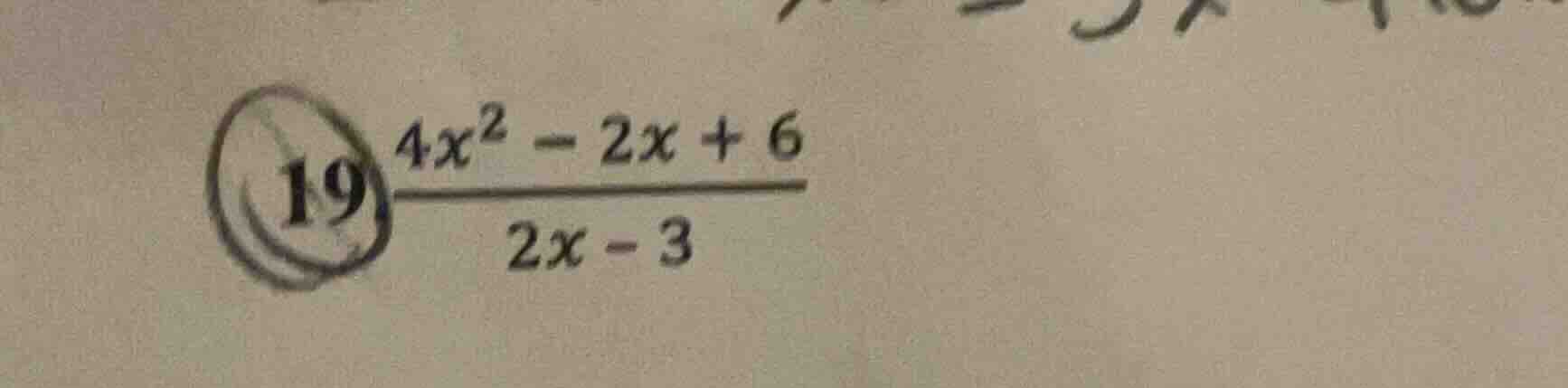
19 \frac{4x^{2} - 2x + 6}{2x - 3}
To solve the division of the polynomial \(\frac{4x^2 - 2x + 6}{2x - 3}\), we can use polynomial long division.
Step 1: Divide the leading terms
Divide the leading term of the numerator \(4x^2\) by the leading term of the denominator \(2x\):
\[
\frac{4x^2}{2x}=2x
\]
Step 2: Multiply the divisor by the result
Multiply the divisor \(2x - 3\) by \(2x\):
\[
(2x - 3)\times2x = 4x^2 - 6x
\]
Step 3: Subtract this from the numerator
Subtract \(4x^2 - 6x\) from \(4x^2 - 2x + 6\):
\[
(4x^2 - 2x + 6)-(4x^2 - 6x)=4x^2 - 2x + 6 - 4x^2 + 6x = 4x + 6
\]
Step 4: Divide the new leading term
Now, divide the leading term of the new polynomial \(4x\) by the leading term of the divisor \(2x\):
\[
\frac{4x}{2x}=2
\]
Step 5: Multiply the divisor by this result
Multiply the divisor \(2x - 3\) by \(2\):
\[
(2x - 3)\times2 = 4x - 6
\]
Step 6: Subtract this from the previous remainder
Subtract \(4x - 6\) from \(4x + 6\):
\[
(4x + 6)-(4x - 6)=4x + 6 - 4x + 6 = 12
\]
So, when we divide \(4x^2 - 2x + 6\) by \(2x - 3\), we get a quotient of \(2x + 2\) and a remainder of \(12\). We can express this as:
\[
\frac{4x^2 - 2x + 6}{2x - 3}=2x + 2+\frac{12}{2x - 3}
\]
If we want to check if we can factor or simplify further, we note that the remainder is \(12\) and the divisor is \(2x - 3\), so the division is complete in terms of polynomial long division.
If we were to find the value of \(x\) that makes the division exact (i.e., remainder \(0\)), we set the remainder equal to \(0\):
\[
12 = 0
\]
which is not possible, so there is no real value of \(x\) that makes the division exact. However, if we were just performing the polynomial division, the result is \(2x + 2+\frac{12}{2x - 3}\).

Snap & solve any problem in the app
Get step-by-step solutions on Sovi AI
Photo-based solutions with guided steps
Explore more problems and detailed explanations
To solve the division of the polynomial \(\frac{4x^2 - 2x + 6}{2x - 3}\), we can use polynomial long division.
Step 1: Divide the leading terms
Divide the leading term of the numerator \(4x^2\) by the leading term of the denominator \(2x\):
\[
\frac{4x^2}{2x}=2x
\]
Step 2: Multiply the divisor by the result
Multiply the divisor \(2x - 3\) by \(2x\):
\[
(2x - 3)\times2x = 4x^2 - 6x
\]
Step 3: Subtract this from the numerator
Subtract \(4x^2 - 6x\) from \(4x^2 - 2x + 6\):
\[
(4x^2 - 2x + 6)-(4x^2 - 6x)=4x^2 - 2x + 6 - 4x^2 + 6x = 4x + 6
\]
Step 4: Divide the new leading term
Now, divide the leading term of the new polynomial \(4x\) by the leading term of the divisor \(2x\):
\[
\frac{4x}{2x}=2
\]
Step 5: Multiply the divisor by this result
Multiply the divisor \(2x - 3\) by \(2\):
\[
(2x - 3)\times2 = 4x - 6
\]
Step 6: Subtract this from the previous remainder
Subtract \(4x - 6\) from \(4x + 6\):
\[
(4x + 6)-(4x - 6)=4x + 6 - 4x + 6 = 12
\]
So, when we divide \(4x^2 - 2x + 6\) by \(2x - 3\), we get a quotient of \(2x + 2\) and a remainder of \(12\). We can express this as:
\[
\frac{4x^2 - 2x + 6}{2x - 3}=2x + 2+\frac{12}{2x - 3}
\]
If we want to check if we can factor or simplify further, we note that the remainder is \(12\) and the divisor is \(2x - 3\), so the division is complete in terms of polynomial long division.
If we were to find the value of \(x\) that makes the division exact (i.e., remainder \(0\)), we set the remainder equal to \(0\):
\[
12 = 0
\]
which is not possible, so there is no real value of \(x\) that makes the division exact. However, if we were just performing the polynomial division, the result is \(2x + 2+\frac{12}{2x - 3}\).