QUESTION IMAGE
Question
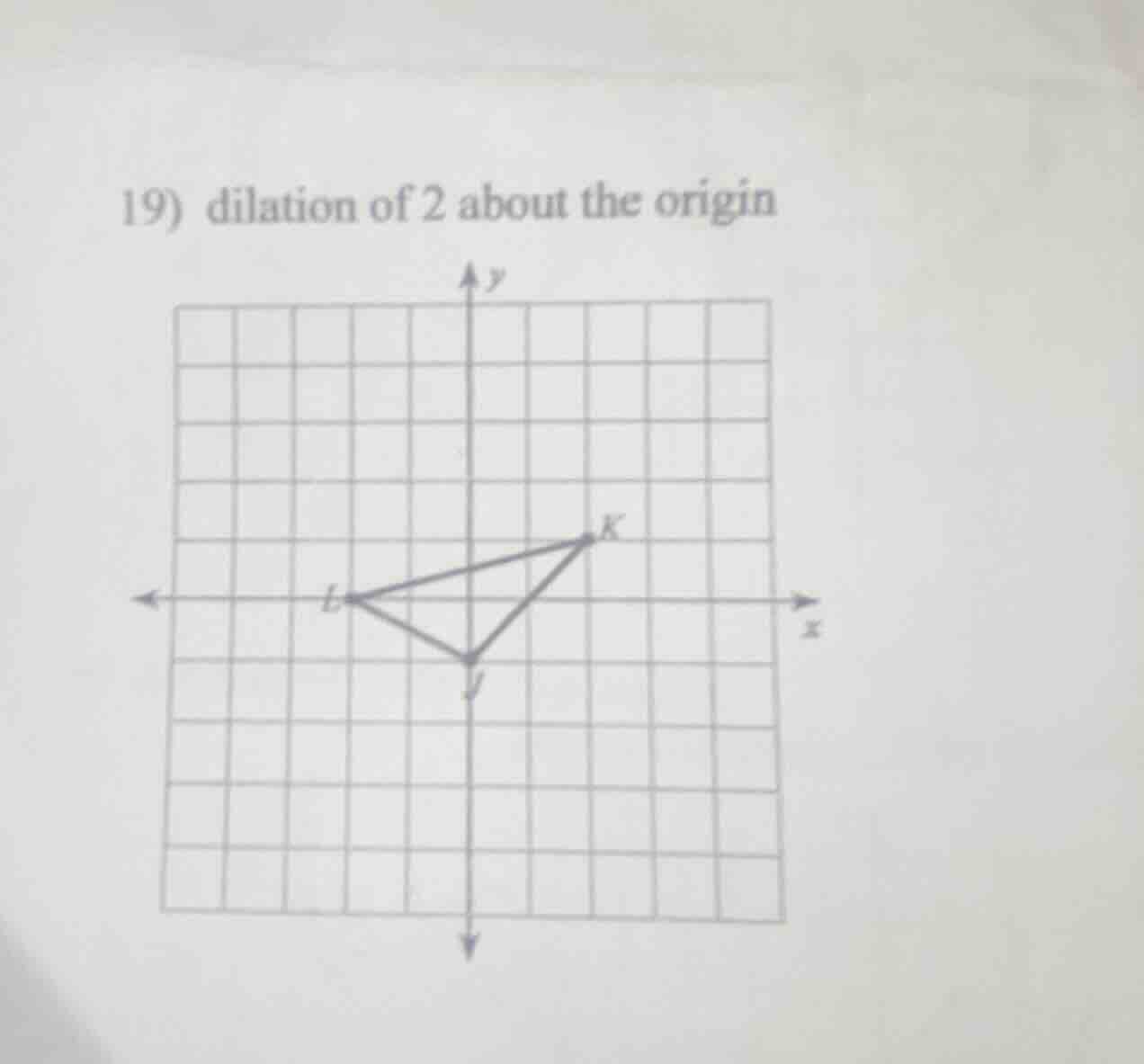
- dilation of 2 about the origin
Step1: Identify original coordinates
First, find the coordinates of points \( L \), \( J \), and \( K \) from the graph. Let's assume:
- \( L(-2, 0) \)
- \( J(0, -1) \)
- \( K(2, 1) \)
Step2: Apply dilation rule
The rule for dilation about the origin with scale factor \( k \) is \( (x, y) \to (kx, ky) \). Here, \( k = 2 \).
For \( L(-2, 0) \):
\( x' = 2 \times (-2) = -4 \), \( y' = 2 \times 0 = 0 \), so \( L'(-4, 0) \)
For \( J(0, -1) \):
\( x' = 2 \times 0 = 0 \), \( y' = 2 \times (-1) = -2 \), so \( J'(0, -2) \)
For \( K(2, 1) \):
\( x' = 2 \times 2 = 4 \), \( y' = 2 \times 1 = 2 \), so \( K'(4, 2) \)

Snap & solve any problem in the app
Get step-by-step solutions on Sovi AI
Photo-based solutions with guided steps
Explore more problems and detailed explanations
The dilated coordinates are \( L'(-4, 0) \), \( J'(0, -2) \), and \( K'(4, 2) \). To graph the dilated triangle, plot these points and connect them.