QUESTION IMAGE
Question
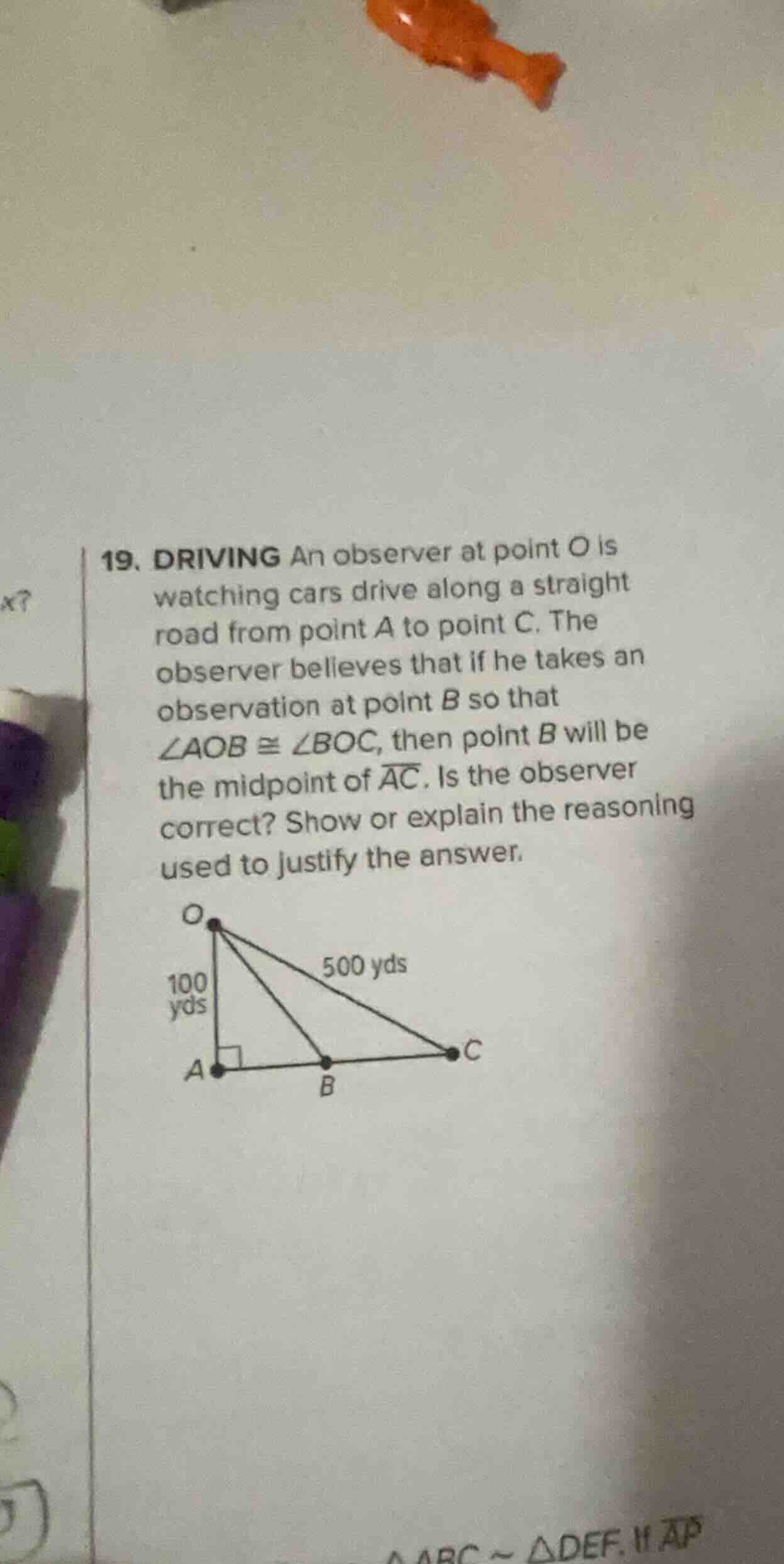
- driving an observer at point o is watching cars drive along a straight road from point a to point c. the observer believes that if he takes an observation at point b so that ∠aob ≅ ∠boc, then point b will be the midpoint of \\(\overline{ac}\\). is the observer correct? show or explain the reasoning used to justify the answer.
Step1: Analyze triangle OAC
In right triangle \( OAC \), \( OA = 100 \) yds, \( OC = 500 \) yds. By Pythagorean theorem, \( AC=\sqrt{OC^{2}-OA^{2}}=\sqrt{500^{2}-100^{2}}=\sqrt{250000 - 10000}=\sqrt{240000}=200\sqrt{6}\approx489.9\) yds.
Step2: Analyze triangle OAB
Let \( AB = x \), \( OB = y \). In right triangle \( OAB \), \( y=\sqrt{100^{2}+x^{2}} \). Given \( \angle AOB\cong\angle BOC \), but \( OB \) is not perpendicular to \( AC \) (unless \( B \) is midpoint, but we check lengths). If \( B \) were midpoint, \( AB=\frac{AC}{2}\approx244.95 \) yds. But let's see \( OB \): if \( AB = 244.95 \), \( OB=\sqrt{100^{2}+244.95^{2}}\approx\sqrt{10000 + 60000}=\sqrt{70000}\approx264.58 \) yds. But \( OC = 500 \) yds, and \( OB
eq OC \), so triangles \( OAB \) and \( OBC \) are not congruent (since \( OA = OA \), \( \angle AOB=\angle BOC \), but \( OB
eq OC \)), so \( AB
eq BC \). Alternatively, the angle bisector theorem: the angle bisector of an angle in a triangle divides the opposite side into segments proportional to the adjacent sides. Here, \( OB \) is angle bisector of \( \angle AOC \), so \( \frac{AB}{BC}=\frac{OA}{OC}=\frac{100}{500}=\frac{1}{5} \), so \( AB=\frac{1}{6}AC \), \( BC=\frac{5}{6}AC \), so \( B \) is not midpoint.

Snap & solve any problem in the app
Get step-by-step solutions on Sovi AI
Photo-based solutions with guided steps
Explore more problems and detailed explanations
The observer is not correct. By the angle - bisector theorem (or Pythagorean theorem calculation), \( AB
eq BC \), so \( B \) is not the mid - point of \( \overline{AC} \).