QUESTION IMAGE
Question
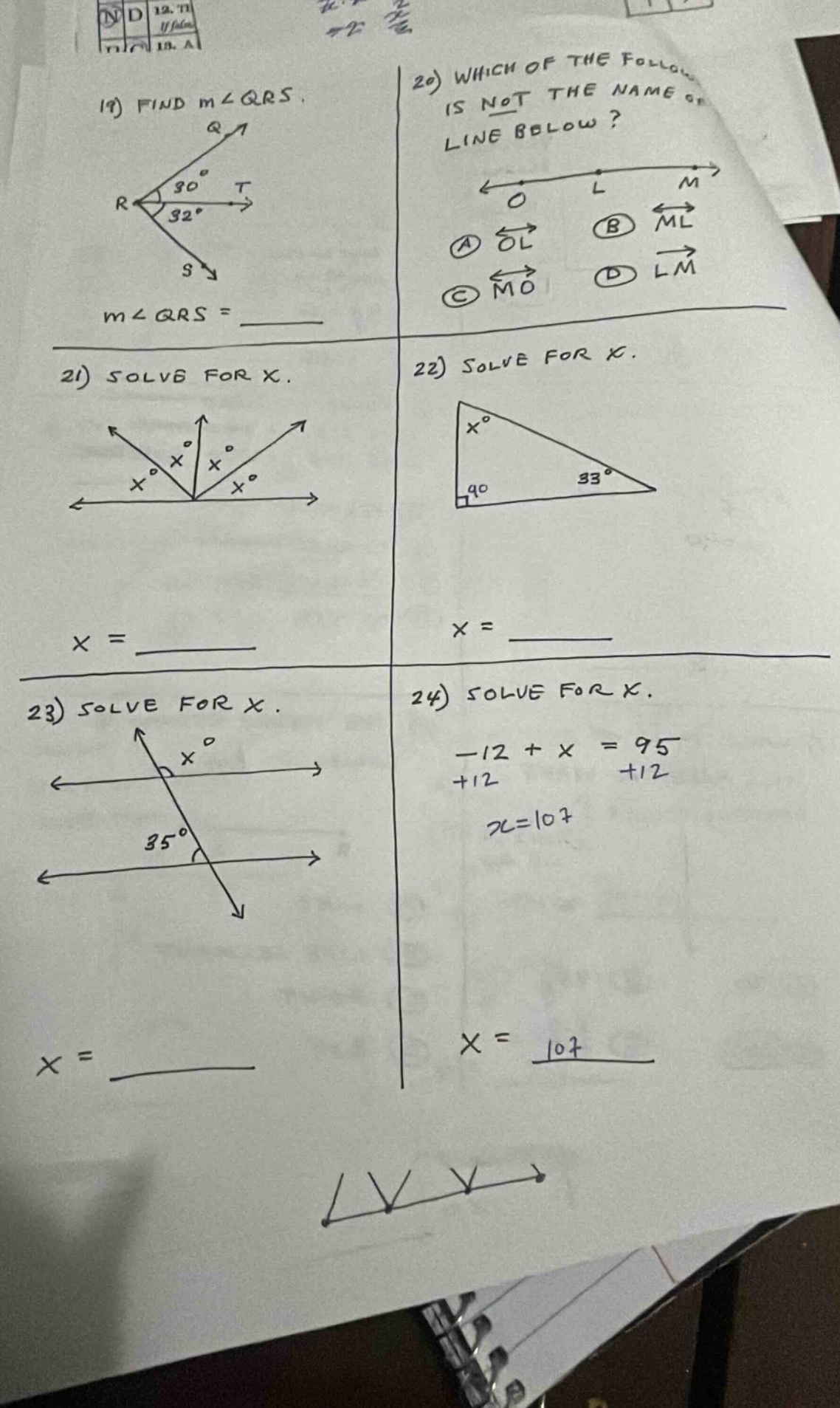
- find m∠qrs.
m∠qrs = ______
- which of the follow is not the name of line below ?
a (overleftrightarrow{ol}) b (overleftarrow{ml})
c (overleftarrow{mo}) d (overrightarrow{lm})
- solve for x.
x = ______
- solve for x.
x = ______
- solve for x.
x = ______
- solve for x.
-12 + x = 95
+12 +12
x=107
x = 107
Problem 19: Find \( m\angle QRS \)
Step 1: Identify the angles at \( R \)
The angle \( \angle QRS \) is the sum of \( \angle QRT \) and \( \angle TRS \). Given \( \angle QRT = 30^\circ \) and \( \angle TRS = 32^\circ \).
Step 2: Add the two angles
To find \( m\angle QRS \), we add the measures of the two angles: \( 30^\circ + 32^\circ \).
\[
30^\circ + 32^\circ = 62^\circ
\]
- A line can be named using two points with an arrow (for a ray) or a line segment with two points. But for a line (infinite in both directions), the name should represent the line.
- \( \overleftrightarrow{OL} \), \( \overleftrightarrow{MO} \), \( \overleftrightarrow{LM} \) are valid as they represent the line. \( \overleftrightarrow{ML} \) is a ray (since it has one arrow), not the line. Wait, no—wait, the line is from \( O \) to \( M \) (infinite). Wait, actually, the line is the same as \( LM \), \( OL \), \( MO \). The option \( \overleftrightarrow{ML} \) is a ray (direction matters for rays). Wait, the line is the set of points \( O, L, M \) extended. So the incorrect one is \( \overleftrightarrow{ML} \) (option B) because it's a ray (direction from \( M \) to \( L \), but the line is infinite in both directions, but actually, line names are with two points and arrows. Wait, no—maybe the line is \( \overleftrightarrow{OM} \) or \( \overleftrightarrow{LM} \). Wait, the options: \( \overleftrightarrow{OL} \) (line through \( O \) and \( L \)), \( \overleftrightarrow{ML} \) (ray from \( M \) to \( L \), but line would be \( \overleftrightarrow{LM} \) or \( \overleftrightarrow{OL} \) or \( \overleftrightarrow{MO} \). So the answer is B.
Step 1: Identify the total angle
The angles around a straight line (or a point) sum to \( 180^\circ \). There are 5 angles each of measure \( x^\circ \), so the sum is \( 5x \).
Step 2: Set up the equation
Since the total angle is \( 180^\circ \), we have \( 5x = 180^\circ \).
Step 3: Solve for \( x \)
Divide both sides by 5:
\[
x = \frac{180^\circ}{5} = 36^\circ
\]

Snap & solve any problem in the app
Get step-by-step solutions on Sovi AI
Photo-based solutions with guided steps
Explore more problems and detailed explanations
\( 62^\circ \)