QUESTION IMAGE
Question
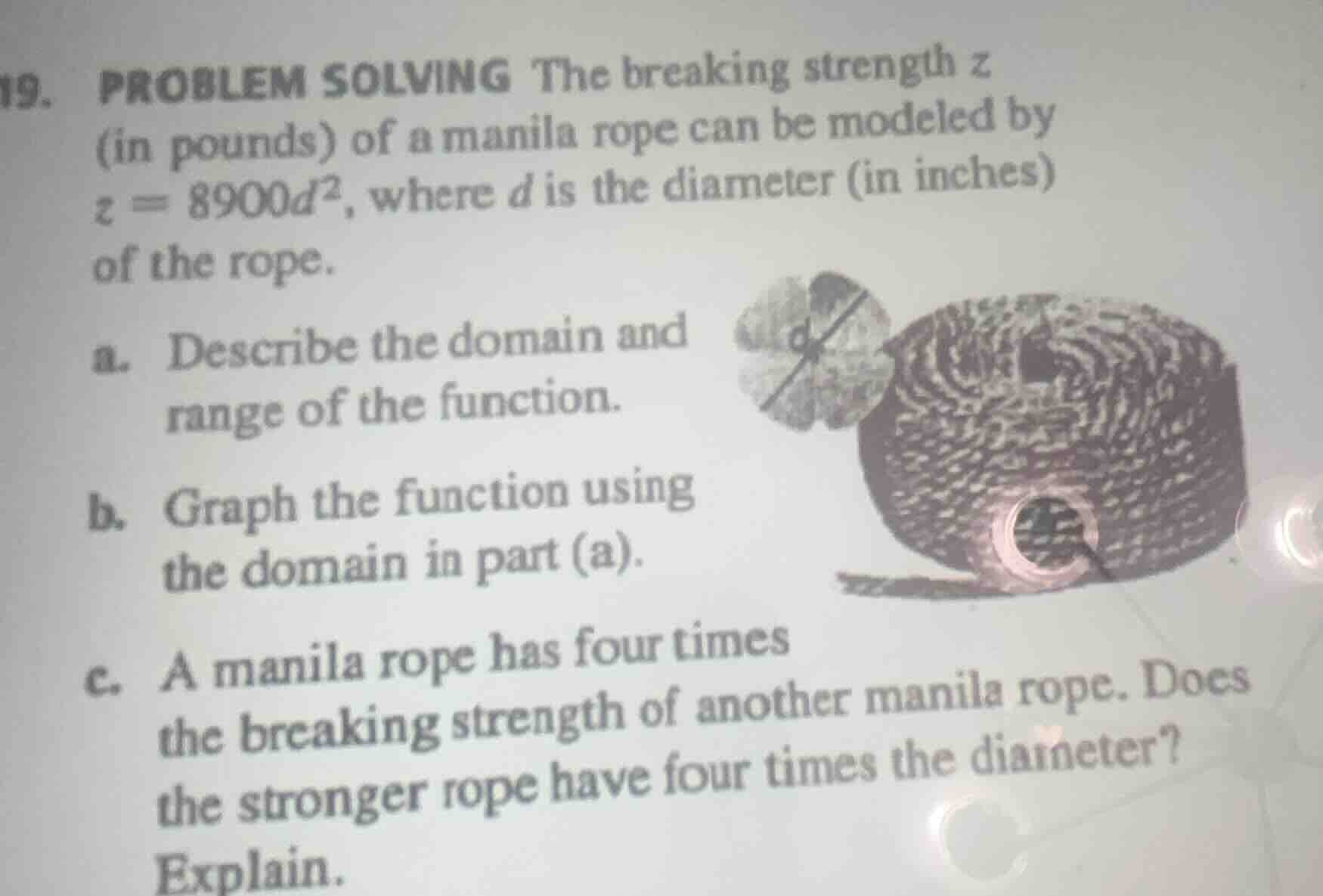
- problem solving the breaking strength ( z ) (in pounds) of a manila rope can be modeled by ( z = 8900d^2 ), where ( d ) is the diameter (in inches) of the rope.
a. describe the domain and range of the function.
b. graph the function using the domain in part (a).
c. a manila rope has four times the breaking strength of another manila rope. does the stronger rope have four times the diameter? explain.
Part (a)
Step1: Analyze the domain
The diameter \( d \) of a rope represents a physical quantity (length). In the real - world context, the diameter of a rope cannot be negative or zero (a rope with diameter \( d = 0 \) does not exist in a practical sense). So, the domain of the function \( z=8900d^{2} \) is all positive real numbers. In interval notation, the domain is \( d>0 \) or \( (0,+\infty) \).
Step2: Analyze the range
We know that the function is \( z = 8900d^{2} \), and \( d>0 \). When \( d>0 \), \( d^{2}>0 \). Multiplying both sides of the inequality \( d^{2}>0 \) by \( 8900 \) (a positive number), we get \( 8900d^{2}>0 \). So, the range of the function \( z = 8900d^{2} \) is all positive real numbers. In interval notation, the range is \( z>0 \) or \( (0,+\infty) \).
Step1: Identify the function type
The function \( z = 8900d^{2} \) is a quadratic function. For a quadratic function of the form \( y = ax^{2}+bx + c \) (in our case, \( b = 0 \), \( c = 0 \), and \( a=8900>0 \)), the graph is a parabola.
Step2: Determine the key points and shape
Since the domain is \( d>0 \), we consider the part of the parabola where \( d>0 \). When \( d = 0 \), \( z=0 \), but since \( d>0 \), we have an open circle at the origin ( \( (0,0) \) is not included in the domain). As \( d \) increases, \( z=8900d^{2} \) increases rapidly. We can choose some values of \( d \) (e.g., \( d = 1 \), then \( z=8900\times1^{2}=8900 \); \( d = 2 \), then \( z=8900\times2^{2}=8900\times4 = 35600 \)) and plot the points \( (1,8900) \), \( (2,35600) \) etc. The graph is the right - hand side (for \( d>0 \)) of a parabola that opens upwards with vertex at the origin (not included) and passes through the points we calculated.
Step1: Let the diameter of the weaker rope be \( d_1 \) and its breaking strength be \( z_1 \), and the diameter of the stronger rope be \( d_2 \) and its breaking strength be \( z_2 \)
We know that \( z_1=8900d_1^{2} \) and \( z_2 = 8900d_2^{2} \). Given that \( z_2 = 4z_1 \).
Step2: Substitute the expressions for \( z_1 \) and \( z_2 \)
Substitute \( z_1=8900d_1^{2} \) and \( z_2 = 8900d_2^{2} \) into \( z_2 = 4z_1 \):
\( 8900d_2^{2}=4\times(8900d_1^{2}) \)
Step3: Solve for the relationship between \( d_2 \) and \( d_1 \)
Divide both sides of the equation \( 8900d_2^{2}=4\times(8900d_1^{2}) \) by \( 8900 \):
\( d_2^{2}=4d_1^{2} \)
Take the square root of both sides. Since \( d_1>0 \) and \( d_2>0 \) (diameters are positive), we have \( d_2 = 2d_1 \) (we take the positive square root because diameter is positive).
This shows that if the breaking strength is four times, the diameter is two times, not four times.

Snap & solve any problem in the app
Get step-by-step solutions on Sovi AI
Photo-based solutions with guided steps
Explore more problems and detailed explanations
Domain: All positive real numbers (\( d>0 \) or \( (0,+\infty) \)); Range: All positive real numbers (\( z > 0 \) or \( (0,+\infty) \))