QUESTION IMAGE
Question
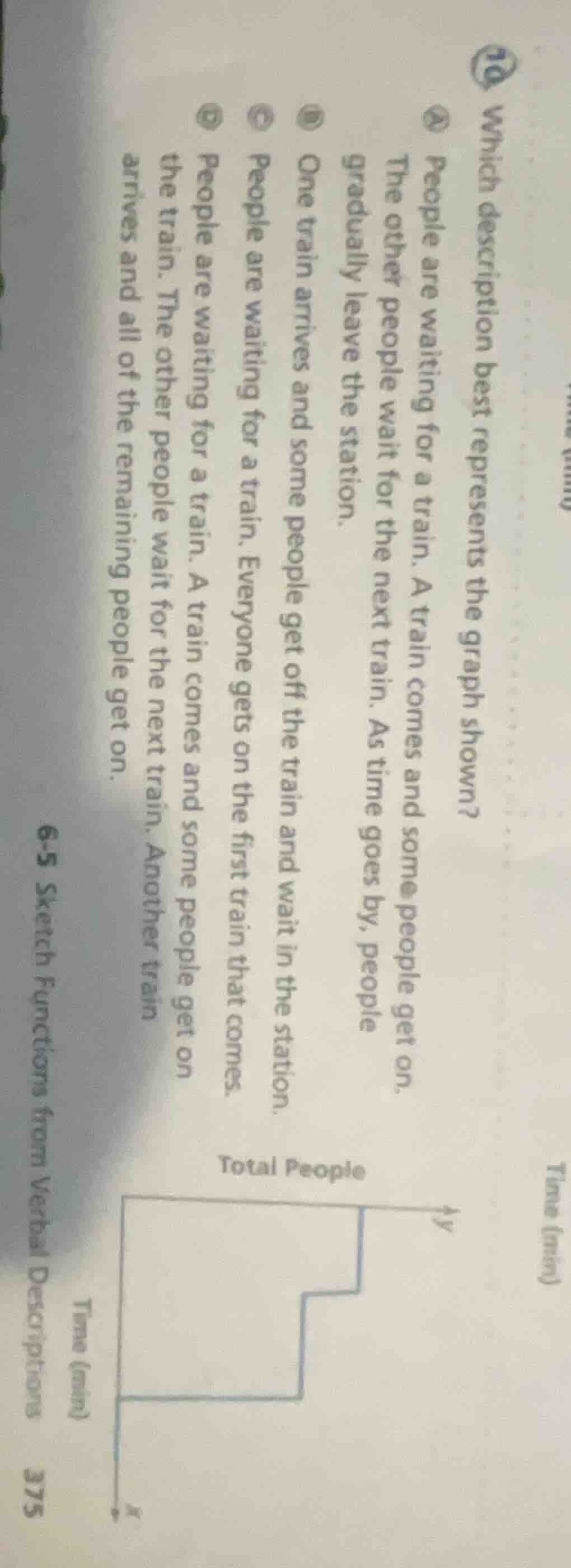
19 which description best represents the graph shown? a people are waiting for a train. a train comes and some people get on. the other people wait for the next train. as time goes by, people gradually leave the station. b one train arrives and some people get off the train and wait in the station. c people are waiting for a train. everyone gets on the first train that comes. d people are waiting for a train. a train comes and some people get on the train. the other people wait for the next train. another train arrives and all of the remaining people get on. 6-5 sketch functions from verbal descriptions 375
To determine the correct description, we analyze each option:
- Option A: Mentions people gradually leaving, but the graph likely shows discrete changes (train arrivals/departures), not gradual. Eliminate.
- Option B: Says some people get off and others wait. But the graph's structure (steps) suggests when a train arrives, a group boards (increasing people) or all board (if total changes). This option's "wait in station" after getting off doesn't match typical train station flow (people wait for trains, not after alighting to wait again). Eliminate.
- Option C: States "everyone gets on the first train". If everyone boards, the number of people waiting would drop to 0 after the first train. But the graph has multiple steps, implying multiple trains. If everyone boards the first, there'd be no subsequent people, so this is incorrect. Eliminate.
- Option D: People wait for a train (initial group), a train arrives and some board (first step up), others wait. Then another train arrives and all remaining board (second step up? Or the graph's steps: first, people wait (flat line), then a train arrives, some board (increase), others wait. Then another train arrives, all remaining board (another increase? Or the graph's structure: the first flat is waiting, then a train comes, some get on (so total people increase by those who boarded), others wait. Then another train comes, all remaining get on (total people increase by the rest). This matches the step - like graph (discrete changes at train arrivals, with people boarding in groups as trains come, first some, then all remaining).

Snap & solve any problem in the app
Get step-by-step solutions on Sovi AI
Photo-based solutions with guided steps
Explore more problems and detailed explanations
D. People are waiting for a train. A train arrives and some people get on the train. The other people wait for the next train. Another train arrives and all of the remaining people get on.