QUESTION IMAGE
Question
1963: the year that changed everything
background knowledge booster
1963 was a pivotal moment in american history. it was a year where the push for civil rights reached its peak, marked by peaceful protests, powerful speeches, and significant challenges. this year forced the nation to look in the mirror and decide what kind of future it wanted for all citizens, regardless of race
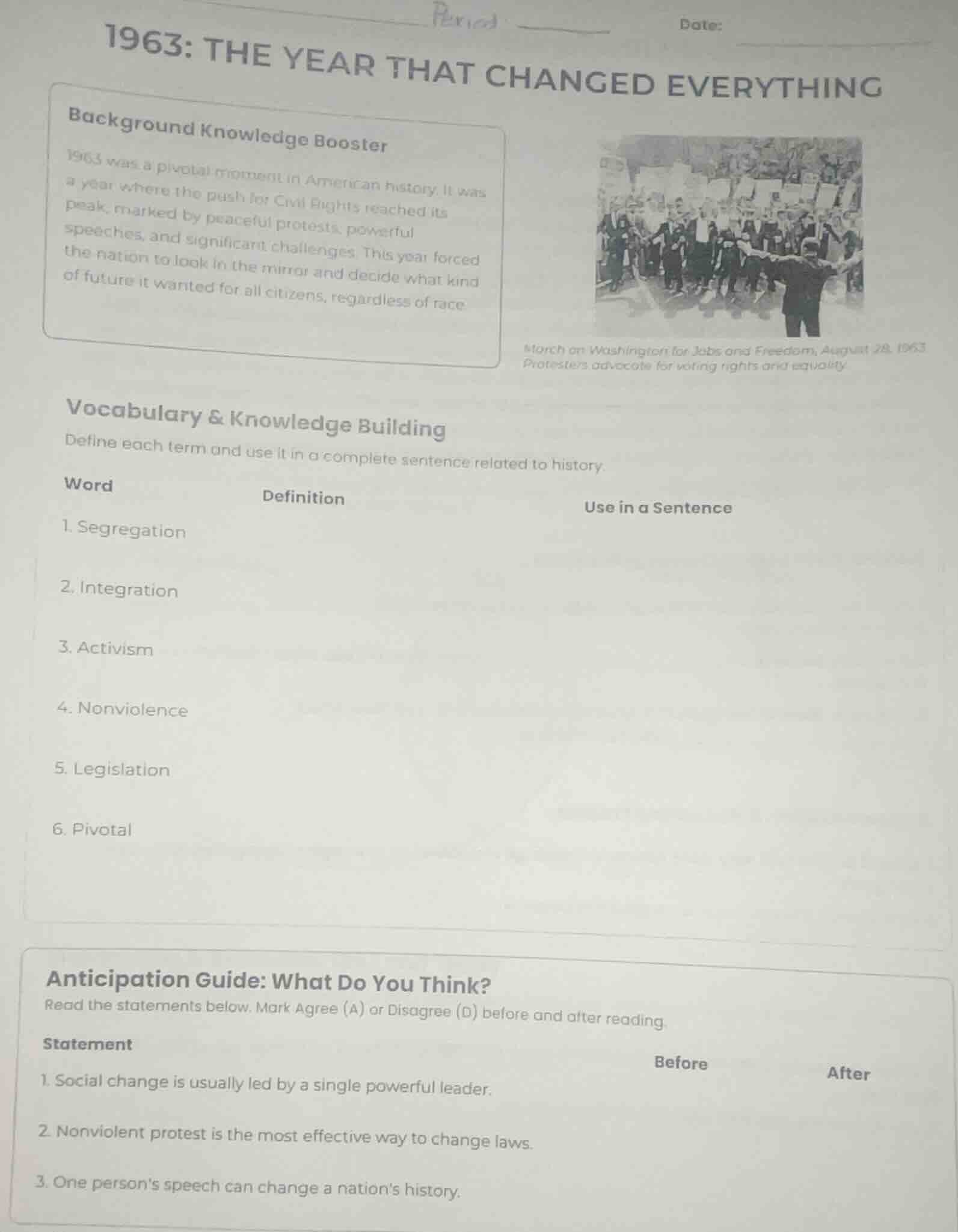
march on washington for jobs and freedom, august 28, 1963
protesters advocate for voting rights and equality
vocabulary & knowledge building
define each term and use it in a complete sentence related to history.
word\tdefinition\tuse in a sentence
- segregation
- integration
- activism
- nonviolence
- legislation
- pivotal
anticipation guide: what do you think?
read the statements below. mark agree (a) or disagree (d) before and after reading.
statement\tbefore\tafter
- social change is usually led by a single powerful leader.
- nonviolent protest is the most effective way to change laws.
- one person’s speech can change a nation’s history.
Vocabulary & Knowledge Building
- Segregation: Defined as the enforced separation of racial, ethnic, or social groups in public spaces, housing, education, etc., often supported by law. Sentence ties to 1960s U.S. history where this system was challenged.
- Integration: The process of bringing previously separated groups together in shared spaces, aiming for equal access and participation. Sentence references school integration efforts of the civil rights era.
- Activism: Actions taken to promote or oppose social, political, or economic change. Sentence links to civil rights activists' work in 1963.
- Nonviolence: A practice of using peaceful methods (protests, boycotts, speeches) to advocate for change, avoiding physical force. Sentence connects to Martin Luther King Jr.'s core strategy.
- Legislation: Laws or acts passed by a governing body. Sentence refers to key civil rights laws of the 1960s.
- Pivotal: Describing a critical, turning-point event that alters the course of history. Sentence frames 1963 as this type of moment for U.S. civil rights.
Anticipation Guide
- Statement 1: Social change relies on collective action, not just one leader, so the correct post-reading stance is Disagree.
- Statement 2: Nonviolent protests in 1963 (like the March on Washington) were highly effective in driving legislative change, so the correct post-reading stance is Agree.
- Statement 3: Martin Luther King Jr.'s "I Have a Dream" speech shifted public opinion and fueled civil rights progress, so the correct post-reading stance is Agree.

Snap & solve any problem in the app
Get step-by-step solutions on Sovi AI
Photo-based solutions with guided steps
Explore more problems and detailed explanations
Vocabulary & Knowledge Building
| Word | Definition | Use in a Sentence |
|---|---|---|
| 2. Integration | The process of uniting separated groups in shared, equal spaces | The civil rights movement fought for the integration of all public facilities to ensure equal treatment for Black citizens. |
| 3. Activism | Actions to promote or challenge social/ political change | Civil rights activism in 1963 included mass marches and sit-ins to demand voting rights and equality. |
| 4. Nonviolence | A peaceful strategy to advocate for change without force | Martin Luther King Jr. championed nonviolence as a moral and effective tool for civil rights progress in 1963. |
| 5. Legislation | Laws passed by a governing body | The 1963 civil rights protests pressured Congress to draft new legislation ending segregation. |
| 6. Pivotal | Being a critical turning point in history | 1963 was a pivotal year for U.S. civil rights, as it laid the groundwork for landmark equality laws. |
Anticipation Guide (Post-Reading Stances)
- Statement 1: Disagree (D)
- Statement 2: Agree (A)
- Statement 3: Agree (A)