QUESTION IMAGE
Question
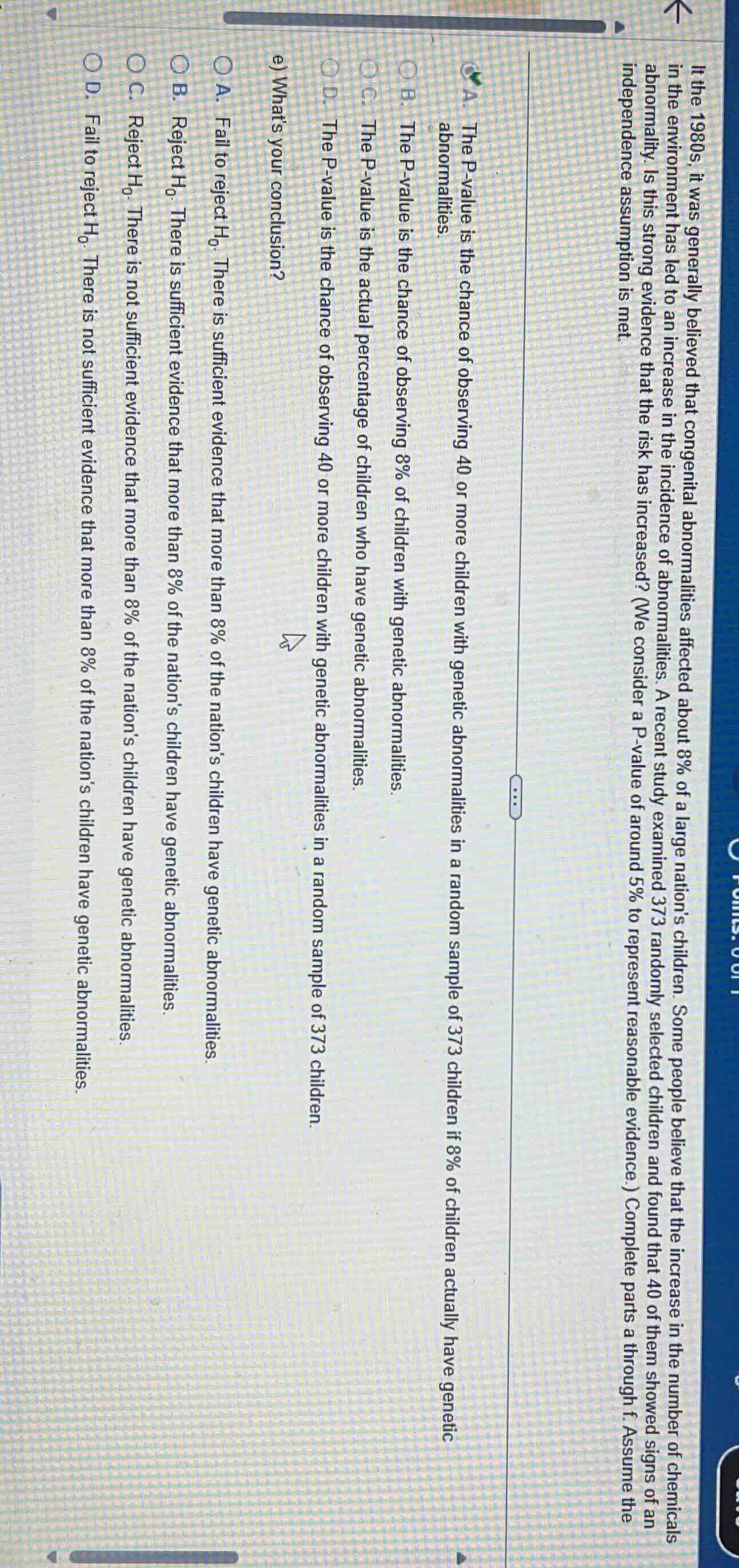
if the 1980s, it was generally believed that congenital abnormalities affected about 8% of a large nation’s children. some people believe that the increase in the number of chemicals in the environment has led to an increase in the incidence of abnormalities. a recent study examined 373 randomly selected children and found that 40 of them showed signs of an abnormality. is this strong evidence that the risk has increased? (we consider a p - value of around 5% to represent reasonable evidence.) assume the independence assumption is met. complete parts a through f.
a.
a. the p - value is the chance of observing 40 or more children with genetic abnormalities in a random sample of 373 children if 8% of children actually have genetic abnormalities.
b. the p - value is the chance of observing 8% of children with genetic abnormalities.
c. the p - value is the actual percentage of children who have genetic abnormalities.
d. the p - value is the chance of observing 40 or more children with genetic abnormalities in a random sample of 373 children.
e) whats your conclusion?
a. fail to reject ( h_0 ). there is sufficient evidence that more than 8% of the nation’s children have genetic abnormalities.
b. reject ( h_0 ). there is sufficient evidence that more than 8% of the nation’s children have genetic abnormalities.
c. reject ( h_0 ). there is not sufficient evidence that more than 8% of the nation’s children have genetic abnormalities.
d. fail to reject ( h_0 ). there is not sufficient evidence that more than 8% of the nation’s children have genetic abnormalities.
Step1: Identify hypotheses
Let $p$ = proportion of children with abnormalities.
$H_0: p = 0.08$
$H_a: p > 0.08$
Step2: Verify P-value definition
The P-value is the probability of observing a sample statistic as extreme or more extreme than the one found, assuming the null hypothesis is true. Here, that means the chance of observing 40 or more affected children in a sample of 373, if $p=0.08$.
Step3: Evaluate conclusion
The problem states a P-value of ~5% is reasonable evidence. Since $0.05 < 0.10$ (standard significance level), we reject $H_0$, concluding there is sufficient evidence that more than 8% of children have abnormalities.

Snap & solve any problem in the app
Get step-by-step solutions on Sovi AI
Photo-based solutions with guided steps
Explore more problems and detailed explanations
Part (the P-value definition):
A. The P-value is the chance of observing 40 or more children with genetic abnormalities in a random sample of 373 children if 8% of children actually have genetic abnormalities.
Part (conclusion):
B. Reject $H_0$. There is sufficient evidence that more than 8% of the nation's children have genetic abnormalities.