QUESTION IMAGE
Question
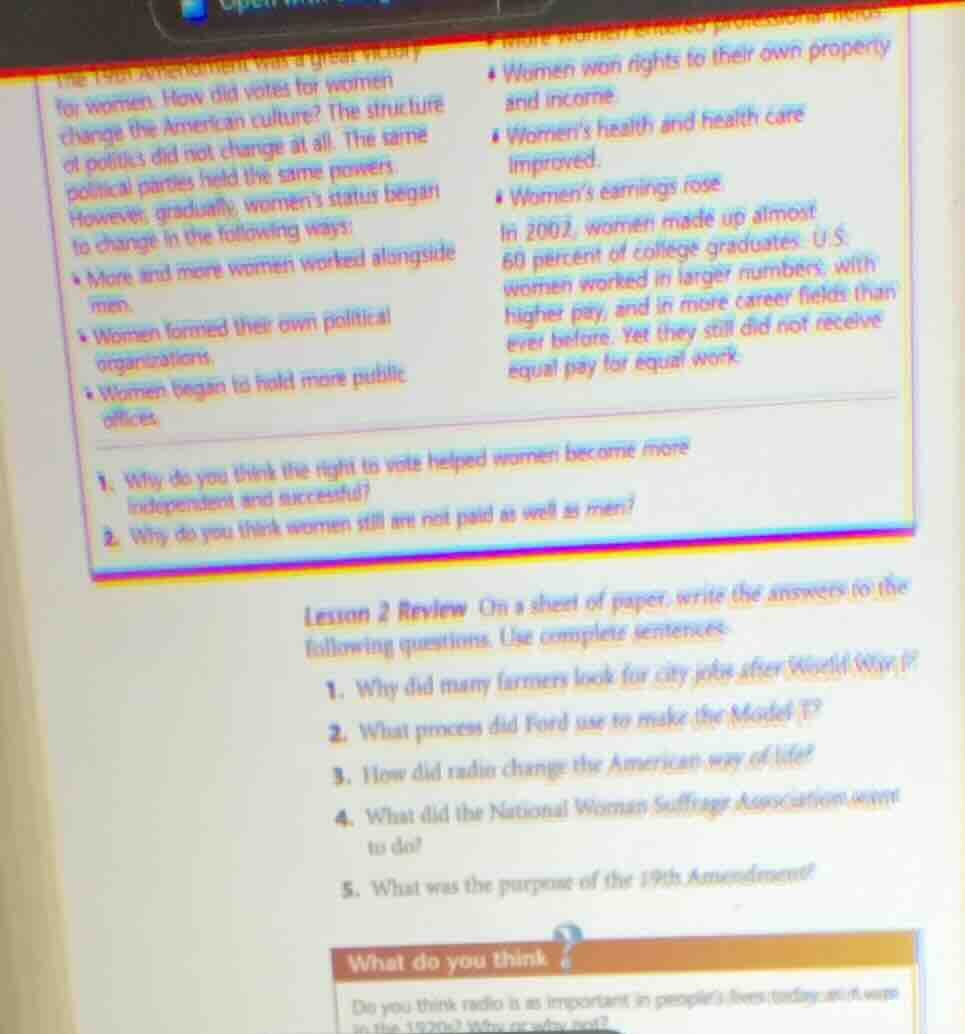
the 19th amendment was a great victory for women. how did votes for women change the american culture? the structure of politics did not change at all. the same political parties held the same powers. however, gradually, womens status began to change in the following ways:• more and more women worked alongside men.• women formed their own political organizations.• women began to hold more public offices.• women won rights to their own property and income.• womens health and health care improved.• womens earnings rose.in 2002, women made up almost 60 percent of college graduates. u.s. women worked in larger numbers, with higher pay, and in more career fields than ever before. yet they still did not receive equal pay for equal work.1. why do you think the right to vote helped women become more independent and successful?2. why do you think women still are not paid as well as men?lesson 2 review on a sheet of paper, write the answers to the following questions. use complete sentences.1. why did many farmers look for city jobs after world war i?2. what process did ford use to make the model t?3. how did radio change the american way of life?4. what did the national woman suffrage association want to do?5. what was the purpose of the 19th amendment?what do you thinkdo you think radio is as important in peoples lives today as it was
- For question 1 (voting rights and women's success): The right to vote gave women a political voice to advocate for laws and policies that expanded their access to education, employment, and property rights. This political leverage helped dismantle barriers, allowing women to pursue careers, gain financial independence, and build social status.
- For question 2 (gender pay gap): Historical systemic discrimination, occupational segregation (women overrepresented in lower-paying fields), and implicit biases about women's roles and value in the workforce contribute to ongoing unequal pay.
- For Lesson 2 Review question 1: After World War I, improved farm machinery reduced the need for farm labor, and growing urban industries offered steady wages and new economic opportunities, pulling farmers to cities.
- For Lesson 2 Review question 2: Ford used the moving assembly line, which broke production into small, repetitive tasks and moved the vehicle frame along a conveyor, drastically speeding up production.
- For Lesson 2 Review question 3: Radio created a shared national cultural experience by broadcasting news, entertainment, and advertising to people across the country, unifying regional tastes and spreading information faster than ever before.
- For Lesson 2 Review question 4: The National Woman Suffrage Association worked to secure the right to vote for women in the United States, primarily through advocating for a federal constitutional amendment.
- For Lesson 2 Review question 5: The purpose of the 19th Amendment was to prohibit the denial of voting rights to citizens of the United States on the basis of sex, granting women the legal right to vote.

Snap & solve any problem in the app
Get step-by-step solutions on Sovi AI
Photo-based solutions with guided steps
Explore more problems and detailed explanations
- The right to vote gave women political influence to push for policies that expanded their access to education, jobs, and property rights, breaking down barriers to independence and success.
- Persistent systemic discrimination, occupational segregation into lower-paying fields, and implicit gender biases about work value continue to cause the gender pay gap.
- Many farmers moved to cities after World War I because mechanized farming reduced labor needs, and urban factories offered steady, new economic opportunities.
- Ford used the moving assembly line process to manufacture the Model T, which streamlined production by moving the vehicle along a conveyor for specialized, repetitive tasks.
- Radio changed American life by creating a shared national culture, as it spread news, entertainment, and advertising across regions, unifying public experiences and speeding up information sharing.
- The National Woman Suffrage Association aimed to secure women's right to vote in the U.S., focusing on advocating for a federal constitutional amendment for suffrage.
- The 19th Amendment's purpose was to prevent U.S. citizens from being denied the right to vote based on their sex, legally granting women the franchise.