QUESTION IMAGE
Question
6.
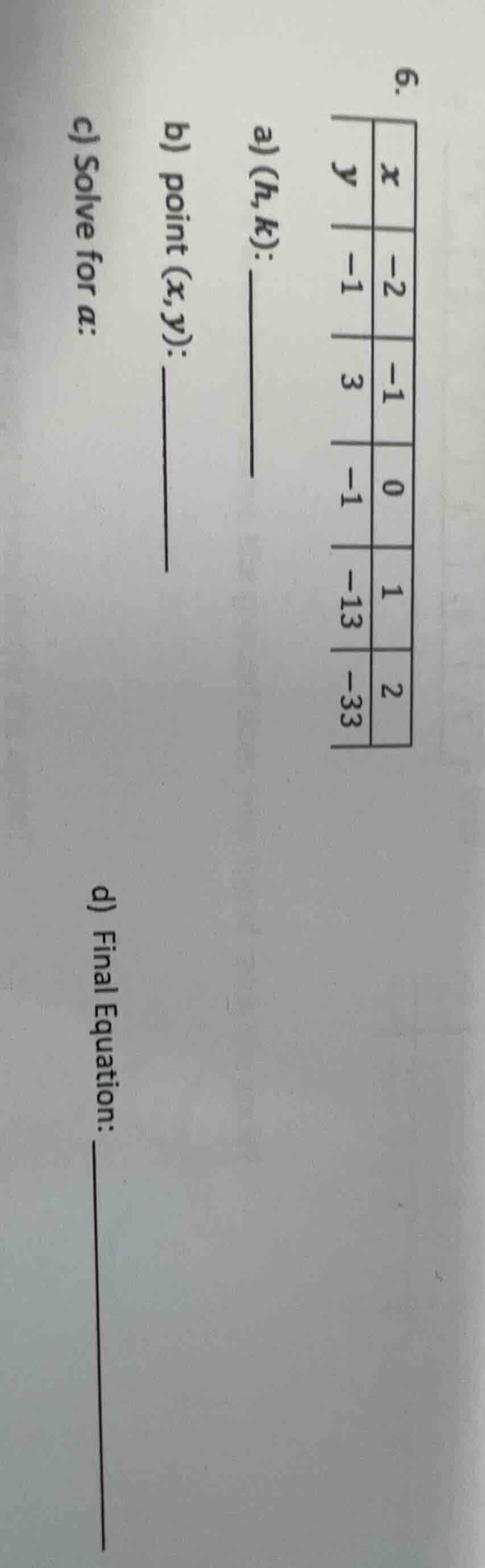
| x | y
| -2 | -1
| -1 | 3
| 0 | -1
| 1 | -13
| 2 | -33
a) (h,k): ____
b) point (x,y): ____
c) solve for a:
d) final equation: ____
Part a) Finding \((h,k)\)
To find the vertex \((h,k)\) of a quadratic function from a table, we look for the axis of symmetry. The axis of symmetry for a quadratic function (which has a parabolic graph) is the vertical line that passes through the vertex. For a table of values, we can find the \(x\)-coordinate of the vertex by looking for the \(x\)-value where the function is symmetric. Let's list the \(x\) and \(y\) values:
| \(x\) | \(-2\) | \(-1\) | \(0\) | \(1\) | \(2\) |
|---|
We can see that the \(y\)-values at \(x = -2\) and \(x = 0\) are both \(-1\). The axis of symmetry (and thus the \(x\)-coordinate of the vertex \(h\)) is the midpoint of \(x=-2\) and \(x = 0\). The midpoint formula for two points \(x_1\) and \(x_2\) is \(h=\frac{x_1 + x_2}{2}\). So, \(h=\frac{-2 + 0}{2}=\frac{-2}{2}=-1\). Now we find the \(y\)-value at \(x=-1\), which is \(y = 3\). So the vertex \((h,k)\) is \((-1,3)\).
Part b) Choosing a point \((x,y)\)
We can choose any point from the table that is not the vertex. Let's choose the point \((0,-1)\) (we could also choose \((-2,-1)\), \((1,-13)\), \((2,-33)\) etc.).
Part c) Solving for \(a\)
The vertex form of a quadratic function is \(y=a(x - h)^2+k\). We know \(h=-1\), \(k = 3\), and we can use the point \((x,y)=(0,-1)\) to solve for \(a\).
Substitute \(h=-1\), \(k = 3\), \(x = 0\), and \(y=-1\) into the vertex form:
\[
-1=a(0 - (-1))^2+3
\]
Simplify the equation:
\[
-1=a(1)^2+3
\]
\[
-1=a + 3
\]
Subtract \(3\) from both sides:
\[
a=-1 - 3=-4
\]
Part d) Final Equation
Now that we have \(a=-4\), \(h=-1\), and \(k = 3\), we substitute these into the vertex form \(y=a(x - h)^2+k\):
\[
y=-4(x - (-1))^2+3
\]
Simplify the equation:
\[
y=-4(x + 1)^2+3
\]
If we want to expand it to standard form:
\[
y=-4(x^2+2x + 1)+3
\]
\[
y=-4x^2-8x-4 + 3
\]
\[
y=-4x^2-8x-1
\]

Snap & solve any problem in the app
Get step-by-step solutions on Sovi AI
Photo-based solutions with guided steps
Explore more problems and detailed explanations
s:
a) \(\boldsymbol{(-1,3)}\)
b) We chose \(\boldsymbol{(0,-1)}\) (other valid points: \((-2,-1)\), \((1,-13)\), \((2,-33)\))
c) \(\boldsymbol{a=-4}\)
d) Vertex form: \(\boldsymbol{y=-4(x + 1)^2+3}\) or Standard form: \(\boldsymbol{y=-4x^2-8x-1}\)