QUESTION IMAGE
Question
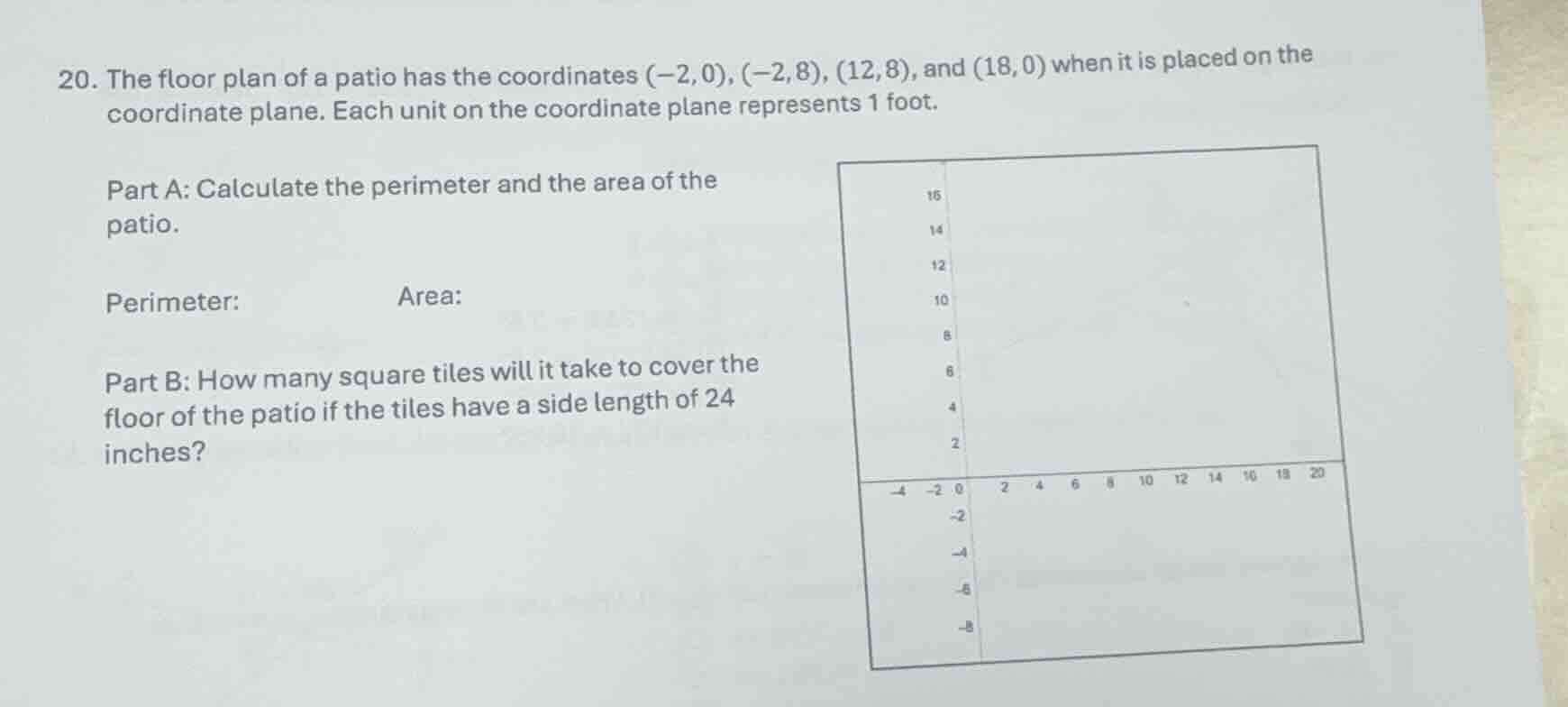
- the floor plan of a patio has the coordinates (-2,0), (-2,8), (12,8), and (18,0) when it is placed on the coordinate plane. each unit on the coordinate plane represents 1 foot. part a: calculate the perimeter and the area of the patio. perimeter: area: part b: how many square tiles will it take to cover the floor of the patio if the tiles have a side length of 24 inches?
Part A: Perimeter and Area Calculation
Step 1: Identify the shape and side lengths
The coordinates are \((-2,0)\), \((-2,8)\), \((12,8)\), and \((18,0)\). Let's find the lengths of the sides:
- Vertical side 1: Between \((-2,0)\) and \((-2,8)\). The length is \(|8 - 0| = 8\) feet (since x - coordinate is same, length is difference in y - coordinates).
- Horizontal side 1: Between \((-2,8)\) and \((12,8)\). The length is \(|12 - (-2)| = 14\) feet (since y - coordinate is same, length is difference in x - coordinates).
- Vertical side 2: Between \((12,8)\) and \((18,0)\). Wait, no, actually, the fourth point is \((18,0)\). Let's check the sides again. Wait, the figure is a trapezoid? Wait, no, let's plot the points:
- \((-2,0)\) to \((-2,8)\): vertical line (length 8)
- \((-2,8)\) to \((12,8)\): horizontal line (length \(12 - (-2)=14\))
- \((12,8)\) to \((18,0)\): Wait, no, the fourth point is \((18,0)\). Wait, from \((12,8)\) to \((18,0)\) is a slant side? Wait, no, maybe I made a mistake. Wait, the four points are \((-2,0)\), \((-2,8)\), \((12,8)\), \((18,0)\). Let's find the length between \((12,8)\) and \((18,0)\) using the distance formula \(d=\sqrt{(x_2 - x_1)^2+(y_2 - y_1)^2}\). So \(x_1 = 12,y_1 = 8,x_2 = 18,y_2 = 0\). Then \(d=\sqrt{(18 - 12)^2+(0 - 8)^2}=\sqrt{6^2+(-8)^2}=\sqrt{36 + 64}=\sqrt{100}=10\) feet.
- And between \((18,0)\) and \((-2,0)\): horizontal line, length \(|18 - (-2)| = 20\) feet? Wait, no, \((18,0)\) to \((-2,0)\): length is \(18-(-2)=20\) feet. Wait, now I see, the figure is a trapezoid with two parallel sides (the two horizontal sides? No, wait, \((-2,0)\) to \((-2,8)\) is vertical, \((-2,8)\) to \((12,8)\) is horizontal, \((12,8)\) to \((18,0)\) is slant, \((18,0)\) to \((-2,0)\) is horizontal. Wait, no, actually, the two parallel sides are the two vertical? No, wait, the y - coordinates of \((-2,0)\) and \((18,0)\) are 0, and the y - coordinates of \((-2,8)\) and \((12,8)\) are 8. So the two parallel sides (bases) of the trapezoid are the lengths of the two horizontal segments: the lower base is from \((-2,0)\) to \((18,0)\), length \(18-(-2)=20\) feet. The upper base is from \((-2,8)\) to \((12,8)\), length \(12 - (-2)=14\) feet. The height of the trapezoid is the vertical distance between the two horizontal lines, which is \(8 - 0 = 8\) feet (since the y - coordinates of the two horizontal lines are 0 and 8). And the two non - parallel sides: one is from \((-2,8)\) to \((-2,0)\) (length 8 feet) and the other is from \((12,8)\) to \((18,0)\) (length 10 feet, as calculated before).
Now, to find the perimeter, we sum up all the side lengths:
Perimeter \(= 8+14 + 10+20=52\) feet.
To find the area of a trapezoid, the formula is \(A=\frac{(b_1 + b_2)}{2}\times h\), where \(b_1\) and \(b_2\) are the lengths of the two parallel sides (bases) and \(h\) is the height. Here, \(b_1 = 20\) feet, \(b_2 = 14\) feet, \(h = 8\) feet. So \(A=\frac{(20 + 14)}{2}\times8=\frac{34}{2}\times8 = 17\times8 = 136\) square feet.
Step 2: Verification of side lengths
- Side 1: \((-2,0)\) to \((-2,8)\): vertical, length \(8\) (correct, since \(y\) changes by 8).
- Side 2: \((-2,8)\) to \((12,8)\): horizontal, length \(14\) (correct, \(x\) changes by \(12-(-2)=14\)).
- Side 3: \((12,8)\) to \((18,0)\): distance formula gives \(10\) (correct, as \(\sqrt{(6)^2+(-8)^2}=10\)).
- Side 4: \((18,0)\) to \((-2,0)\): horizontal, length \(20\) (correct, \(x\) changes by \(18-(-2)=20\)).
Perimeter: \(8 + 14+10 + 20 = 52\) feet.
Area: Using trapezoid formula, \(\frac{(20 + 14)}{2}\times8=136\) square feet.
Part…
Step1: Identify side lengths
- Vertical side: \(8\) ft (between \((-2,0)\) & \((-2,8)\))
- Horizontal side 1: \(14\) ft (between \((-2,8)\) & \((12,8)\))
- Slant side: \(10\) ft (between \((12,8)\) & \((18,0)\), via distance formula)
- Horizontal side 2: \(20\) ft (between \((18,0)\) & \((-2,0)\))
Step2: Calculate Perimeter
Sum all sides: \(8 + 14+10 + 20 = 52\) ft
Step3: Calculate Area (Trapezoid)
Bases \(b_1 = 20\) ft, \(b_2 = 14\) ft, height \(h = 8\) ft.
\(A=\frac{(20 + 14)}{2}\times8=\frac{34}{2}\times8 = 136\) sq ft
Step1: Convert tile side to feet
24 inches \(=\frac{24}{12}=2\) feet. Area of 1 tile: \(2\times2 = 4\) sq ft
Step2: Divide patio area by tile area
\(\frac{136}{4}=34\)

Snap & solve any problem in the app
Get step-by-step solutions on Sovi AI
Photo-based solutions with guided steps
Explore more problems and detailed explanations
Perimeter: \(52\) feet
Area: \(136\) square feet