QUESTION IMAGE
Question
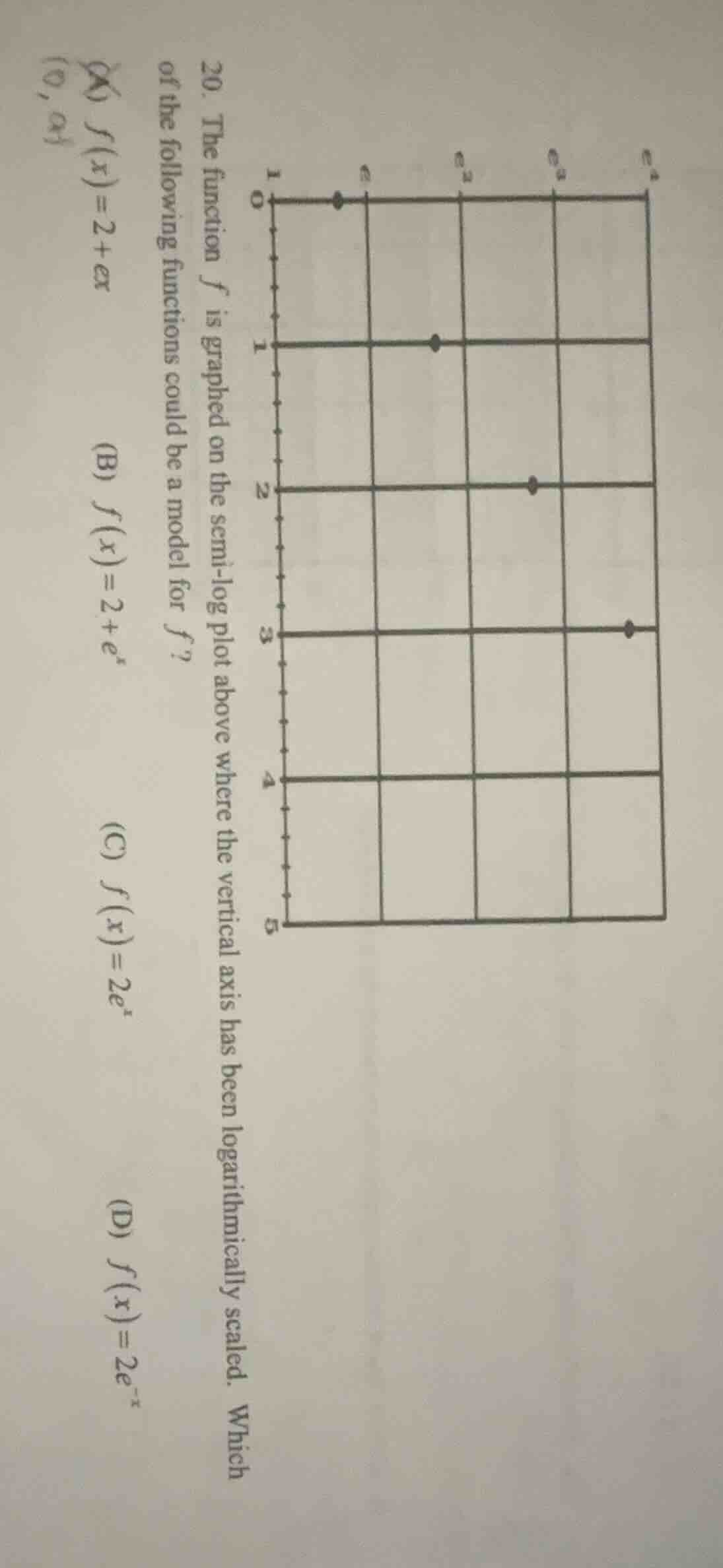
- the function ( f ) is graphed on the semi - log plot above where the vertical axis has been logarithmically scaled. which of the following functions could be a model for ( f )?
(a) ( f(x)=2 + ex )
(b) ( f(x)=2 + e^{x} )
(c) ( f(x)=2e^{x} )
(d) ( f(x)=2e^{-x} )
Step1: Analyze the semi - log plot
In a semi - log plot where the vertical axis is logarithmically scaled (let's assume it's a natural log scale, so \(y = \ln(f(x))\) if we consider the vertical axis as the log - transformed axis), we can find the relationship between \(x\) and \(f(x)\). Let's look at the points on the graph. From the plot, we can see the coordinates (assuming the horizontal axis is \(x\) and the vertical axis is the log - scaled value of \(f(x)\)). Let's take some points: when \(x = 0\), the vertical value (log - scaled) seems to be \(\ln(2)\) (since if we check the options, we can work backwards). When \(x = 1\), the vertical value is \(\ln(2e)\) or \(\ln(2)+1\), when \(x = 2\), it's \(\ln(2e^{2})\) or \(\ln(2)+2\), when \(x = 3\), it's \(\ln(2e^{3})\) or \(\ln(2)+3\).
Step2: Check the function form
Let's consider the general form of the function. If we assume that the log - scaled vertical axis (let \(y=\ln(f(x))\)) has a linear relationship with \(x\), i.e., \(y = \ln(2)+x\) (from the points: when \(x = 0\), \(y=\ln(2)\); \(x = 1\), \(y=\ln(2)+1\); \(x = 2\), \(y=\ln(2)+2\); \(x = 3\), \(y=\ln(2)+3\)). Then, exponentiating both sides, we get \(f(x)=e^{\ln(2)+x}=2e^{x}\). Let's check the options:
- Option A: \(f(x)=2 + ex\). This is a linear function in \(x\), and its log - transformed form \(\ln(2 + ex)\) is not linear in \(x\), so it doesn't fit.
- Option B: \(f(x)=2 + e^{x}\). The log - transformed form \(\ln(2 + e^{x})\) is not linear in \(x\), so it doesn't fit.
- Option C: \(f(x)=2e^{x}\). Then \(\ln(f(x))=\ln(2)+x\), which is a linear function in \(x\) (slope \(= 1\), intercept \(\ln(2)\)), which matches the pattern we saw from the semi - log plot.
- Option D: \(f(x)=2e^{-x}\). Then \(\ln(f(x))=\ln(2)-x\), which has a negative slope, but from the plot, the slope of the log - transformed function is positive (as \(x\) increases, the log - scaled value increases), so this doesn't fit.

Snap & solve any problem in the app
Get step-by-step solutions on Sovi AI
Photo-based solutions with guided steps
Explore more problems and detailed explanations
C. \(f(x) = 2e^{x}\)