QUESTION IMAGE
Question
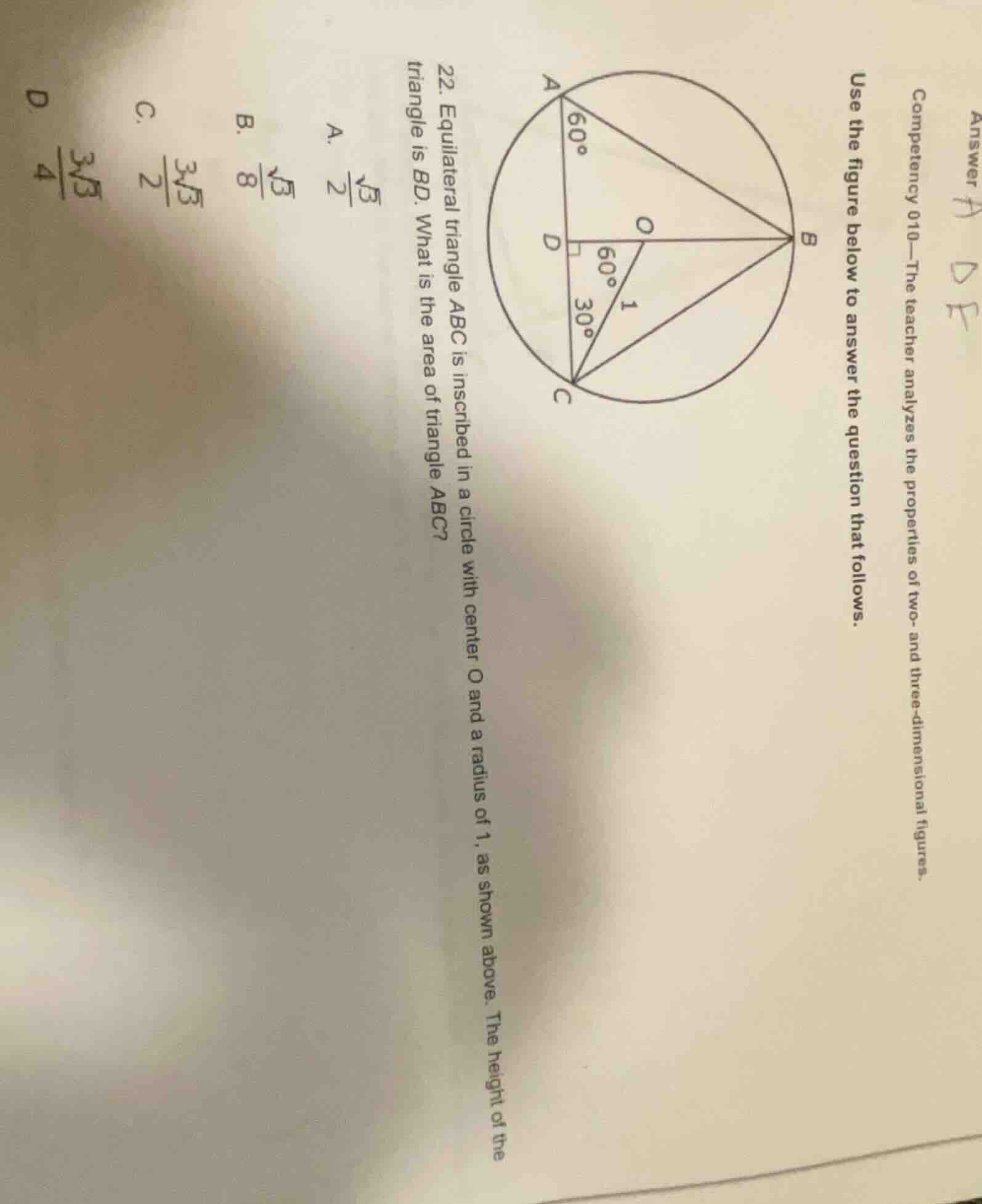
- equilateral triangle abc is inscribed in a circle with center o and a radius of 1, as shown above. the height of the triangle is bd. what is the area of triangle abc? a. $\frac{sqrt{3}}{2}$ b. $\frac{sqrt{3}}{8}$ c. $\frac{3sqrt{3}}{2}$ d. $\frac{3sqrt{3}}{4}$
Step1: Find the length of DC
In right triangle \(ODC\), \(\angle OCD = 30^\circ\), \(OC = 1\) (radius). So \(OD=\frac{1}{2}\), and by Pythagoras, \(DC=\sqrt{OC^{2}-OD^{2}}=\sqrt{1 - (\frac{1}{2})^{2}}=\frac{\sqrt{3}}{2}\).
Step2: Find the length of AC
Since \(OD\perp AC\) and \(O\) is the center, \(AD = DC\), so \(AC = 2DC = 2\times\frac{\sqrt{3}}{2}=\sqrt{3}\).
Step3: Find the length of BD
The height \(BD\) of the equilateral triangle: \(BO = 1\), \(OD=\frac{1}{2}\), so \(BD=BO + OD=1+\frac{1}{2}=\frac{3}{2}\)? Wait, no, wait. Wait, in the equilateral triangle inscribed in the circle, the center \(O\) is also the centroid, so the height \(h\) of the triangle: the distance from center to a side is \(r/2\) (for equilateral triangle inscribed in circle of radius \(r\))? Wait, no, let's re - examine.
Wait, the radius \(r = 1\). In \(\triangle ODC\), \(\angle DOC = 60^\circ\), \(OC = 1\), \(OD=\cos60^\circ\times OC=\frac{1}{2}\), \(DC=\sin60^\circ\times OC=\frac{\sqrt{3}}{2}\). Then \(AC = 2DC=\sqrt{3}\). The height of the equilateral triangle \(h\) (which is \(BD\)): since the centroid divides the height in ratio \(2:1\), the height \(h\) of the equilateral triangle \(ABC\) is \(3\times OD\)? No, wait, \(O\) is the center, so the distance from \(O\) to \(AC\) is \(OD=\frac{1}{2}\), so the height \(BD=BO + OD\), where \(BO = 1\), \(OD=\frac{1}{2}\), so \(BD=\frac{3}{2}\)? Wait, no, that's wrong. Wait, actually, for an equilateral triangle inscribed in a circle of radius \(r\), the side length \(a=\sqrt{3}r\), and the height \(h=\frac{3}{2}r\). Since \(r = 1\), \(h=\frac{3}{2}\), and side length \(a=\sqrt{3}\).
Step4: Calculate the area of \(\triangle ABC\)
The area of an equilateral triangle is \(A=\frac{\sqrt{3}}{4}a^{2}\), but we can also use \(A=\frac{1}{2}\times base\times height\). Here, base \(AC = \sqrt{3}\), height \(BD=\frac{3}{2}\). So \(A=\frac{1}{2}\times\sqrt{3}\times\frac{3}{2}=\frac{3\sqrt{3}}{4}\)? Wait, no, wait, let's check again.
Wait, no, the height of the equilateral triangle: in an equilateral triangle inscribed in a circle of radius \(r\), the height \(h=\frac{3r}{2}\). When \(r = 1\), \(h=\frac{3}{2}\), and the side length \(a=\sqrt{3}r=\sqrt{3}\). Then area \(A=\frac{1}{2}\times a\times h=\frac{1}{2}\times\sqrt{3}\times\frac{3}{2}=\frac{3\sqrt{3}}{4}\)? But wait, the options: option D is \(\frac{3\sqrt{3}}{4}\)? Wait, no, let's recalculate.
Wait, another approach: the area of an equilateral triangle inscribed in a circle of radius \(r\) is \(A=\frac{3\sqrt{3}}{4}r^{2}\). When \(r = 1\), \(A=\frac{3\sqrt{3}}{4}\). Let's verify with the given figure.
In \(\triangle OBC\), \(OB = OC = 1\), \(\angle BOC = 120^\circ\) (since \(\triangle ABC\) is equilateral, central angle \(\angle BOC = 120^\circ\)). The area of \(\triangle OBC\) is \(\frac{1}{2}\times OB\times OC\times\sin120^\circ=\frac{1}{2}\times1\times1\times\frac{\sqrt{3}}{2}=\frac{\sqrt{3}}{4}\). Then the area of \(\triangle ABC\) is \(3\times\) area of \(\triangle OBC\) (since the equilateral triangle is divided into three congruent triangles by the center) \(=3\times\frac{\sqrt{3}}{4}=\frac{3\sqrt{3}}{4}\).

Snap & solve any problem in the app
Get step-by-step solutions on Sovi AI
Photo-based solutions with guided steps
Explore more problems and detailed explanations
\(\frac{3\sqrt{3}}{4}\) (Option D)