QUESTION IMAGE
Question
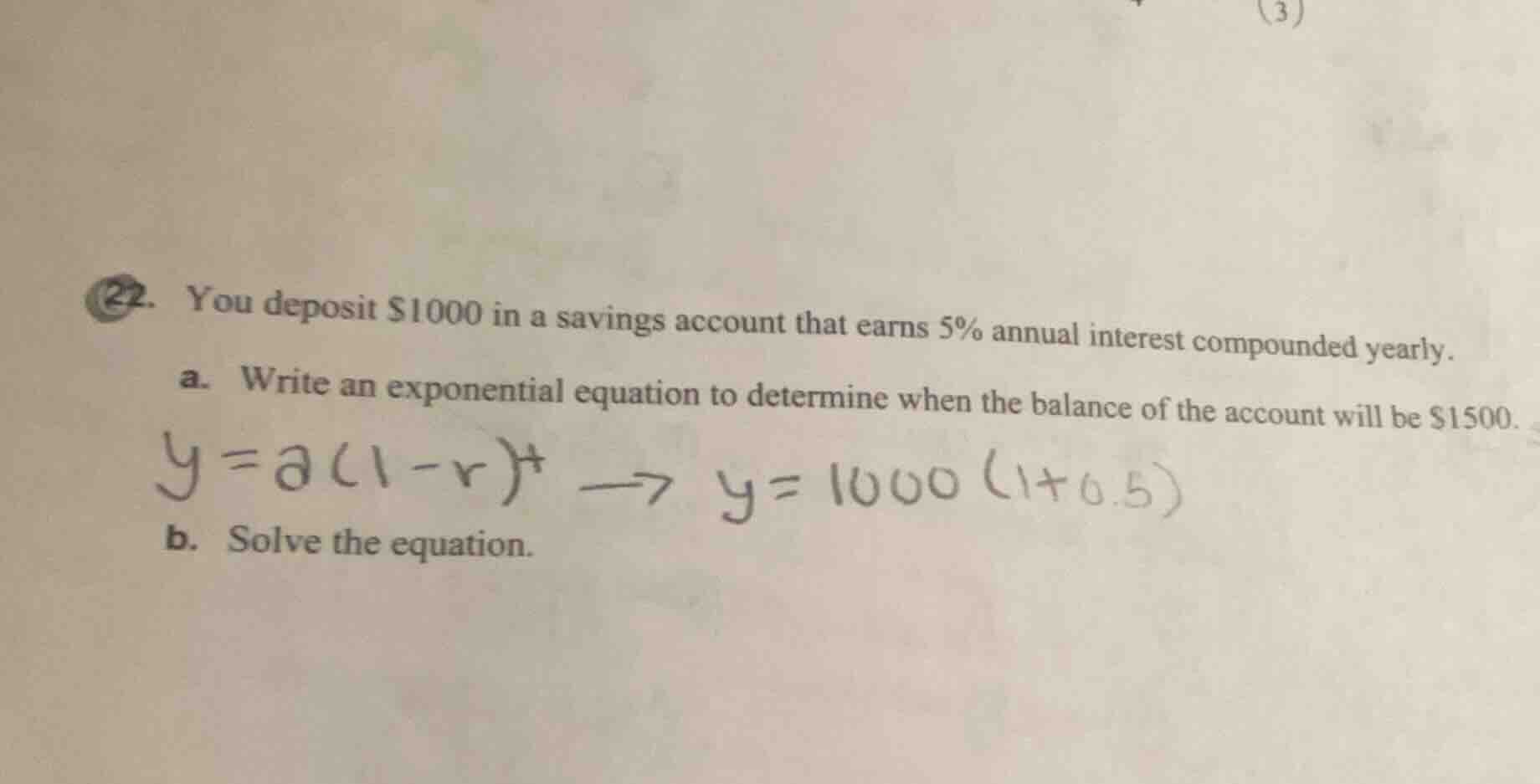
- you deposit $1000 in a savings account that earns 5% annual interest compounded yearly.
a. write an exponential equation to determine when the balance of the account will be $1500.
b. solve the equation.
Part (a)
Step1: Recall compound interest formula
The compound interest formula is $A = P(1 + r)^t$, where $A$ is the final amount, $P$ is the principal amount, $r$ is the annual interest rate (in decimal), and $t$ is the time in years.
Here, $P = 1000$, $r = 0.05$ (since 5% = 0.05), and we want to find $t$ when $A = 1500$. So the equation is $1500 = 1000(1 + 0.05)^t$.
Part (b)
Step1: Start with the equation
We have $1500 = 1000(1.05)^t$.
Step2: Divide both sides by 1000
$\frac{1500}{1000} = (1.05)^t$, which simplifies to $1.5 = (1.05)^t$.
Step3: Take the natural logarithm of both sides
$\ln(1.5) = \ln((1.05)^t)$.
Step4: Use the logarithm power rule
$\ln(1.5) = t\ln(1.05)$.
Step5: Solve for $t$
$t = \frac{\ln(1.5)}{\ln(1.05)}$.
Step6: Calculate the value
Using a calculator, $\ln(1.5) \approx 0.4055$ and $\ln(1.05) \approx 0.0488$. So $t \approx \frac{0.4055}{0.0488} \approx 8.31$.

Snap & solve any problem in the app
Get step-by-step solutions on Sovi AI
Photo-based solutions with guided steps
Explore more problems and detailed explanations
s:
a. The exponential equation is $\boldsymbol{1500 = 1000(1.05)^t}$ (or $y = 1000(1.05)^t$ with $y = 1500$).
b. The time $t$ is approximately $\boldsymbol{8.31}$ years.