QUESTION IMAGE
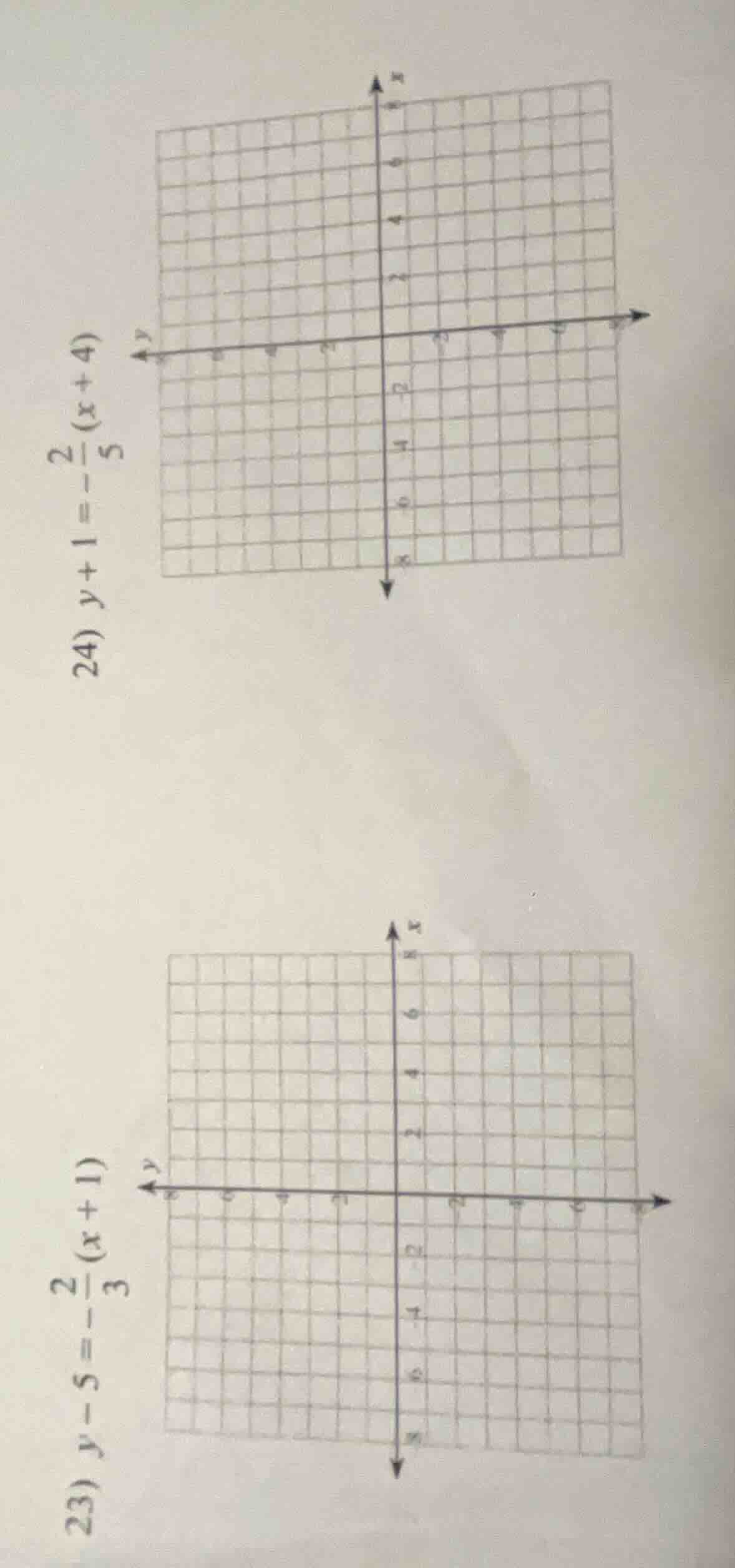
Question
- $y - 5 = -\frac{2}{3}(x + 1)$
- $y + 1 = -\frac{2}{5}(x + 4)$
Problem 23: \( y - 5 = -\frac{2}{3}(x + 1) \)
Step1: Convert to slope - intercept form (\(y=mx + b\))
First, we expand the right - hand side of the equation \(y-5=-\frac{2}{3}(x + 1)\). Using the distributive property \(a(b + c)=ab+ac\), where \(a =-\frac{2}{3}\), \(b=x\) and \(c = 1\), we get \(y-5=-\frac{2}{3}x-\frac{2}{3}\).
Then, we add 5 to both sides of the equation. To add 5 (which is \(\frac{15}{3}\)) to \(-\frac{2}{3}\), we have \(y=-\frac{2}{3}x-\frac{2}{3}+5=-\frac{2}{3}x+\frac{- 2 + 15}{3}=-\frac{2}{3}x+\frac{13}{3}\).
Step2: Find the y - intercept and a second point
The y - intercept (\(b\)) is \(\frac{13}{3}\approx4.33\). So the line crosses the y - axis at \((0,\frac{13}{3})\).
The slope (\(m\)) is \(-\frac{2}{3}\), which means for a run of 3 (change in \(x\) by 3), the rise is - 2 (change in \(y\) by - 2). Starting from \((0,\frac{13}{3})\), if we move 3 units to the right (increase \(x\) by 3) to \(x = 3\), and 2 units down (decrease \(y\) by 2) from \(\frac{13}{3}\), we get \(y=\frac{13}{3}-2=\frac{13 - 6}{3}=\frac{7}{3}\approx2.33\). So another point is \((3,\frac{7}{3})\).
We can also find the x - intercept by setting \(y = 0\):
\(0=-\frac{2}{3}x+\frac{13}{3}\)
Multiply both sides by 3: \(0=-2x + 13\)
\(2x=13\)
\(x=\frac{13}{2}=6.5\). So the x - intercept is \((6.5,0)\)
Problem 24: \(y + 1=-\frac{2}{5}(x + 4)\)
Step1: Convert to slope - intercept form (\(y=mx + b\))
First, use the distributive property on the right - hand side of the equation \(y + 1=-\frac{2}{5}(x + 4)\). We have \(y + 1=-\frac{2}{5}x-\frac{8}{5}\).
Then, subtract 1 (which is \(\frac{5}{5}\)) from both sides: \(y=-\frac{2}{5}x-\frac{8}{5}-1=-\frac{2}{5}x-\frac{8 + 5}{5}=-\frac{2}{5}x-\frac{13}{5}\)
Step2: Find the y - intercept and a second point
The y - intercept (\(b\)) is \(-\frac{13}{5}=-2.6\). So the line crosses the y - axis at \((0,-\frac{13}{5})\).
The slope (\(m\)) is \(-\frac{2}{5}\), which means for a run of 5 (change in \(x\) by 5), the rise is - 2 (change in \(y\) by - 2). Starting from \((0,-\frac{13}{5})\), if we move 5 units to the right (increase \(x\) by 5) to \(x = 5\), and 2 units down (decrease \(y\) by 2) from \(-\frac{13}{5}\), we get \(y=-\frac{13}{5}-2=-\frac{13+10}{5}=-\frac{23}{5}=-4.6\). So another point is \((5,-\frac{23}{5})\).
To find the x - intercept, set \(y = 0\):
\(0=-\frac{2}{5}x-\frac{13}{5}\)
Multiply both sides by 5: \(0=-2x-13\)
\(2x=-13\)
\(x=-\frac{13}{2}=-6.5\). So the x - intercept is \((-6.5,0)\)
(If the question was to graph the lines, the above steps help in identifying the key points (intercepts, points using slope) to plot the lines. If the question was to solve for \(x\) or \(y\) or analyze the equations, the steps for converting to slope - intercept form and finding intercepts are useful.)

Snap & solve any problem in the app
Get step-by-step solutions on Sovi AI
Photo-based solutions with guided steps
Explore more problems and detailed explanations
(for graphing, key points):
- For \(y - 5=-\frac{2}{3}(x + 1)\):
- y - intercept: \((0,\frac{13}{3})\approx(0,4.33)\)
- x - intercept: \((6.5,0)\)
- Another point: \((3,\frac{7}{3})\approx(3,2.33)\)
- For \(y + 1=-\frac{2}{5}(x + 4)\):
- y - intercept: \((0,-\frac{13}{5})\approx(0,-2.6)\)
- x - intercept: \((-6.5,0)\)
- Another point: \((5,-\frac{23}{5})\approx(5,-4.6)\)