QUESTION IMAGE
Question
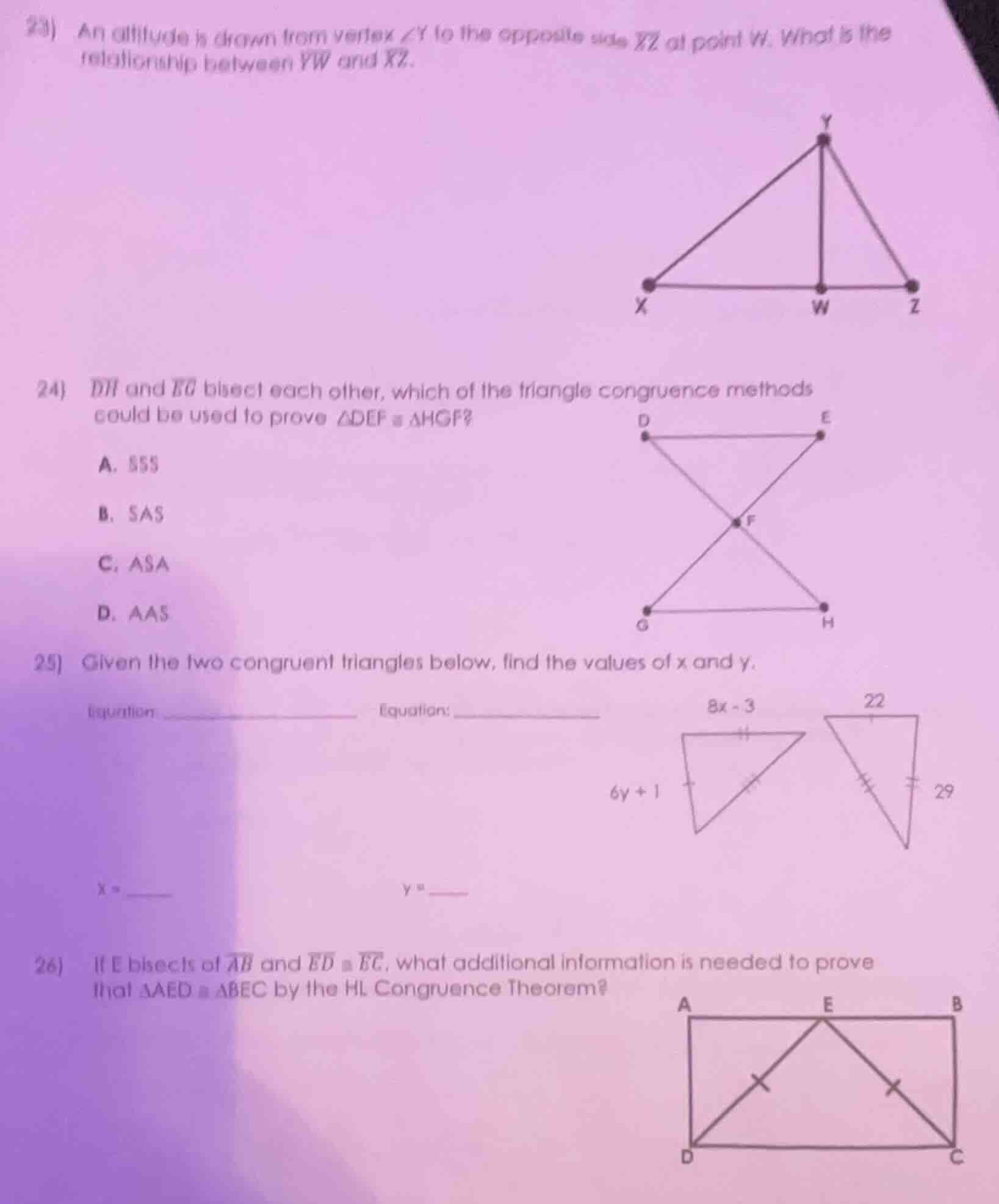
- an altitude is drawn from vertex ∠y to the opposite side xz at point w. what is the relationship between yw and xz.
- dh and eg bisect each other, which of the triangle congruence methods could be used to prove △def ≅ △hgf?
a. sss
b. sas
c. asa
d. aas
- given the two congruent triangles below, find the values of x and y.
equation ____________ equation: ____________
x = ____ y = ____
- if e bisects of ab and ed ≅ ec, what additional information is needed to prove that △aed ≅ △bec by the hl congruence theorem?
Question 23
Step1: Recall the definition of an altitude
An altitude of a triangle is a perpendicular segment from a vertex to the line containing the opposite side. So, \( \overline{YW} \) is an altitude from \( Y \) to \( \overline{XZ} \), which means \( \angle YWX \) and \( \angle YWZ \) are right angles (\( 90^\circ \)).
Step2: Determine the relationship
Since \( \overline{YW} \) is perpendicular to \( \overline{XZ} \), the relationship between \( \overline{YW} \) and \( \overline{XZ} \) is that they are perpendicular. In other words, \( YW \perp XZ \).
- Given that \( \overline{DH} \) and \( \overline{EG} \) bisect each other at \( F \), so \( DF = FH \) and \( EF = FG \) (by the definition of bisecting a segment).
- Also, \( \angle DFE \) and \( \angle HFG \) are vertical angles, so they are congruent (\( \angle DFE \cong \angle HFG \)).
- Now, in \( \triangle DEF \) and \( \triangle HGF \), we have \( DF = FH \), \( \angle DFE \cong \angle HFG \), and \( EF = FG \). This satisfies the SAS (Side - Angle - Side) congruence criterion (two sides and the included angle of one triangle are congruent to two sides and the included angle of the other triangle).
- So, the triangle congruence method that can be used to prove \( \triangle DEF \cong \triangle HGF \) is SAS.
Step1: Find the equation for \( x \)
Since the triangles are congruent, their corresponding sides are equal. The side with length \( 8x - 3 \) corresponds to the side with length \( 22 \). So we set up the equation:
\( 8x - 3=22 \)
Step2: Solve for \( x \)
Add 3 to both sides of the equation:
\( 8x=22 + 3=25 \)
Divide both sides by 8:
\( x=\frac{25}{8}=3.125 \)
Step3: Find the equation for \( y \)
The side with length \( 6y + 1 \) corresponds to the side with length \( 29 \). So we set up the equation:
\( 6y+1 = 29 \)
Step4: Solve for \( y \)
Subtract 1 from both sides:
\( 6y=29 - 1 = 28 \)
Divide both sides by 6:
\( y=\frac{28}{6}=\frac{14}{3}\approx4.666\cdots \) (or as a fraction \( \frac{14}{3} \))

Snap & solve any problem in the app
Get step-by-step solutions on Sovi AI
Photo-based solutions with guided steps
Explore more problems and detailed explanations
\( YW \) is perpendicular to \( XZ \) (or \( YW \perp XZ \))