QUESTION IMAGE
Question
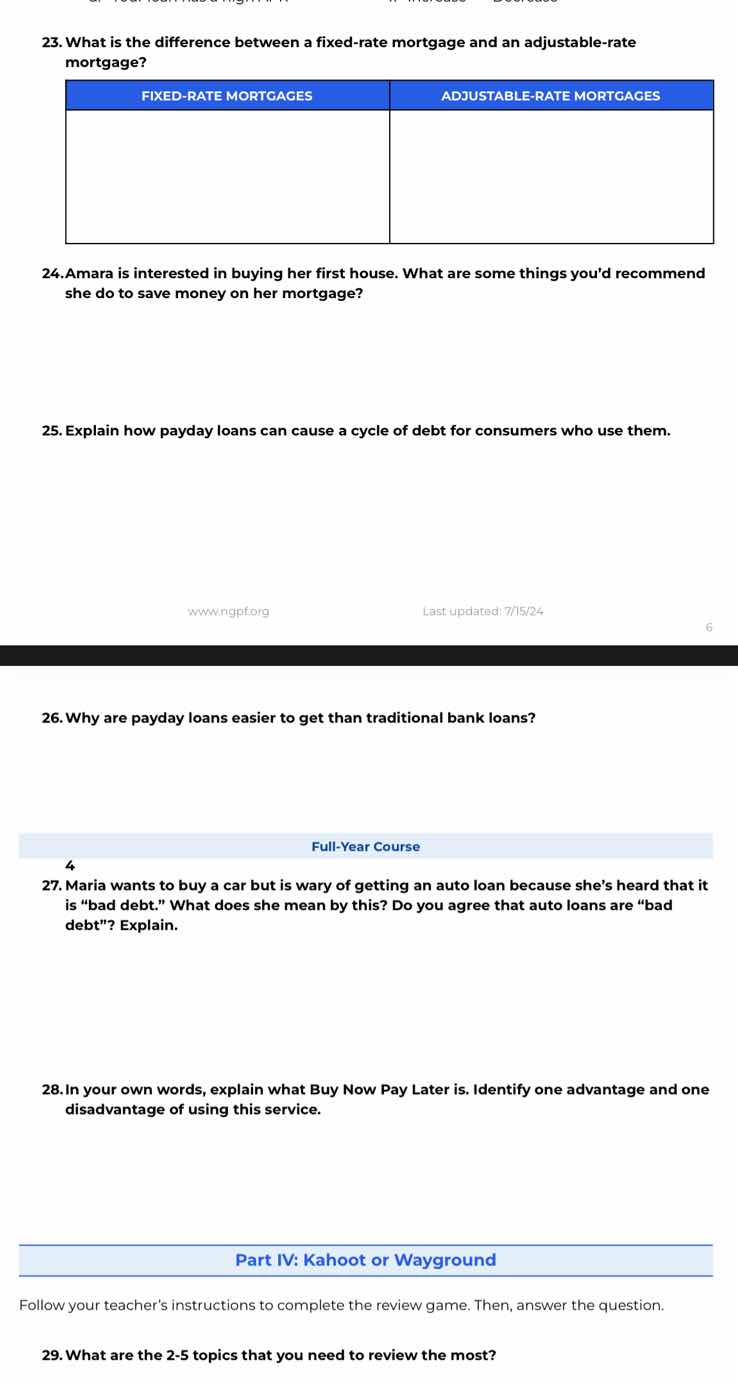
- what is the difference between a fixed - rate mortgage and an adjustable - rate mortgage?
fixed - rate mortgages adjustable - rate mortgages
- amara is interested in buying her first house. what are some things youd recommend she do to save money on her mortgage?
- explain how payday loans can cause a cycle of debt for consumers who use them.
www.ngpf.org last updated: 7/15/24
6
- why are payday loans easier to get than traditional bank loans?
full - year course
4
- maria wants to buy a car but is wary of getting an auto loan because shes heard that it is “bad debt.” what does she mean by this? do you agree that auto loans are “bad debt”? explain.
- in your own words, explain what buy now pay later is. identify one advantage and one disadvantage of using this service.
part iv: kahoot or wayground
follow your teachers instructions to complete the review game. then, answer the question.
- what are the 2 - 5 topics that you need to review the most?
For Question 23:
Fixed-rate mortgages have an interest rate that stays the same for the entire loan term, while adjustable-rate mortgages have an interest rate that can change (usually after an initial fixed period) based on market indexes.
| FIXED-RATE MORTGAGES | ADJUSTABLE-RATE MORTGAGES |
|---|---|
| Predictable monthly payments | Monthly payments can increase or decrease after the initial period |
| Better for long-term stability if rates rise | May start with lower rates, but carries uncertainty about future payments |
For Question 24:
- Improve credit score to qualify for lower interest rates.
- Save for a larger down payment to reduce loan amount and avoid private mortgage insurance (PMI).
- Shop around with multiple lenders to compare interest rates and fees.
- Choose a shorter loan term (e.g., 15-year) to pay less total interest over time.
- Make extra principal payments when possible to reduce the total interest owed.
For Question 25:
Payday loans have extremely high interest rates and short repayment terms (usually two weeks). Many consumers cannot repay the full loan amount by the due date, so they roll over the loan, which adds more fees and interest. This creates a cycle where the borrower keeps paying fees without reducing the original debt, leading to increasing debt that is hard to escape.
For Question 26:
Payday loans have much less strict eligibility requirements than traditional bank loans. They do not require a good credit score, collateral, or proof of stable income in most cases. Lenders only typically require a checking account and proof of income (even a small or irregular one), making them accessible to people who would be denied by banks.
For Question 27:
"Bad debt" refers to debt used to purchase an asset that loses value over time and does not generate income. An auto loan is considered bad debt by some because cars depreciate in value as soon as they are driven off the lot, and the loan interest adds to the total cost of the depreciating asset.
Whether auto loans are "bad debt" depends on context: they can be a necessary expense for people who need a car to get to work or essential activities. However, they are not an investment, so they do not build wealth like a mortgage (which builds home equity) would. So they are not inherently "bad" but are not wealth-building debt.
For Question 28:
Buy Now Pay Later (BNPL) is a payment service that allows consumers to purchase goods immediately and pay for them in installments, usually with no interest if payments are made on time.
- Advantage: Interest-free installments (if paid on schedule) allow for flexible, interest-free short-term financing for purchases.
- Disadvantage: Late fees can be high, and missed payments can damage credit scores; it also encourages overspending since the full cost is not paid upfront.
For Question 29:
This is personalized, but common high-priority topics for review would be:
- Differences between fixed and adjustable-rate mortgages
- The cycle of debt from payday loans
- Strategies to save on mortgage costs
- The pros and cons of Buy Now Pay Later services
- Distinctions between "good" and "bad" debt

Snap & solve any problem in the app
Get step-by-step solutions on Sovi AI
Photo-based solutions with guided steps
Explore more problems and detailed explanations
Question 23:
| FIXED-RATE MORTGAGES | ADJUSTABLE-RATE MORTGAGES |
|---|---|
| Predictable monthly payments | Variable monthly payments |
| Stable for long-term homeownership | Risk of rate hikes over time |
Question 24:
- Boost credit score for lower rates
- Save a larger down payment
- Compare offers from multiple lenders
- Choose a shorter loan term
- Make extra principal payments
Question 25:
Payday loans have exorbitant interest rates and short repayment windows. When consumers cannot repay the full amount, they roll over the loan, adding steep fees and interest. This creates a cycle where the borrower pays ongoing costs without reducing the original debt, trapping them in increasing, unmanageable debt.
Question 26:
Payday loans have minimal eligibility requirements: no need for good credit, collateral, or strict proof of stable income. They only typically require a checking account and basic income verification, making them accessible to those rejected by traditional banks.
Question 27:
"Bad debt" refers to debt for depreciating, non-income-generating assets. Cars lose value quickly, so some see auto loans as bad debt because the asset's value drops while interest adds to costs.
Auto loans are not inherently bad: they are often necessary for essential transportation. However, they do not build wealth like a mortgage, so they are non-wealth-building debt rather than strictly "bad."
Question 28:
Buy Now Pay Later (BNPL) is a service that lets shoppers buy items immediately and pay in interest-free installments (if on time).
- Advantage: Interest-free short-term payment flexibility
- Disadvantage: High late fees and risk of overspending/credit damage
Question 29:
Example high-priority review topics:
- Fixed vs. adjustable-rate mortgage differences
- Payday loan debt cycles
- Mortgage cost-saving strategies
- Buy Now Pay Later pros and cons
- "Good" vs. "bad" debt definitions