QUESTION IMAGE
Question
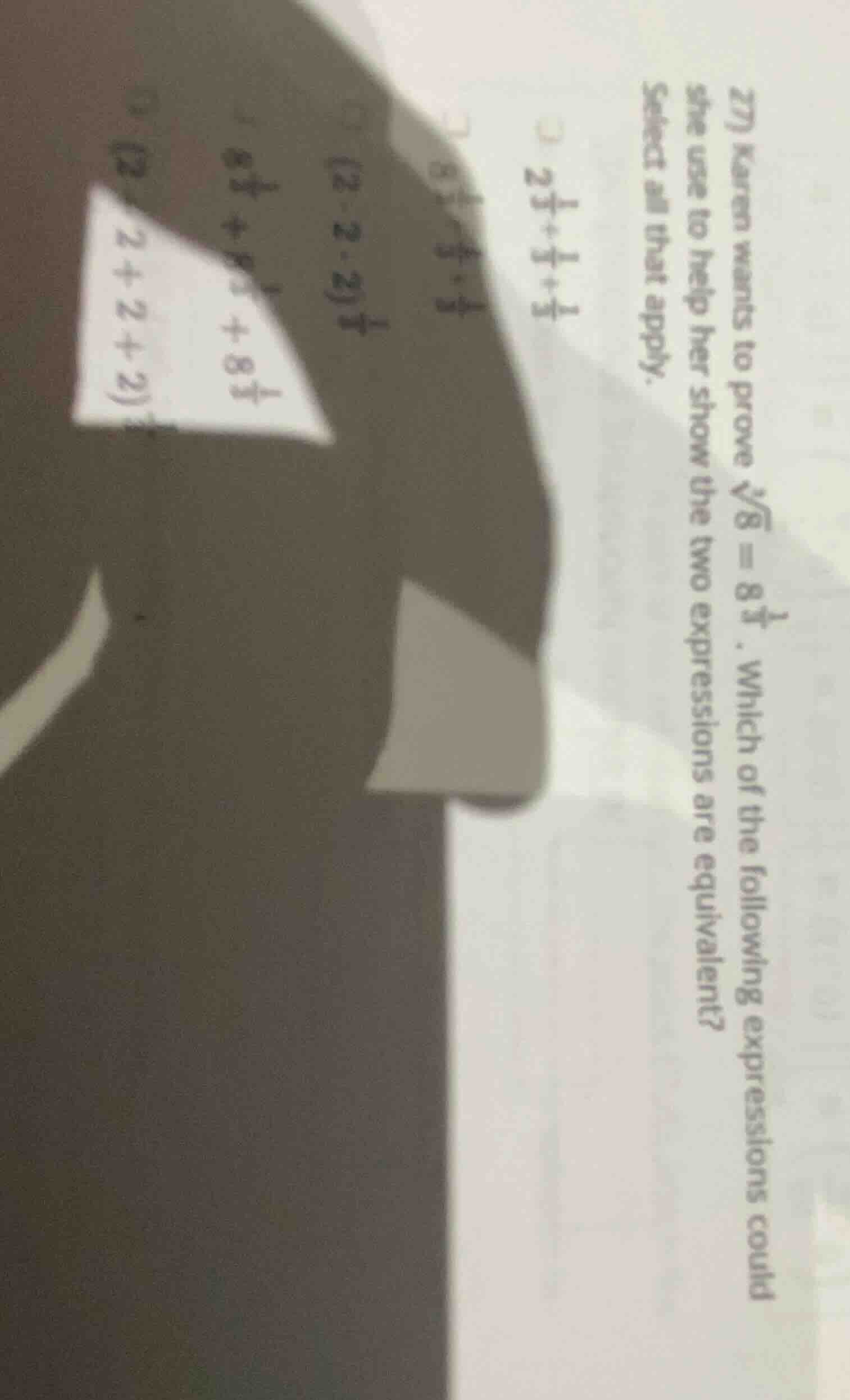
- karen wants to prove (sqrt3{8} = 8^{\frac{1}{3}}). which of the following expressions could she use to help her show the two expressions are equivalent? select all that apply. (\bigcirc 2^{\frac{1}{3}} cdot 2^{\frac{1}{3}} cdot 2^{\frac{1}{3}}) (\bigcirc 8^{\frac{1}{3}} cdot 8^{\frac{1}{3}} cdot 8^{\frac{1}{3}}) (\bigcirc (2 cdot 2 cdot 2)^{\frac{1}{3}}) (\bigcirc 8^{\frac{1}{3}} + 8^{\frac{1}{3}} + 8^{\frac{1}{3}}) (\bigcirc (2 + 2 + 2)^{\frac{1}{3}})
To prove \(\sqrt[3]{8}=8^{\frac{1}{3}}\), we can use the property of exponents and radicals. Recall that \(\sqrt[n]{a}=a^{\frac{1}{n}}\) for any real number \(a\) and positive integer \(n\). Also, we know that \(8 = 2^3\).
Step 1: Rewrite \(8\) as a power of \(2\)
We know that \(8 = 2\times2\times2=2^3\). So we can rewrite \(8^{\frac{1}{3}}\) as \((2^3)^{\frac{1}{3}}\)
Step 2: Apply the exponent rule \((a^m)^n=a^{m\times n}\)
For \((2^3)^{\frac{1}{3}}\), using the rule \((a^m)^n = a^{m\times n}\), we have \(m = 3\) and \(n=\frac{1}{3}\), so \((2^3)^{\frac{1}{3}}=2^{3\times\frac{1}{3}}\)
Step 3: Simplify the exponent
\(3\times\frac{1}{3}=1\), so \(2^{3\times\frac{1}{3}} = 2^1=2\)
Now, let's check the value of \(\sqrt[3]{8}\). By definition, \(\sqrt[3]{8}\) is the number \(x\) such that \(x^3 = 8\). We know that \(2^3=8\), so \(\sqrt[3]{8}=2\)
Now let's analyze the given expressions (assuming the expressions are related to showing the equivalence of \(\sqrt[3]{8}\) and \(8^{\frac{1}{3}}\)):
- For an expression like \(8^{\frac{1}{3}}\times8^{\frac{1}{3}}\times8^{\frac{1}{3}}\): Using the rule \(a^m\times a^n=a^{m + n}\), we have \(8^{\frac{1}{3}+\frac{1}{3}+\frac{1}{3}}=8^{\frac{1 + 1+ 1}{3}}=8^{\frac{3}{3}}=8^1 = 8\). But we know that \((\sqrt[3]{8})^3=8\) and \((8^{\frac{1}{3}})^3 = 8\), so this shows that \(8^{\frac{1}{3}}\) cubed is \(8\), which is consistent with the definition of cube root.
- For an expression like \((2\times2\times2)^{\frac{1}{3}}\): Since \(2\times2\times2 = 2^3=8\), then \((2\times2\times2)^{\frac{1}{3}}=(2^3)^{\frac{1}{3}}=2\) (as we calculated before), and \(\sqrt[3]{8}=2\), so this is equivalent.
- For an expression like \(2^{\frac{1}{3}+\frac{1}{3}+\frac{1}{3}}\): \(2^{\frac{1 + 1+ 1}{3}}=2^{\frac{3}{3}}=2^1 = 2\), and \(\sqrt[3]{8}=2\), so this is equivalent.
- For an expression like \((2 - 2)^{\frac{1}{3}}\): \(2-2 = 0\), and \(\sqrt[3]{0}=0
eq2\), so this is not equivalent.
- For an expression like \(8^{\frac{1}{3}}+8^{\frac{1}{3}}+8^{\frac{1}{3}}\): \(8^{\frac{1}{3}}=2\), so \(2 + 2+ 2=6
eq2\), so this is not equivalent.
- For an expression like \(2+2+2+2\): This is \(8
eq2\), so this is not equivalent.

Snap & solve any problem in the app
Get step-by-step solutions on Sovi AI
Photo-based solutions with guided steps
Explore more problems and detailed explanations
The expressions that apply to show \(\sqrt[3]{8}=8^{\frac{1}{3}}\) are the ones that correctly use exponent rules or the definition of cube root to show both equal to \(2\) (or show the consistency of the cube - root and exponent form). For example, if the options include \(8^{\frac{1}{3}}\times8^{\frac{1}{3}}\times8^{\frac{1}{3}}\), \((2\times2\times2)^{\frac{1}{3}}\), \(2^{\frac{1}{3}+\frac{1}{3}+\frac{1}{3}}\) (assuming these are the relevant options), these would be the correct ones. If we assume the options are:
A. \(8^{\frac{1}{3}}\times8^{\frac{1}{3}}\times8^{\frac{1}{3}}\)
B. \((2 - 2)^{\frac{1}{3}}\)
C. \(8^{\frac{1}{3}}+8^{\frac{1}{3}}+8^{\frac{1}{3}}\)
D. \((2\times2\times2)^{\frac{1}{3}}\)
E. \(2+2+2+2\)
F. \(2^{\frac{1}{3}+\frac{1}{3}+\frac{1}{3}}\)
Then the correct options are A, D, F.
(Note: The final answer depends on the exact expressions provided. The above is a general analysis based on the problem of showing \(\sqrt[3]{8}=8^{\frac{1}{3}}\))