QUESTION IMAGE
Question
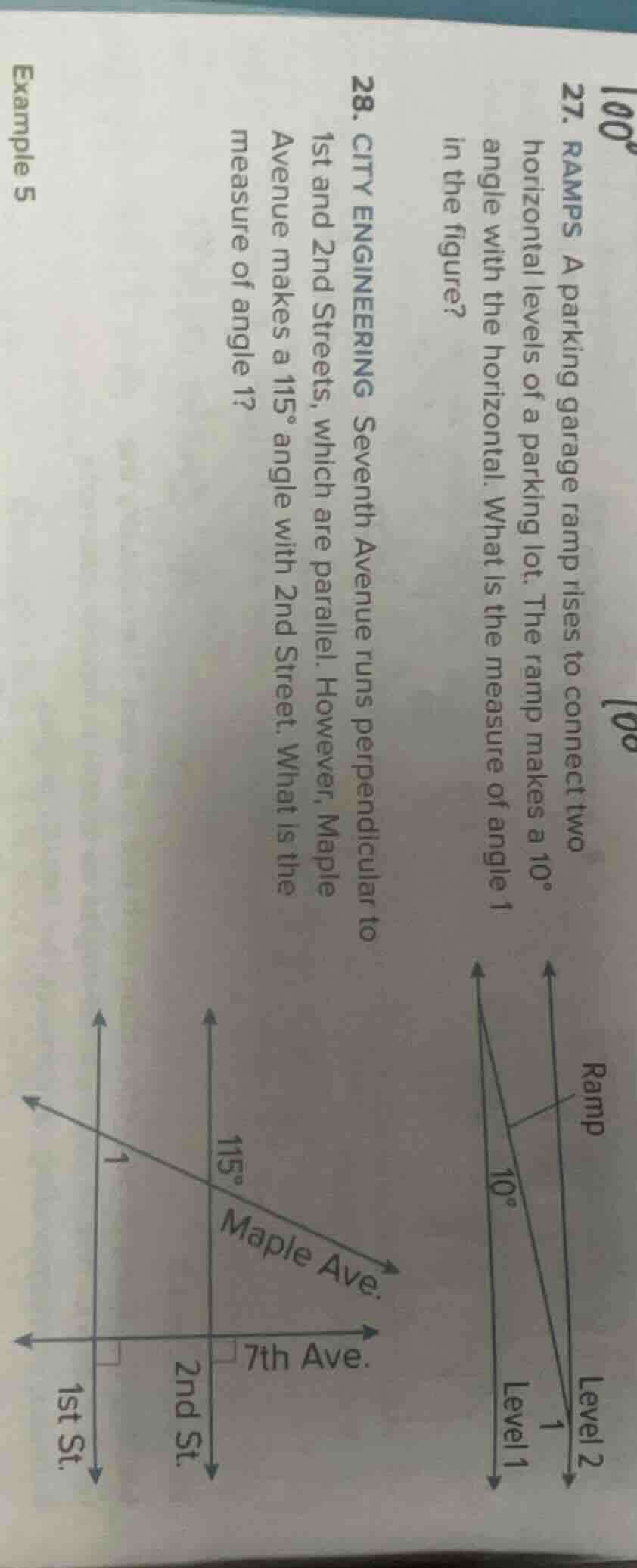
- ramps a parking garage ramp rises to connect two horizontal levels of a parking lot. the ramp makes a 10° angle with the horizontal. what is the measure of angle 1 in the figure?
- city engineering seventh avenue runs perpendicular to 1st and 2nd streets, which are parallel. however, maple avenue makes a 115° angle with 2nd street. what is the measure of angle 1?
Problem 27: Ramps
Step 1: Identify the relationship
The ramp makes a \(10^\circ\) angle with the horizontal. The angle between the two vertical levels (Level 1 and Level 2) is related to angle 1 by the fact that the sum of the \(10^\circ\) angle and angle 1 should be \(90^\circ\) (since the vertical and horizontal are perpendicular, and the ramp forms a right - triangle - like situation with the vertical and horizontal). Wait, actually, looking at the diagram, the two vertical lines (Level 1 and Level 2) are parallel, and the ramp is a transversal. The angle between the ramp and the horizontal is \(10^\circ\), and angle 1 and the \(10^\circ\) angle are complementary? Wait, no. Let's think again. The vertical lines are parallel, and the ramp is a transversal. The angle between the ramp and the horizontal is \(10^\circ\), and the angle between the ramp and the vertical (Level 2) would be \(90 - 10=80^\circ\)? No, maybe I got it wrong. Wait, the problem says "a parking garage ramp rises to connect two horizontal levels of a parking lot. The ramp makes a \(10^\circ\) angle with the horizontal. What is the measure of angle 1 in the figure?" Looking at the diagram, Level 1 and Level 2 are vertical (parallel), and the ramp is a line connecting them. The angle between the ramp and the horizontal is \(10^\circ\), so angle 1 and the \(10^\circ\) angle are such that angle 1 \(= 90^\circ- 10^\circ\)? Wait, no, maybe it's a corresponding angle or alternate interior angle. Wait, the two vertical lines are parallel, and the ramp is a transversal. The angle between the ramp and the horizontal is \(10^\circ\), so the angle between the ramp and the vertical (Level 2) is \(90 - 10 = 80^\circ\)? No, I think I made a mistake. Wait, actually, the angle between the ramp and the horizontal is \(10^\circ\), and angle 1 is the angle between the ramp and the vertical (Level 2). Since the horizontal and vertical are perpendicular (\(90^\circ\)), angle 1 \(=90^\circ - 10^\circ=80^\circ\)? Wait, no, maybe the other way. Wait, the ramp makes a \(10^\circ\) angle with the horizontal, so the angle between the ramp and the vertical (which is parallel to Level 2) is angle 1, and since horizontal and vertical are perpendicular, angle 1 \(= 90^\circ-10^\circ = 80^\circ\)? Wait, no, maybe the angle between the two vertical lines and the ramp. Wait, let's use the property of parallel lines. The vertical lines (Level 1 and Level 2) are parallel, and the ramp is a transversal. The angle between the ramp and the horizontal is \(10^\circ\), so the angle between the ramp and the vertical (Level 2) is \(90 - 10=80^\circ\), and angle 1 is equal to that angle because of alternate interior angles (since the vertical lines are parallel). So angle 1 \(= 80^\circ\)? Wait, no, maybe I messed up. Wait, the correct approach: the ramp makes a \(10^\circ\) angle with the horizontal. The angle between the ramp and the vertical (Level 2) is \(90 - 10 = 80^\circ\), and since Level 1 and Level 2 are parallel, angle 1 is equal to that angle (alternate interior angles). So angle 1 \(= 80^\circ\)? Wait, no, maybe the angle is \(10^\circ\) more? Wait, no, let's start over. The horizontal is a straight line, the ramp makes \(10^\circ\) with the horizontal, so the angle adjacent to angle 1 (on the horizontal) is \(10^\circ\), and since the vertical is perpendicular to the horizontal, angle 1 \(= 90^\circ-10^\circ=80^\circ\)? Wait, I think that's it.
Step 2: Calculate angle 1
Since the ramp makes a \(10^\circ\) angle with the horizontal, and the vertical (Level 2) is perpendicular to the horizontal, angle 1 and…
Step 1: Analyze the given angles and parallel lines
1st and 2nd Streets are parallel, and 7th Avenue is perpendicular to both 1st and 2nd Streets (so 7th Avenue is a transversal perpendicular to the parallel lines 1st St and 2nd St). Maple Avenue makes a \(115^\circ\) angle with 2nd Street. We need to find angle 1, which is formed by Maple Avenue and 1st Street.
Since 1st St and 2nd St are parallel, and Maple Avenue is a transversal, the sum of the angle between Maple Avenue and 2nd St (\(115^\circ\)) and the angle between Maple Avenue and 1st St (angle 1) should be \(180^\circ\) (consecutive interior angles) if they were same - side, but wait, 7th Avenue is perpendicular to 1st and 2nd St, so the angle between 7th Avenue and 1st St is \(90^\circ\), and between 7th Avenue and 2nd St is \(90^\circ\).
Wait, let's look at the diagram. 7th Avenue is perpendicular to 1st St and 2nd St (right angles). Maple Avenue makes \(115^\circ\) with 2nd St. So the angle between Maple Avenue and 7th Avenue (at 2nd St) is \(115^\circ- 90^\circ = 25^\circ\)? No, wait, 7th Avenue is perpendicular to 2nd St, so the angle between 7th Avenue and 2nd St is \(90^\circ\). Maple Avenue makes \(115^\circ\) with 2nd St, so the angle between Maple Avenue and 7th Avenue (at 2nd St) is \(115 - 90=25^\circ\). Since 1st St and 2nd St are parallel, and 7th Avenue is a transversal, the angle between Maple Avenue and 1st St (angle 1) is equal to the angle between Maple Avenue and 7th Avenue (at 2nd St) because of alternate interior angles? Wait, no. Wait, 1st St and 2nd St are parallel, 7th Avenue is perpendicular to both (so 7th Avenue is a transversal with right angles), and Maple Avenue is another transversal. The angle between Maple Avenue and 2nd St is \(115^\circ\), so the angle between Maple Avenue and 1st St (angle 1) is \(180 - 115=65^\circ\)? Wait, no, let's use the property of parallel lines. If two parallel lines are cut by a transversal, the consecutive interior angles are supplementary. 1st St and 2nd St are parallel, Maple Avenue is a transversal. The angle between Maple Avenue and 2nd St is \(115^\circ\), so the angle between Maple Avenue and 1st St (angle 1) is \(180 - 115 = 65^\circ\)? Wait, but 7th Avenue is perpendicular to 1st and 2nd St, so the angle between 7th Avenue and 1st St is \(90^\circ\), and between 7th Avenue and 2nd St is \(90^\circ\). Let's calculate the angle between Maple Avenue and 7th Avenue at 2nd St: \(115^\circ-90^\circ = 25^\circ\). Then, since 1st St and 2nd St are parallel, the angle between Maple Avenue and 7th Avenue at 1st St is also \(25^\circ\) (alternate interior angles). And since the angle between 7th Avenue and 1st St is \(90^\circ\), angle 1 \(=90^\circ - 25^\circ=65^\circ\)? Wait, that's the same as \(180 - 115 = 65^\circ\).
Step 2: Calculate angle 1
We know that 1st St \(\parallel\) 2nd St, and Maple Avenue is a transversal. The angle between Maple Avenue and 2nd St is \(115^\circ\). Consecutive interior angles between parallel lines cut by a transversal are supplementary. So \(\text{angle }1+115^\circ = 180^\circ\) (wait, no, that's if they are same - side interior angles). Wait, no, actually, 1st St and 2nd St are parallel, and 7th Avenue is perpendicular to both, so the angle between Maple Avenue and 1st St (angle 1) and the angle between Maple Avenue and 2nd St are related by the fact that the angle between Maple Avenue and 2nd St is \(115^\circ\), and the angle between Maple Avenue and 1st St is \(180 - 115=65^\circ\) (because of the parallel lines and the transversal Maple Avenue, and the fact that 7th A…

Snap & solve any problem in the app
Get step-by-step solutions on Sovi AI
Photo-based solutions with guided steps
Explore more problems and detailed explanations
\(80^\circ\)