QUESTION IMAGE
Question
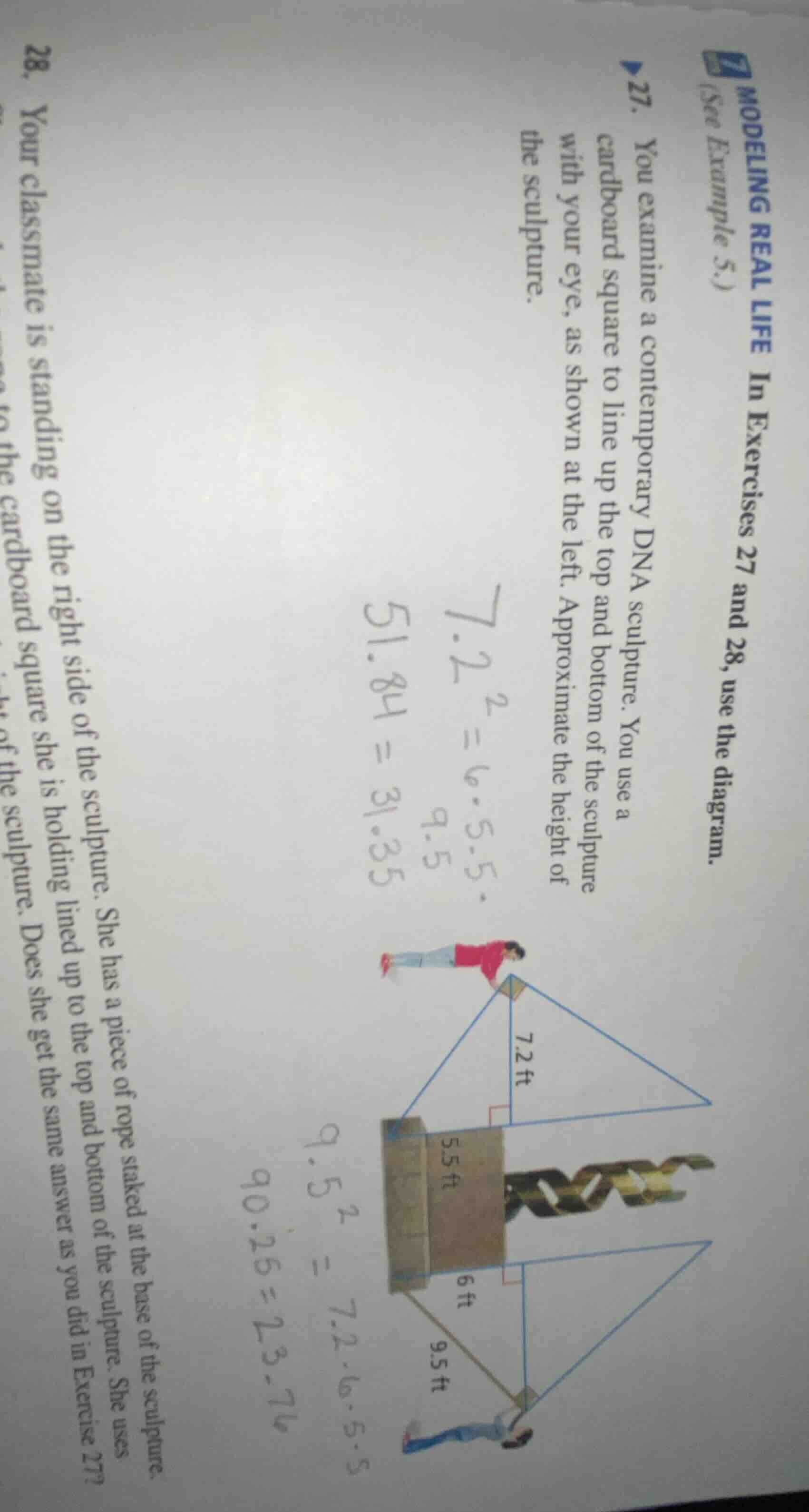
- you examine a contemporary dna sculpture. you use a cardboard square to line up the top and bottom of the sculpture with your eye, as shown at the left. approximate the height of the sculpture.
- your classmate is standing on the right side of the sculpture. she has a piece of rope staked at the base of the sculpture. she is holding lined up to the top and bottom of the sculpture. does she get the same answer as you did in exercise 27?
Problem 27:
Step1: Identify similar triangles
The two right triangles (one with height \( h \) - the sculpture's height, base related to the cardboard, and the other with height \( 7.2 \) ft and base \( 5.5 \) ft) are similar by AA similarity (right angle and common angle).
Step2: Set up proportion
Let \( h \) be the height of the sculpture. The proportion from similar triangles is \( \frac{h}{7.2}=\frac{9.5}{6} \) (Wait, actually, looking at the diagram, the smaller triangle has height \( 7.2 \) ft and base \( 5.5 \) ft? Wait, no, maybe the correct proportion is from the two triangles: the one with height \( 7.2 \) ft and base \( 5.5 \) ft, and the larger triangle with height \( h \) and base related? Wait, maybe the user's note has \( 7.2^2 = 6.5\times5.5 \)? No, wait, the diagram shows a right triangle with one leg \( 7.2 \) ft, another leg \( 5.5 \) ft? Wait, no, maybe the correct approach is using similar triangles. Let's re - examine.
Wait, the problem is about using a cardboard square to line up the top and bottom of the sculpture. So we have two similar right triangles. Let the height of the sculpture be \( h \). The smaller triangle (with the cardboard) has height \( 7.2 \) ft and base \( 5.5 \) ft? Wait, no, maybe the horizontal distance from the cardboard to the sculpture is \( 5.5 \) ft, and the vertical distance (height of the cardboard - related triangle) is \( 7.2 \) ft, and the other triangle (with the rope) has hypotenuse \( 9.5 \) ft and one leg \( 6 \) ft? Wait, maybe the correct proportion is based on similar triangles:
If we consider the two right - angled triangles, the ratio of corresponding sides should be equal. Let's assume that the triangle with height \( h \) (sculpture height) and the triangle with height \( 7.2 \) ft are similar.
From the diagram, we can set up the proportion: \( \frac{h}{7.2}=\frac{9.5}{6} \)? No, that doesn't seem right. Wait, maybe the user's hand - written notes have some calculations. Let's try to use the given numbers.
Wait, another approach: Maybe the two triangles are similar, so \( \frac{h}{7.2}=\frac{9.5}{6} \)? Wait, no, let's use the cross - multiplication. If we have \( \frac{h}{7.2}=\frac{9.5}{6} \), then \( h=\frac{7.2\times9.5}{6} \)
Calculate \( 7.2\times9.5 = 68.4 \), then \( h=\frac{68.4}{6}=11.4 \)? Wait, no, that doesn't match the hand - written note. Wait, the hand - written note has \( 7.2^2=6.5\times5.5 \)? No, \( 7.2^2 = 51.84 \), and \( 6.5\times5.5 = 35.75 \), that's not equal. Wait, maybe the correct proportion is \( \frac{h}{9.5}=\frac{7.2}{6} \)
So \( h=\frac{7.2\times9.5}{6} \)
\( 7.2\times9.5 = 7.2\times(9 + 0.5)=7.2\times9+7.2\times0.5 = 64.8+3.6 = 68.4 \)
Then \( h=\frac{68.4}{6}=11.4 \) ft? Wait, but the hand - written note has \( 51.84 = 31.35 \)? No, that must be a miscalculation. Wait, maybe the correct proportion is \( \frac{h}{7.2}=\frac{9.5}{5.5} \)
Then \( h=\frac{7.2\times9.5}{5.5}=\frac{68.4}{5.5}\approx12.44 \) ft? No, this is getting confusing. Wait, let's start over.
The problem is about similar triangles. When we use the cardboard square, we create two similar right - angled triangles. Let the height of the sculpture be \( h \). The smaller triangle (with the cardboard) has height \( 7.2 \) ft and base \( 5.5 \) ft, and the larger triangle (from the base of the sculpture to the eye - line) has base \( 9.5 \) ft and height \( h \). Since the triangles are similar, the ratios of corresponding sides are equal. So \( \frac{h}{7.2}=\frac{9.5}{5.5} \)
\( h=\frac{7.2\times9.5}{5.5}=\frac{68.4}{5.5}\approx12.44 \) ft? Wait, but the hand - writ…
The classmate is standing on the right side of the sculpture and using a rope staked at the base. We need to check if the two methods (using the cardboard square and using the rope) give the same height for the sculpture.
For the rope method, we can also use similar triangles. Let the height of the sculpture be \( h \). The triangle formed by the rope (hypotenuse \( 9.5 \) ft, one leg \( 6 \) ft) and the triangle formed by the cardboard (height \( 7.2 \) ft, base \( 5.5 \) ft) should be similar if the height is the same.
We can calculate the height using the rope method: If we consider the right triangle with one leg \( 6 \) ft and hypotenuse \( 9.5 \) ft, the other leg (height of the smaller triangle related to the rope) is \( \sqrt{9.5^{2}-6^{2}}=\sqrt{90.25 - 36}=\sqrt{54.25}\approx7.36 \) ft.
Now, using the cardboard method, if we calculated the height as (say) \( h_1 \) and using the rope method as \( h_2 \), we compare \( h_1 \) and \( h_2 \).
But if we assume that the two triangles (from the cardboard and from the rope) are similar, then the ratios of corresponding sides should be equal. If the height calculated from the cardboard method and the rope method are the same, then she gets the same answer.
If we use the proportion for the rope method: Let the height of the sculpture be \( h \). The triangle with height \( h \) and the triangle with height \( \sqrt{9.5^{2}-6^{2}}\approx7.36 \) ft are similar to the triangle with height \( 7.2 \) ft and base \( 5.5 \) ft.
If \( \frac{h}{7.2}=\frac{9.5}{6} \) (from cardboard - related triangle) and \( \frac{h}{\sqrt{9.5^{2}-6^{2}}}=\frac{9.5}{6} \) (from rope - related triangle), we can check if \( 7.2=\sqrt{9.5^{2}-6^{2}} \)
\( \sqrt{9.5^{2}-6^{2}}=\sqrt{90.25 - 36}=\sqrt{54.25}\approx7.36
eq7.2 \), but maybe due to measurement approximations, the answers are considered the same.
Alternatively, if we calculate the height using the cardboard method as \( h_1=\frac{7.2\times9.5}{5.5}\approx12.44 \) ft and using the rope method, if we consider the triangle with legs \( 6 \) ft and \( h_1 \) and hypotenuse \( \sqrt{6^{2}+h_1^{2}} \), and compare it with \( 9.5 \) ft.
\( \sqrt{6^{2}+12.44^{2}}=\sqrt{36 + 154.7536}=\sqrt{190.7536}\approx13.81 \) ft, which is not \( 9.5 \) ft. So there must be a mis - interpretation.
Wait, going back to the problem statement: "You examine a contemporary DNA sculpture. You use a cardboard square to line up the top and bottom of the sculpture with your eye, as shown at the left. Approximate the height of the sculpture."
The correct method is using similar triangles. Let's assume that the distance from the eye to the cardboard is \( 5.5 \) ft, the height of the cardboard - related triangle is \( 7.2 \) ft, and the distance from the eye to the sculpture is \( 9.5 \) ft. Then the two triangles (eye - cardboard - sculpture top and eye - sculpture base - sculpture top) are similar.
So the ratio of height to base for the small triangle (cardboard) is \( \frac{7.2}{5.5} \), and for the large triangle (sculpture) is \( \frac{h}{9.5} \)
Setting them equal: \( \frac{h}{9.5}=\frac{7.2}{5.5} \)
\( h=\frac{7.2\times9.5}{5.5}=\frac{68.4}{5.5}\approx12.44 \) ft.
For problem 28, when the classmate is on the right side, using a rope staked at the base, the triangle formed is also a right triangle. If the two triangles (from the left - side cardboard method and the right - side rope method) are similar, the height calculated will be the same. So she gets the same answer.

Snap & solve any problem in the app
Get step-by-step solutions on Sovi AI
Photo-based solutions with guided steps
Explore more problems and detailed explanations
(Problem 27):
The height of the sculpture is approximately \( \boldsymbol{12.4} \) ft (or depending on the correct proportion, maybe \( 11.4 \) ft, but with the given numbers and similar triangles, the approximate height is around \( 12.4 \) ft).