QUESTION IMAGE
Question
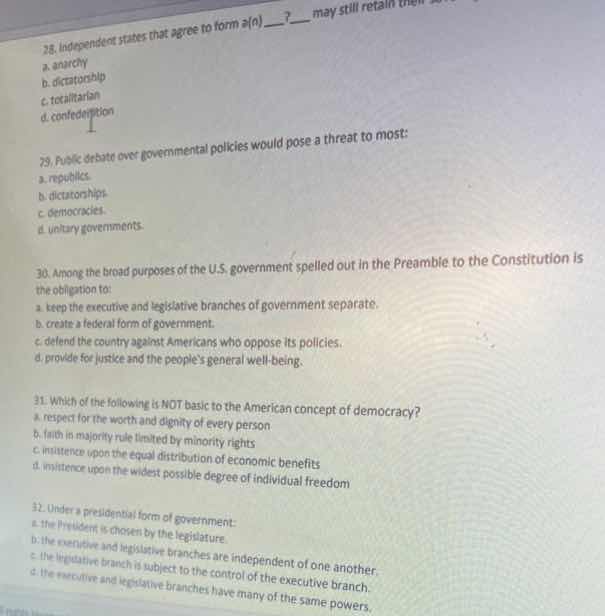
- independent states that agree to form a(n) ___ may still retain their a. anarchy b. dictatorship c. totalitarian d. confederation 29. public debate over governmental policies would pose a threat to most: a. republics b. dictatorships c. democracies d. unitary governments 30. among the broad purposes of the u.s. government spelled out in the preamble to the constitution is the obligation to: a. keep the executive and legislative branches of government separate. b. create a federal form of government. c. defend the country against americans who oppose its policies. d. provide for justice and the people’s general well - being. 31. which of the following is not basic to the american concept of democracy? a. respect for the worth and dignity of every person b. faith in majority rule limited by minority rights c. insistence upon the equal distribution of economic benefits d. insistence upon the widest possible degrees of individual freedom 32. under a presidential form of government: a. the president is chosen by the legislature. b. the executive and legislative branches are independent of one another. c. the legislative branch is subject to the control of the executive branch. d. the executive and legislative branches have many of the same powers.
Response
Question 28
Brief Explanations
To solve this, we analyze each option:
- a. anarchy: Anarchy is a state of no government, so independent states forming anarchy doesn't make sense.
- b. dictatorship: A dictatorship is a single - ruler system, not something independent states form together.
- c. totalitarian: Totalitarian is a type of government control, not a form formed by independent states.
- d. confederation: A confederation is an association of independent states that agree to work together while retaining their sovereignty. So this fits.
Brief Explanations
Let's analyze each option:
- a. republics: Republics can have public debate as it's part of democratic - like processes in many republics.
- b. dictatorships: In a dictatorship, the ruler has absolute power. Public debate over policies would challenge the dictator's authority, so it poses a threat.
- c. democracies: Public debate is a core part of democracies, so it's not a threat.
- d. unitary governments: Unitary governments can still have public debate as they are about centralization of power, not suppression of debate.
Brief Explanations
We refer to the Preamble of the U.S. Constitution:
- a. keep the executive and legislative branches separate: The separation of powers is about the structure of government, not a purpose in the Preamble.
- b. create a federal form of government: The Preamble is about the general purposes like justice, welfare, etc., not creating a federal form (that's more about the structure of the government system).
- c. defend the country against Americans who oppose its policies: The Preamble is about the well - being of the people and justice, not defending against dissenting Americans.
- d. provide for justice and the people’s general well - being: This is one of the main purposes stated in the Preamble (e.g., "establish Justice, insure domestic Tranquility, provide for the common defence, promote the general Welfare...").

Snap & solve any problem in the app
Get step-by-step solutions on Sovi AI
Photo-based solutions with guided steps
Explore more problems and detailed explanations
d. confederation