QUESTION IMAGE
Question
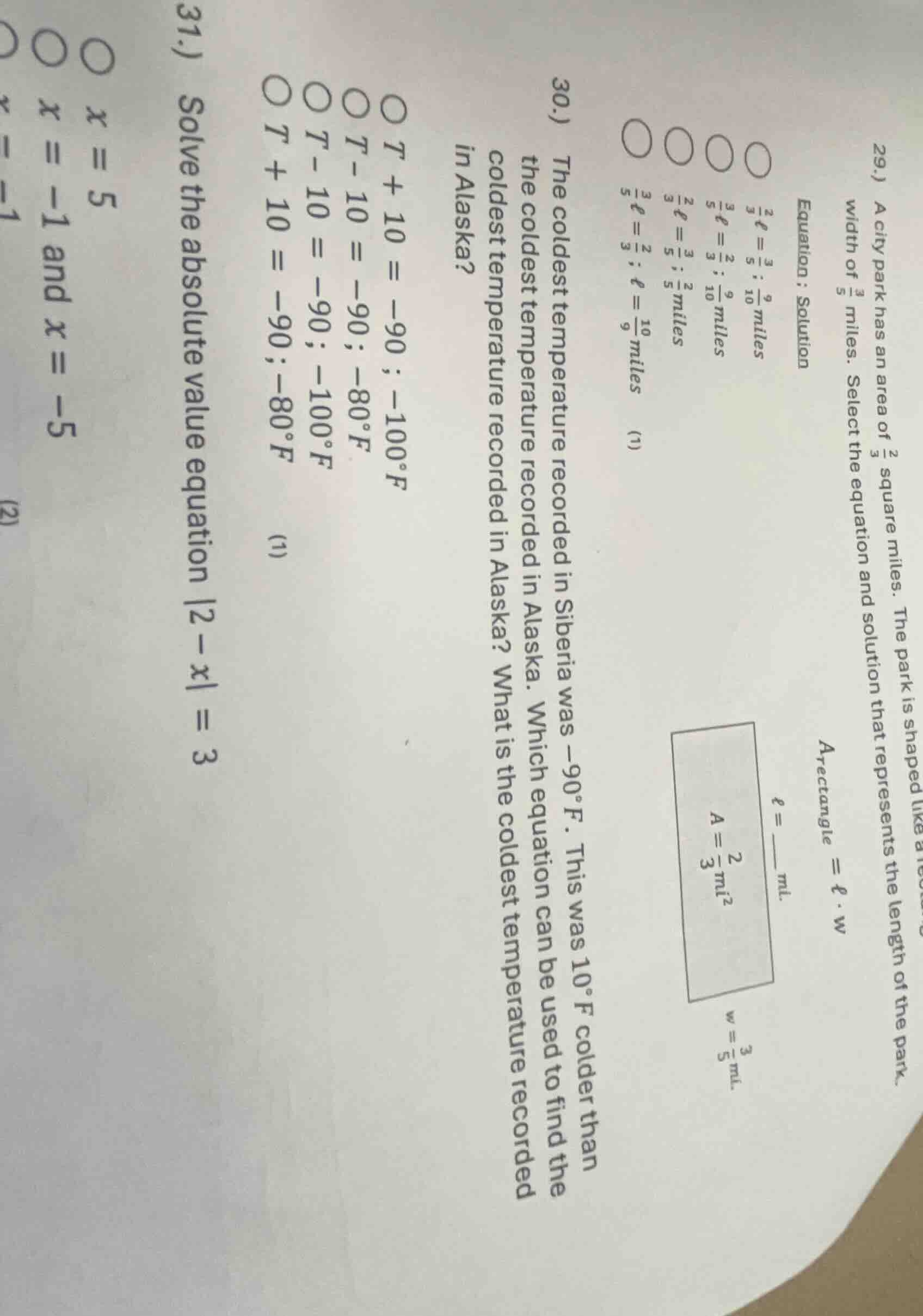
29.) a city park has an area of \\( \frac{2}{3} \\) square miles. the park is shaped like a rectangle. the width of the park is \\( \frac{3}{5} \\) miles. select the equation and solution that represents the length of the park.
a rectangle: \\( a = \ell \cdot w \\), where \\( a = \frac{2}{3} \text{mi}^2 \\), \\( w = \frac{3}{5} \text{mi} \\), \\( \ell = \underline{\quad\quad} \text{mi} \\).
equation; solution
\\( \frac{2}{3} \ell = \frac{3}{5} \\); \\( \frac{9}{10} \\) miles
\\( \frac{3}{5} \ell = \frac{2}{3} \\); \\( \frac{9}{10} \\) miles
\\( \frac{2}{3} \ell = \frac{3}{5} \\); \\( \frac{2}{5} \\) miles
\\( \frac{3}{5} \ell = \frac{2}{3} \\); \\( \frac{10}{9} \\) miles
30.) the coldest temperature recorded in siberia was \\( -90^{\circ} \text{f} \\). this was \\( 10^{\circ} \text{f} \\) colder than the coldest temperature recorded in alaska. which equation can be used to find the coldest temperature recorded in alaska? what is the coldest temperature recorded in alaska?
\\( t + 10 = -90 \\); \\( -100^{\circ} \text{f} \\)
\\( t - 10 = -90 \\); \\( -80^{\circ} \text{f} \\)
\\( t - 10 = -90 \\); \\( -100^{\circ} \text{f} \\)
\\( t + 10 = -90 \\); \\( -80^{\circ} \text{f} \\)
31.) solve the absolute value equation \\( |2 - x| = 3 \\)
\\( x = 5 \\)
\\( x = -1 \\) and \\( x = -5 \\)
\\( x = -1 \\)
Question 29:
Step1: Recall the area formula for a rectangle
The area \( A \) of a rectangle is given by \( A = \ell \cdot w \), where \( \ell \) is the length and \( w \) is the width. We know \( A = \frac{2}{3} \) square miles and \( w = \frac{3}{5} \) miles. We need to solve for \( \ell \). So we start with the formula \( \frac{2}{3} = \ell \cdot \frac{3}{5} \).
Step2: Solve for \( \ell \)
To solve for \( \ell \), we divide both sides of the equation by \( \frac{3}{5} \), which is the same as multiplying by its reciprocal \( \frac{5}{3} \). So \( \ell=\frac{2}{3}\div\frac{3}{5}=\frac{2}{3}\times\frac{5}{3}=\frac{10}{9} \)? Wait, no, wait. Wait, the area formula: \( A = \ell \times w \), so \( \ell=\frac{A}{w} \). Given \( A = \frac{2}{3} \) and \( w=\frac{3}{5} \), then \( \ell=\frac{\frac{2}{3}}{\frac{3}{5}}=\frac{2}{3}\times\frac{5}{3}=\frac{10}{9} \)? Wait, but let's check the options. Wait, the options are:
- \( \frac{2}{3}\ell=\frac{3}{5} \); \( \frac{9}{10} \) miles
- \( \frac{3}{5}\ell=\frac{2}{3} \); \( \frac{9}{10} \) miles
- \( \frac{2}{3}\ell=\frac{3}{5} \); \( \frac{2}{5} \) miles
- \( \frac{3}{5}\ell=\frac{2}{3} \); \( \frac{10}{9} \) miles
Wait, let's do it again. \( A = \ell \times w \), so \( \frac{2}{3}=\ell\times\frac{3}{5} \). To solve for \( \ell \), we can write the equation as \( \frac{3}{5}\ell=\frac{2}{3} \) (by rearranging, since multiplication is commutative, \( \ell\times\frac{3}{5}=\frac{3}{5}\ell \)). Then, solving for \( \ell \), we multiply both sides by \( \frac{5}{3} \): \( \ell=\frac{2}{3}\times\frac{5}{3}=\frac{10}{9} \)? Wait, no, \( \frac{2}{3}\div\frac{3}{5}=\frac{2}{3}\times\frac{5}{3}=\frac{10}{9} \). Wait, but the fourth option is \( \frac{3}{5}\ell=\frac{2}{3} \); \( \frac{10}{9} \) miles. Wait, maybe I made a mistake earlier. Let's re-express the equation. \( A = \ell \times w \), so \( \frac{2}{3} = \ell \times \frac{3}{5} \). So to solve for \( \ell \), we have \( \ell=\frac{2}{3}\div\frac{3}{5}=\frac{2}{3}\times\frac{5}{3}=\frac{10}{9} \). And the equation is \( \frac{3}{5}\ell=\frac{2}{3} \) (since \( \ell\times\frac{3}{5}=\frac{3}{5}\ell \)). So the correct equation and solution is \( \frac{3}{5}\ell=\frac{2}{3} \); \( \ell=\frac{10}{9} \) miles, which is the fourth option.
Step1: Define the relationship
Let \( T \) be the coldest temperature in Alaska. The temperature in Siberia (\( -90^\circ F \)) is \( 10^\circ F \) colder than in Alaska. So "colder" means the Siberian temperature is \( T - 10 \) (since it's 10 degrees colder than Alaska's temperature \( T \)). So we have the equation \( T - 10=-90 \).
Step2: Solve for \( T \)
To solve for \( T \), we add 10 to both sides of the equation: \( T=-90 + 10=-80 \). So the equation is \( T - 10=-90 \) and the solution is \( T=-80^\circ F \), which is the third option.
Step1: Recall the absolute value equation property
For an absolute value equation \( |a| = b \) (where \( b\geq0 \)), we have \( a = b \) or \( a=-b \). So for \( |2 - x| = 3 \), we can split it into two cases:
Case 1: \( 2 - x = 3 \)
Case 2: \( 2 - x=-3 \)
Step2: Solve Case 1
For Case 1: \( 2 - x = 3 \). Subtract 2 from both sides: \( -x = 3 - 2 = 1 \). Multiply both sides by -1: \( x=-1 \).
Step3: Solve Case 2
For Case 2: \( 2 - x=-3 \). Subtract 2 from both sides: \( -x=-3 - 2=-5 \). Multiply both sides by -1: \( x = 5 \).
So the solutions are \( x = 5 \) and \( x=-1 \).

Snap & solve any problem in the app
Get step-by-step solutions on Sovi AI
Photo-based solutions with guided steps
Explore more problems and detailed explanations
The correct option is the one with equation \( \frac{3}{5}\ell=\frac{2}{3} \) and solution \( \frac{10}{9} \) miles (the fourth option, but since the options are:
- \( \frac{2}{3}\ell=\frac{3}{5} \); \( \frac{9}{10} \) miles
- \( \frac{3}{5}\ell=\frac{2}{3} \); \( \frac{9}{10} \) miles
- \( \frac{2}{3}\ell=\frac{3}{5} \); \( \frac{2}{5} \) miles
- \( \frac{3}{5}\ell=\frac{2}{3} \); \( \frac{10}{9} \) miles
So the correct one is the fourth option: \( \frac{3}{5}\ell=\frac{2}{3} \); \( \frac{10}{9} \) miles.