QUESTION IMAGE
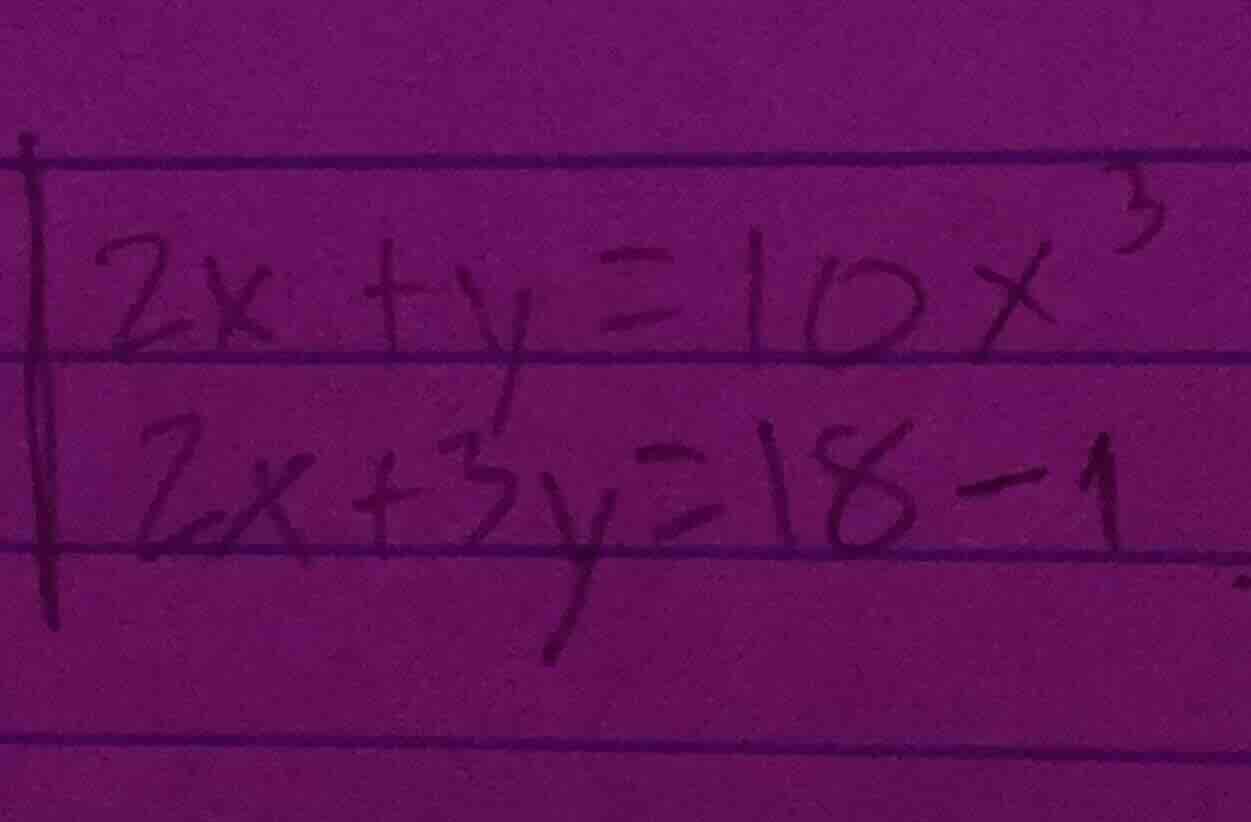
Question
2x + y = 10x³
2x + 3y = 18 - 1
First, we simplify the equations. The first equation is \(2x + y = 10x^3\) (wait, maybe there's a typo? If it's \(2x + y = 10\) and the second is \(2x + 3y = 17\) (since \(18 - 1 = 17\)), we can use elimination. Subtract the first equation from the second: \((2x + 3y) - (2x + y) = 17 - 10\).
Step1: Simplify the second equation
The second equation \(2x + 3y = 18 - 1\) simplifies to \(2x + 3y = 17\).
Step2: Subtract the first equation from the second
Let the first equation be \(2x + y = 10\) (assuming the \(x^3\) is a typo). Then:
\[
\]
Step3: Substitute y back into the first equation
Substitute \(y = 3.5\) into \(2x + y = 10\):
\[
\]
If the first equation is indeed \(2x + y = 10x^3\), the problem becomes more complex (cubic equation), but the second equation is linear. Assuming a linear system (typo in \(x^3\)), the solution is as above.

Snap & solve any problem in the app
Get step-by-step solutions on Sovi AI
Photo-based solutions with guided steps
Explore more problems and detailed explanations
If the system is linear (correcting \(10x^3\) to \(10\)): \(x = 3.25\), \(y = 3.5\) (or \(x = \frac{13}{4}\), \(y = \frac{7}{2}\))