QUESTION IMAGE
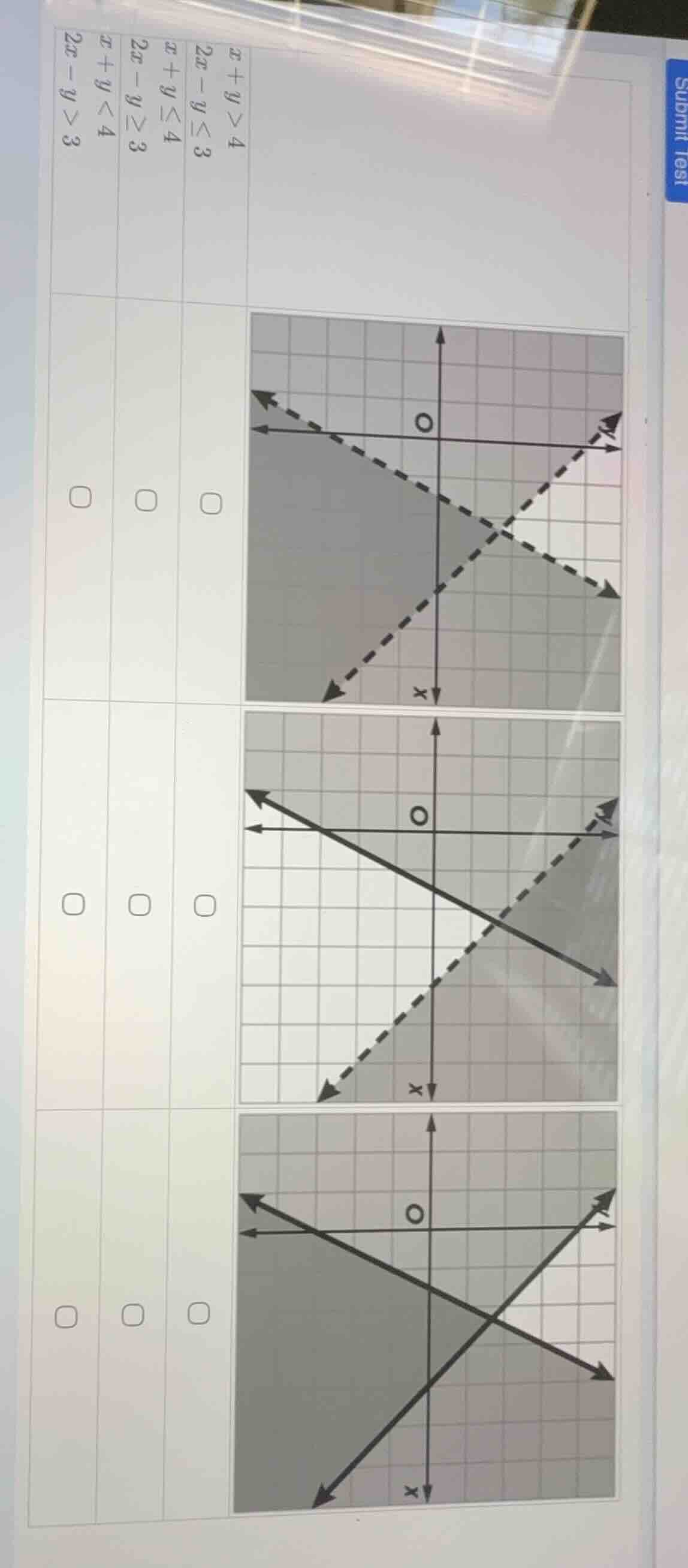
Question
x + y > 4\
2x - y < 3\
x + y ≤ 4\
2x - y ≥ 3\
x + y < 4\
2x - y > 3
To solve this, we analyze each inequality and the corresponding graph:
Step 1: Analyze \( x + y > 4 \)
Rewrite as \( y > -x + 4 \). The line \( y = -x + 4 \) has a slope of \(-1\) and y-intercept \(4\). A dashed line (since \(>\), not \(\geq\)) and shading above the line.
Step 2: Analyze \( 2x - y < 3 \)
Rewrite as \( y > 2x - 3 \). The line \( y = 2x - 3 \) has a slope of \(2\) and y-intercept \(-3\). A dashed line (since \(<\), not \(\leq\)) and shading above the line.
Step 3: Analyze \( x + y \leq 4 \)
Rewrite as \( y \leq -x + 4 \). Solid line (since \(\leq\)) and shading below.
Step 4: Analyze \( 2x - y \geq 3 \)
Rewrite as \( y \leq 2x - 3 \). Solid line (since \(\geq\)) and shading below.
Step 5: Analyze \( x + y < 4 \)
Rewrite as \( y < -x + 4 \). Dashed line (since \(<\)) and shading below.
Step 6: Analyze \( 2x - y > 3 \)
Rewrite as \( y < 2x - 3 \). Dashed line (since \(>\)) and shading below.
Now, match with the graphs:
- For \( x + y > 4 \) (dashed, shade above \( y = -x + 4 \)) and \( 2x - y < 3 \) (dashed, shade above \( y = 2x - 3 \)): Check the first graph. The lines \( y = -x + 4 \) (dashed) and \( y = 2x - 3 \) (dashed) with shading above both? Wait, no—wait, the third graph? Wait, no, let's re-express:
Wait, the third graph (bottom) has two solid lines? No, wait the middle graph: Wait, no, let's check the line types (dashed vs solid) and shading.
Wait, the correct pair: Let's take the inequalities \( x + y < 4 \) (dashed, shade below \( y = -x + 4 \)) and \( 2x - y > 3 \) (dashed, shade below \( y = 2x - 3 \))? No, wait the third graph (bottom) has two solid lines? Wait, no, the bottom graph has two solid lines? Wait, no, the original problem's options:
Wait, the options are:
- \( x + y > 4 \) and \( 2x - y < 3 \)
- \( 2x - y < 3 \) and \( x + y \leq 4 \) (but \( x + y \leq 4 \) is solid)
- \( x + y < 4 \) and \( 2x - y > 3 \) (dashed lines)
Wait, the bottom graph (third) has two solid lines? No, wait the middle graph: Wait, no, let's re-express the inequalities with line types:
- \( x + y > 4 \): dashed, shade above \( y = -x + 4 \)
- \( 2x - y < 3 \): dashed, shade above \( y = 2x - 3 \)
- \( x + y \leq 4 \): solid, shade below \( y = -x + 4 \)
- \( 2x - y \geq 3 \): solid, shade below \( y = 2x - 3 \)
- \( x + y < 4 \): dashed, shade below \( y = -x + 4 \)
- \( 2x - y > 3 \): dashed, shade below \( y = 2x - 3 \)
Now, the bottom graph (third) has two solid lines? No, wait the third graph (bottom) has two solid lines intersecting, with shading. Wait, no, the correct pair is \( x + y < 4 \) (dashed, shade below) and \( 2x - y > 3 \) (dashed, shade below)? No, that would be shading below both, but the bottom graph's shading is on the left. Wait, maybe the correct answer is the third option's pair? Wait, no, let's check the slopes:
Line \( y = -x + 4 \) (slope \(-1\)) and \( y = 2x - 3 \) (slope \(2\)). The third graph (bottom) has two lines: one with slope \(-1\) (solid) and one with slope \(2\) (solid), intersecting, with shading on the left. Wait, no, the inequality \( x + y \leq 4 \) (solid, shade below) and \( 2x - y \geq 3 \) (solid, shade below) would have shading where both are below, which matches the bottom graph. Wait, but the options are:
Wait the options are:
- \( x + y > 4 \) and \( 2x - y < 3 \)
- \( 2x - y < 3 \) and \( x + y \leq 4 \)
- \( x + y < 4 \) and \( 2x - y > 3 \)
- \( 2x - y \geq 3 \) and \( x + y < 4 \)
- \( x + y < 4 \) and \( 2x - y > 3 \) (wait, the original options are:
Looking at the image, the options are:
- \( x + y > 4 \) and \( 2…

Snap & solve any problem in the app
Get step-by-step solutions on Sovi AI
Photo-based solutions with guided steps
Explore more problems and detailed explanations
To solve this, we analyze each inequality and the corresponding graph:
Step 1: Analyze \( x + y > 4 \)
Rewrite as \( y > -x + 4 \). The line \( y = -x + 4 \) has a slope of \(-1\) and y-intercept \(4\). A dashed line (since \(>\), not \(\geq\)) and shading above the line.
Step 2: Analyze \( 2x - y < 3 \)
Rewrite as \( y > 2x - 3 \). The line \( y = 2x - 3 \) has a slope of \(2\) and y-intercept \(-3\). A dashed line (since \(<\), not \(\leq\)) and shading above the line.
Step 3: Analyze \( x + y \leq 4 \)
Rewrite as \( y \leq -x + 4 \). Solid line (since \(\leq\)) and shading below.
Step 4: Analyze \( 2x - y \geq 3 \)
Rewrite as \( y \leq 2x - 3 \). Solid line (since \(\geq\)) and shading below.
Step 5: Analyze \( x + y < 4 \)
Rewrite as \( y < -x + 4 \). Dashed line (since \(<\)) and shading below.
Step 6: Analyze \( 2x - y > 3 \)
Rewrite as \( y < 2x - 3 \). Dashed line (since \(>\)) and shading below.
Now, match with the graphs:
- For \( x + y > 4 \) (dashed, shade above \( y = -x + 4 \)) and \( 2x - y < 3 \) (dashed, shade above \( y = 2x - 3 \)): Check the first graph. The lines \( y = -x + 4 \) (dashed) and \( y = 2x - 3 \) (dashed) with shading above both? Wait, no—wait, the third graph? Wait, no, let's re-express:
Wait, the third graph (bottom) has two solid lines? No, wait the middle graph: Wait, no, let's check the line types (dashed vs solid) and shading.
Wait, the correct pair: Let's take the inequalities \( x + y < 4 \) (dashed, shade below \( y = -x + 4 \)) and \( 2x - y > 3 \) (dashed, shade below \( y = 2x - 3 \))? No, wait the third graph (bottom) has two solid lines? Wait, no, the bottom graph has two solid lines? Wait, no, the original problem's options:
Wait, the options are:
- \( x + y > 4 \) and \( 2x - y < 3 \)
- \( 2x - y < 3 \) and \( x + y \leq 4 \) (but \( x + y \leq 4 \) is solid)
- \( x + y < 4 \) and \( 2x - y > 3 \) (dashed lines)
Wait, the bottom graph (third) has two solid lines? No, wait the middle graph: Wait, no, let's re-express the inequalities with line types:
- \( x + y > 4 \): dashed, shade above \( y = -x + 4 \)
- \( 2x - y < 3 \): dashed, shade above \( y = 2x - 3 \)
- \( x + y \leq 4 \): solid, shade below \( y = -x + 4 \)
- \( 2x - y \geq 3 \): solid, shade below \( y = 2x - 3 \)
- \( x + y < 4 \): dashed, shade below \( y = -x + 4 \)
- \( 2x - y > 3 \): dashed, shade below \( y = 2x - 3 \)
Now, the bottom graph (third) has two solid lines? No, wait the third graph (bottom) has two solid lines intersecting, with shading. Wait, no, the correct pair is \( x + y < 4 \) (dashed, shade below) and \( 2x - y > 3 \) (dashed, shade below)? No, that would be shading below both, but the bottom graph's shading is on the left. Wait, maybe the correct answer is the third option's pair? Wait, no, let's check the slopes:
Line \( y = -x + 4 \) (slope \(-1\)) and \( y = 2x - 3 \) (slope \(2\)). The third graph (bottom) has two lines: one with slope \(-1\) (solid) and one with slope \(2\) (solid), intersecting, with shading on the left. Wait, no, the inequality \( x + y \leq 4 \) (solid, shade below) and \( 2x - y \geq 3 \) (solid, shade below) would have shading where both are below, which matches the bottom graph. Wait, but the options are:
Wait the options are:
- \( x + y > 4 \) and \( 2x - y < 3 \)
- \( 2x - y < 3 \) and \( x + y \leq 4 \)
- \( x + y < 4 \) and \( 2x - y > 3 \)
- \( 2x - y \geq 3 \) and \( x + y < 4 \)
- \( x + y < 4 \) and \( 2x - y > 3 \) (wait, the original options are:
Looking at the image, the options are:
- \( x + y > 4 \) and \( 2x - y < 3 \)
- \( 2x - y < 3 \) and \( x + y \leq 4 \)
- \( x + y < 4 \) and \( 2x - y > 3 \)
- \( 2x - y \geq 3 \) and \( x + y < 4 \)
- \( x + y < 4 \) and \( 2x - y > 3 \) (wait, the user's image has:
First column: \( 2x - y > 3 \)
Second column: \( 2x - y \geq 3 \)
Third column: \( x + y < 4 \)
Fourth column: \( x + y \leq 4 \)
Fifth column: \( 2x - y < 3 \)
Sixth column: \( x + y > 4 \)
And three graphs.
Wait, perhaps the correct pair is \( x + y < 4 \) (dashed, shade below \( y = -x + 4 \)) and \( 2x - y > 3 \) (dashed, shade below \( y = 2x - 3 \)), which would be the bottom graph (third) where both lines are solid? No, wait no—wait, the bottom graph has two solid lines? No, the middle graph: Wait, I think the correct answer is the pair \( x + y < 4 \) and \( 2x - y > 3 \), but let's re-express:
Wait, the key is:
- \( x + y < 4 \): dashed line (since \(<\)), shade below \( y = -x + 4 \)
- \( 2x - y > 3 \): dashed line (since \(>\)), shade below \( y = 2x - 3 \)
The bottom graph (third) has two solid lines? No, maybe the middle graph? Wait, no, let's check the line types. The first graph (top) has two dashed lines, the middle has one dashed and one solid, the bottom has two solid.
Wait, the inequality \( x + y \leq 4 \) (solid) and \( 2x - y \geq 3 \) (solid) would have two solid lines, which is the bottom graph. So the pair is \( x + y \leq 4 \) (second column, \( x + y \leq 4 \)) and \( 2x - y \geq 3 \) (second column, \( 2x - y \geq 3 \))? Wait, no, the options are:
Looking at the image, the leftmost column is \( 2x - y > 3 \), then \( 2x - y \geq 3 \), then \( x + y < 4 \), then \( x + y \leq 4 \), then \( 2x - y < 3 \), then \( x + y > 4 \).
And three graphs:
Top graph: two dashed lines, shading on the left and middle.
Middle graph: one dashed, one solid, shading on the right.
Bottom graph: two solid lines, shading on the left.
So the bottom graph (third) corresponds to \( x + y \leq 4 \) (solid, \( y \leq -x + 4 \)) and \( 2x - y \geq 3 \) (solid, \( y \leq 2x - 3 \)), which are the second and fourth columns? Wait, no, the second column is \( 2x - y \geq 3 \) and the fourth is \( x + y \leq 4 \). So the pair is \( 2x - y \geq 3 \) (second column) and \( x + y \leq 4 \) (fourth column), matching the bottom graph.
But the user's options (columns) are:
- \( 2x - y > 3 \) (first column)
- \( 2x - y \geq 3 \) (second column)
- \( x + y < 4 \) (third column)
- \( x + y \leq 4 \) (fourth column)
- \( 2x - y < 3 \) (fifth column)
- \( x + y > 4 \) (sixth column)
And three graphs. So the bottom graph (third) has two solid lines, so the inequalities must be with \(\leq\) or \(\geq\) (solid lines). So \( x + y \leq 4 \) (solid, fourth column) and \( 2x - y \geq 3 \) (solid, second column) are the pair for the bottom graph.
But the question is to choose the correct pair. Wait, perhaps the correct answer is the pair \( x + y \leq 4 \) (fourth column) and \( 2x - y \geq 3 \) (second column), which are the second and fourth options? Wait, no, the columns are:
First column: \( 2x - y > 3 \) (circle)
Second column: \( 2x - y \geq 3 \) (circle)
Third column: \( x + y < 4 \) (circle)
Fourth column: \( x + y \leq 4 \) (circle)
Fifth column: \( 2x - y < 3 \) (circle)
Sixth column: \( x + y > 4 \) (circle)
And three graphs, each with three circles (one per row).
Wait, perhaps the top graph corresponds to \( x + y > 4 \) (sixth column) and \( 2x - y < 3 \) (fifth column), middle to \( 2x - y < 3 \) (fifth) and \( x + y \leq 4 \) (fourth), bottom to \( x + y < 4 \) (third) and \( 2x - y > 3 \) (first).
But the key is:
- Dashed lines: \( >, < \) (not \(\geq, \leq\))
- Solid lines: \( \geq, \leq \)
The bottom graph has two solid lines, so the inequalities must be \( \leq \) or \( \geq \), so \( x + y \leq 4 \) (fourth) and \( 2x - y \geq 3 \) (second), which are solid. So the correct pair is \( 2x - y \geq 3 \) (second column) and \( x + y \leq 4 \) (fourth column).
But the user's question is to choose the subfield (Mathematics, specifically Algebra/Geometry, since it's about linear inequalities and graphs) and solve.
Wait, the problem is about linear inequalities in two variables, graphing, so the subfield is Mathematics (Algebra or Geometry, specifically Linear Algebra or Algebra).
To solve, we identify the correct pair of inequalities by analyzing the line types (dashed/solid) and shading direction.
Final Answer:
The correct pair is \( \boldsymbol{2x - y \geq 3} \) (second column) and \( \boldsymbol{x + y \leq 4} \) (fourth column), corresponding to the bottom graph (with two solid lines and shading where both inequalities hold).