QUESTION IMAGE
Question
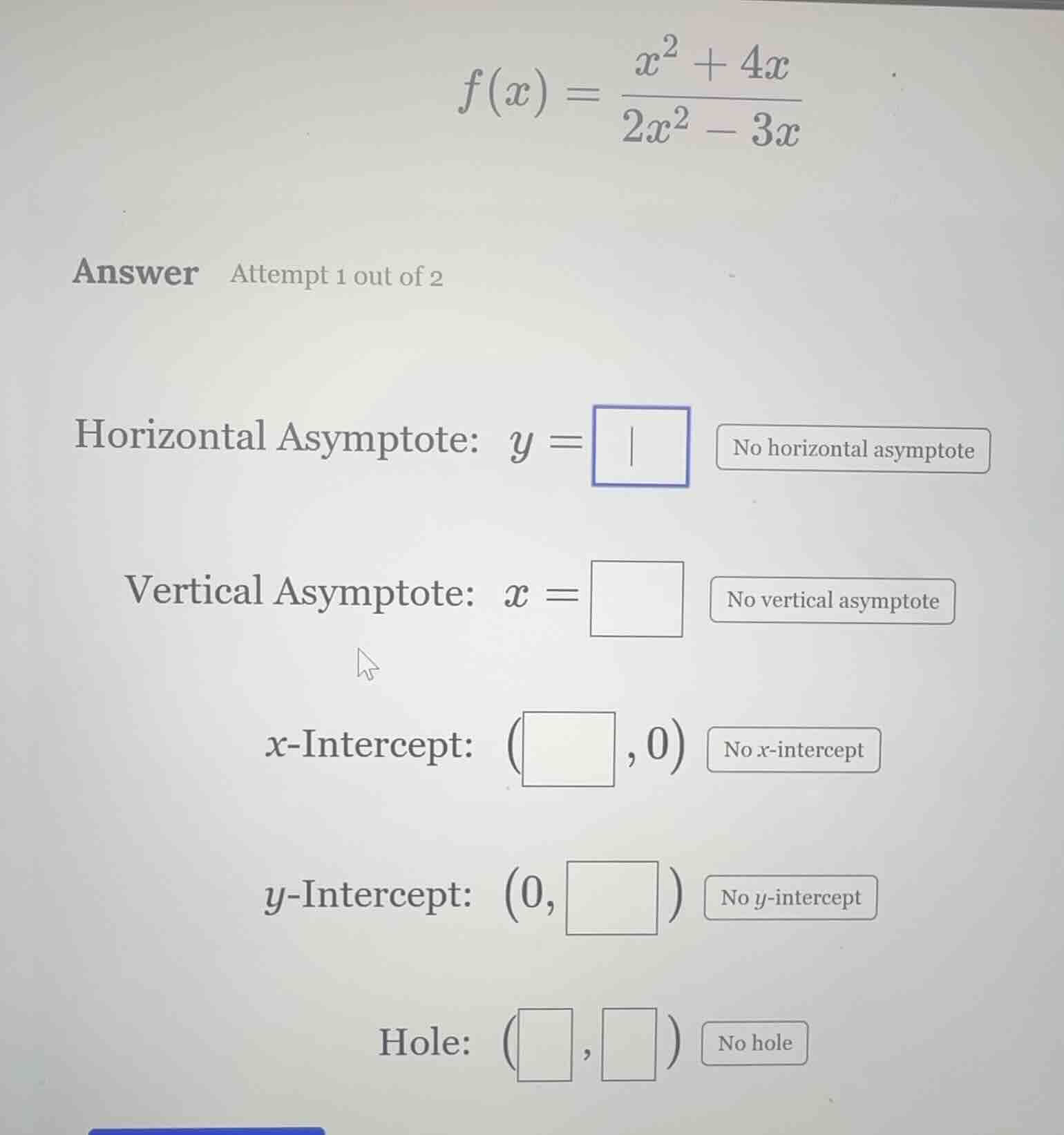
f(x) = \frac{x^2 + 4x}{2x^2 - 3x}
answer attempt 1 out of 2
horizontal asymptote: y = \boxed{} \text{no horizontal asymptote}
vertical asymptote: x = \boxed{} \text{no vertical asymptote}
x-intercept: (\boxed{}, 0) \text{no } x\text{-intercept}
y-intercept: (0, \boxed{}) \text{no } y\text{-intercept}
hole: (\boxed{}, \boxed{}) \text{no hole}
Step1: Simplify the function
First, factor the numerator and the denominator:
- Numerator: \(x^2 + 4x = x(x + 4)\)
- Denominator: \(2x^2 - 3x = x(2x - 3)\)
So, \(f(x)=\frac{x(x + 4)}{x(2x - 3)}\), and we can cancel out the common factor \(x\) (for \(x
eq0\)), getting \(f(x)=\frac{x + 4}{2x - 3}\) (with a hole at \(x = 0\) since \(x = 0\) makes the original denominator zero but is canceled out).
Step2: Find Horizontal Asymptote
For a rational function \(f(x)=\frac{ax^n+...}{bx^m+...}\), if \(n = m\), the horizontal asymptote is \(y=\frac{a}{b}\). Here, after simplifying, the degree of numerator and denominator is 1 (both are linear), so \(a = 1\), \(b = 2\). Thus, horizontal asymptote is \(y=\frac{1}{2}\).
Step3: Find Vertical Asymptote
Vertical asymptotes occur where the simplified denominator is zero (and the numerator is not zero there). Set \(2x - 3=0\), solving for \(x\) gives \(x=\frac{3}{2}\).
Step4: Find x - Intercept
x - intercept is where \(f(x)=0\), so set the numerator of the simplified function equal to zero: \(x + 4=0\), so \(x=-4\). Thus, x - intercept is \((-4,0)\).
Step5: Find y - Intercept
y - intercept is where \(x = 0\), but the original function is undefined at \(x = 0\) (since plugging \(x = 0\) into original denominator gives 0, and even though we simplified, the hole is at \(x = 0\)), so there is no y - intercept.
Step6: Find Hole
The hole occurs at the x - value that made the original numerator and denominator zero (the canceled factor). We canceled \(x\), so when \(x = 0\), plug \(x = 0\) into the simplified function \(\frac{x + 4}{2x - 3}\) to get the y - coordinate: \(\frac{0 + 4}{2(0)-3}=\frac{4}{-3}=-\frac{4}{3}\). So the hole is at \((0,-\frac{4}{3})\).

Snap & solve any problem in the app
Get step-by-step solutions on Sovi AI
Photo-based solutions with guided steps
Explore more problems and detailed explanations
s:
Horizontal Asymptote: \(y=\frac{1}{2}\)
Vertical Asymptote: \(x=\frac{3}{2}\)
x - Intercept: \((-4,0)\)
y - Intercept: No y - intercept
Hole: \((0,-\frac{4}{3})\)