QUESTION IMAGE
Question
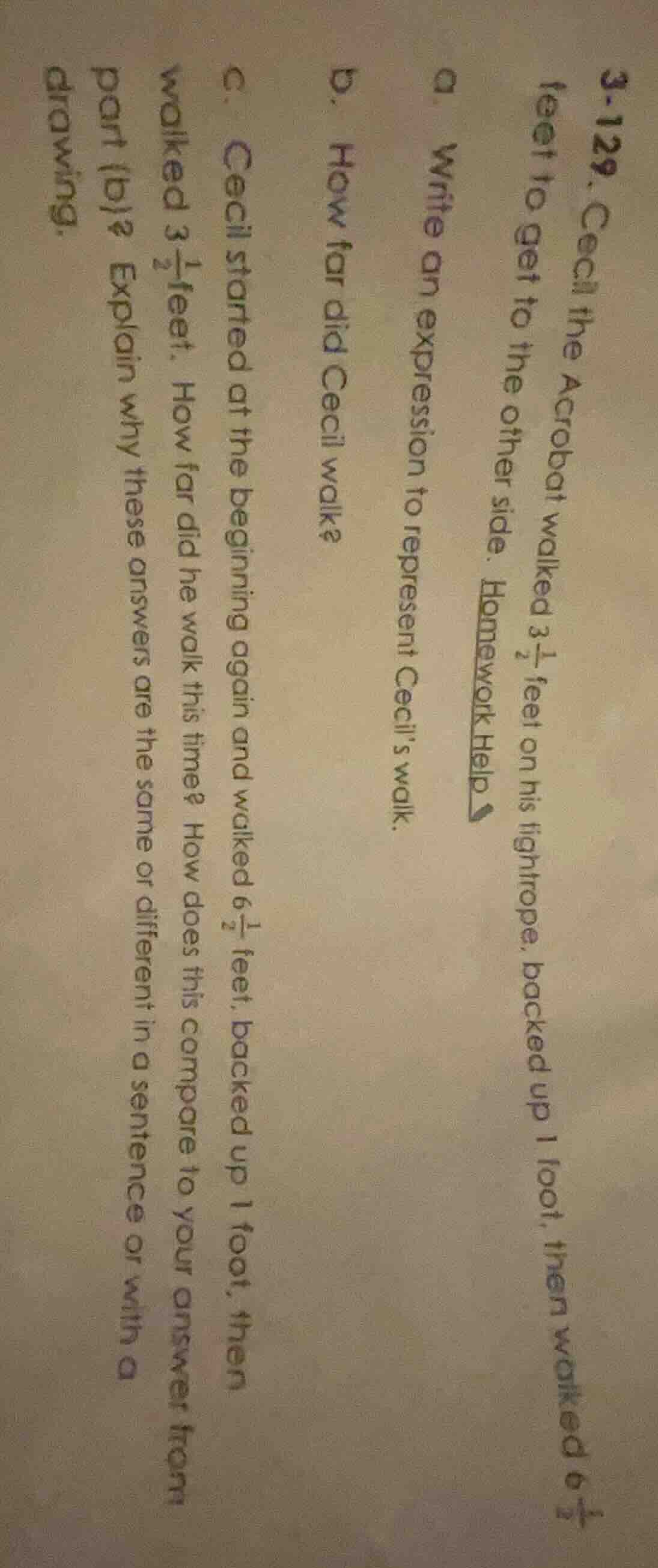
3-129. cecil the acrobat walked 3\frac{1}{2} feet on his tightrope, backed up 1 foot, then walked 6\frac{1}{2} feet to get to the other side. homework help
a. write an expression to represent cecil’s walk.
b. how far did cecil walk?
c. cecil started at the beginning again and walked 6\frac{1}{2} feet, backed up 1 foot, then walked 3\frac{1}{2} feet. how far did he walk this time? how does this compare to your answer from part (b)? explain why these answers are the same or different in a sentence or with a drawing.
Part (a)
Step 1: Identify the movements
Cecil walked \( 3\frac{1}{2} \) feet, then backed up 1 foot (which is a negative movement, so \( - 1 \)), then walked \( 6\frac{1}{2} \) feet.
Step 2: Write the expression
To represent the total walk, we add the distances of each movement. So the expression is \( 3\frac{1}{2}- 1 + 6\frac{1}{2} \).
Part (b)
Step 1: Convert mixed numbers to improper fractions (optional, but easier for calculation)
\( 3\frac{1}{2}=\frac{7}{2} \), \( 6\frac{1}{2}=\frac{13}{2} \)
Step 2: Substitute into the expression and calculate
\( \frac{7}{2}-1+\frac{13}{2}=\frac{7}{2}-\frac{2}{2}+\frac{13}{2}=\frac{7 - 2+13}{2}=\frac{18}{2} = 9 \)
Or we can use the commutative property: \( 3\frac{1}{2}+6\frac{1}{2}-1=(3\frac{1}{2}+6\frac{1}{2})-1 = 10 - 1=9 \)
Part (c)
Step 1: Calculate the distance for this walk
Cecil walked \( 6\frac{1}{2} \) feet, backed up 1 foot, then walked \( 3\frac{1}{2} \) feet. The expression is \( 6\frac{1}{2}-1 + 3\frac{1}{2} \)
Step 2: Calculate the value
Using the commutative property: \( 6\frac{1}{2}+3\frac{1}{2}-1=(6\frac{1}{2}+3\frac{1}{2})-1 = 10 - 1 = 9 \)
Step 3: Compare with part (b)
The answers are the same because addition is commutative, so the order of adding the positive distances (walking forward) does not matter, and we are subtracting the same backward distance (1 foot) in both cases. So the total distance walked is the same.

Snap & solve any problem in the app
Get step-by-step solutions on Sovi AI
Photo-based solutions with guided steps
Explore more problems and detailed explanations
s:
a. The expression is \( \boldsymbol{3\frac{1}{2}-1 + 6\frac{1}{2}} \)
b. Cecil walked \(\boldsymbol{9}\) feet.
c. He walked 9 feet this time. The answers are the same as part (b) because addition is commutative, so the order of adding the forward - walking distances doesn't affect the total, and the backward distance subtracted is the same.