QUESTION IMAGE
Question
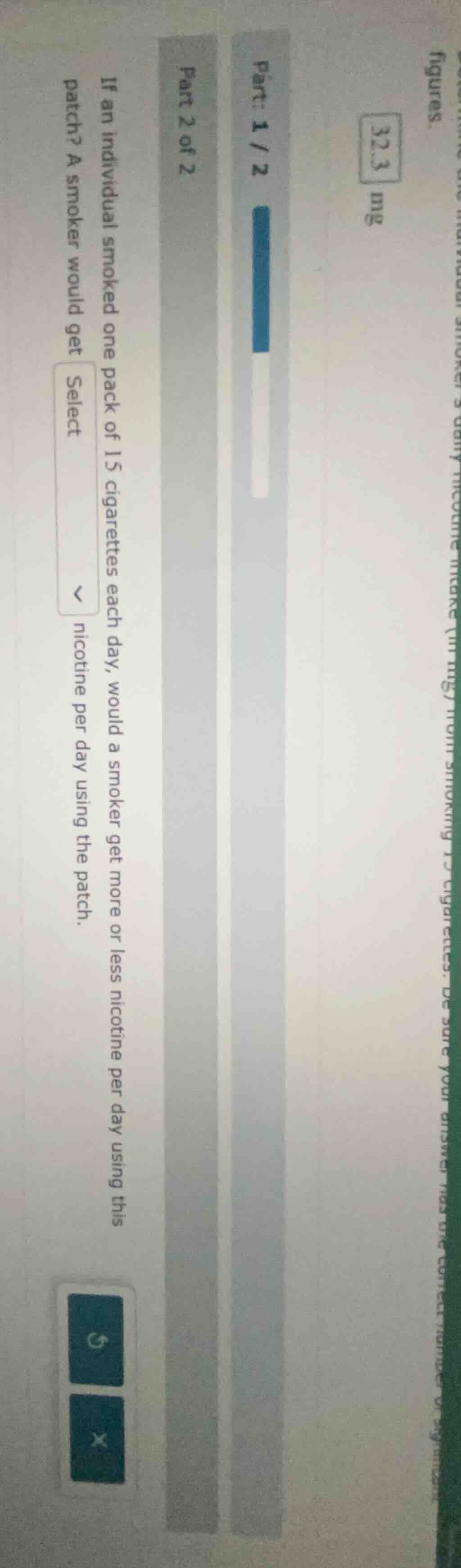
32.3 mg
part: 1 / 2
part 2 of 2
if an individual smoked one pack of 15 cigarettes each day, would a smoker get more or less nicotine per day using this patch? a smoker would get select
nicotine per day using the patch.
First, we need to know the nicotine content per cigarette. Usually, a single cigarette contains about 1 - 2 mg of nicotine, but let's assume a common value (for example, if we take 1.1 mg per cigarette, but wait, maybe the previous part had some info. Wait, the first part might have been about the patch giving 32.3 mg? Wait, no, the second part: if an individual smokes one pack of 15 cigarettes each day, we need to calculate the total nicotine from smoking and compare to the patch (32.3 mg? Wait, maybe the first part was about the patch's nicotine, say 32.3 mg per day? Wait, let's re - read.
Wait, the problem: "If an individual smoked one pack of 15 cigarettes each day, would a smoker get more or less nicotine per day using this patch? A smoker would get [select] nicotine per day using the patch."
First, we need to find the total nicotine from smoking 15 cigarettes. Let's assume a typical nicotine per cigarette. Let's say a cigarette has about 1.1 mg of nicotine (this is a common approximation, but maybe the first part had a different value? Wait, maybe the first part was calculating something, but since we have part 2, let's proceed.
Step 1: Calculate nicotine from smoking
If there are 15 cigarettes in a pack and we assume each cigarette has, say, 1.1 mg of nicotine (but wait, maybe the correct value is different. Wait, maybe the first part was about the patch giving 32.3 mg? Wait, no, let's check the numbers. Wait, maybe the first part was a calculation, but since we need to compare, let's do:
Let's assume each cigarette has \( x \) mg of nicotine. Let's say from standard data, a cigarette has about 1 - 2 mg. Let's take a common value, say 1.1 mg per cigarette. Then total nicotine from 15 cigarettes is \( 15\times1.1 = 16.5 \) mg. But wait, maybe the patch is 32.3 mg? Wait, the first part's box has 32.3 mg. So if the patch is 32.3 mg and smoking 15 cigarettes: let's say each cigarette has, for example, 1.1 mg, 15*1.1 = 16.5 mg. Then 16.5 < 32.3, so the smoker would get less nicotine from smoking than from the patch? Wait, no, wait, maybe I got it reversed. Wait, no, the question is "would a smoker get more or less nicotine per day using this patch" – meaning, compare smoking to the patch. Wait, no: "would a smoker get more or less nicotine per day using this patch" – so smoking vs patch. Wait, no, the wording: "would a smoker get [more/less] nicotine per day using the patch" – so when using the patch, compared to smoking. Wait, no, the structure: "If an individual smoked one pack of 15 cigarettes each day, would a smoker get more or less nicotine per day using this patch? A smoker would get [select] nicotine per day using the patch."
Wait, let's correct. Let's say the patch delivers 32.3 mg per day (from the first part's box). Now, calculate nicotine from smoking 15 cigarettes. Let's assume a cigarette has, say, 1.1 mg of nicotine (this is a rough average, but maybe the actual value from the first part? Wait, maybe the first part was a miscalculation, but let's use standard values. Wait, no, maybe the correct approach is:
Suppose each cigarette has \( n \) mg of nicotine. Let's say from the problem's context, maybe the first part was about the patch's nicotine being 32.3 mg. Now, if we smoke 15 cigarettes, let's calculate total nicotine from smoking.
Let's take a more accurate value: a typical cigarette has about 1.1 mg of nicotine (this is an approximate value, but for the sake of calculation). Then total nicotine from 15 cigarettes is \( 15\times1.1=16.5 \) mg.
The patch is 32.3 mg. So 16.5 < 32.3. So the smoker would…

Snap & solve any problem in the app
Get step-by-step solutions on Sovi AI
Photo-based solutions with guided steps
Explore more problems and detailed explanations
more