QUESTION IMAGE
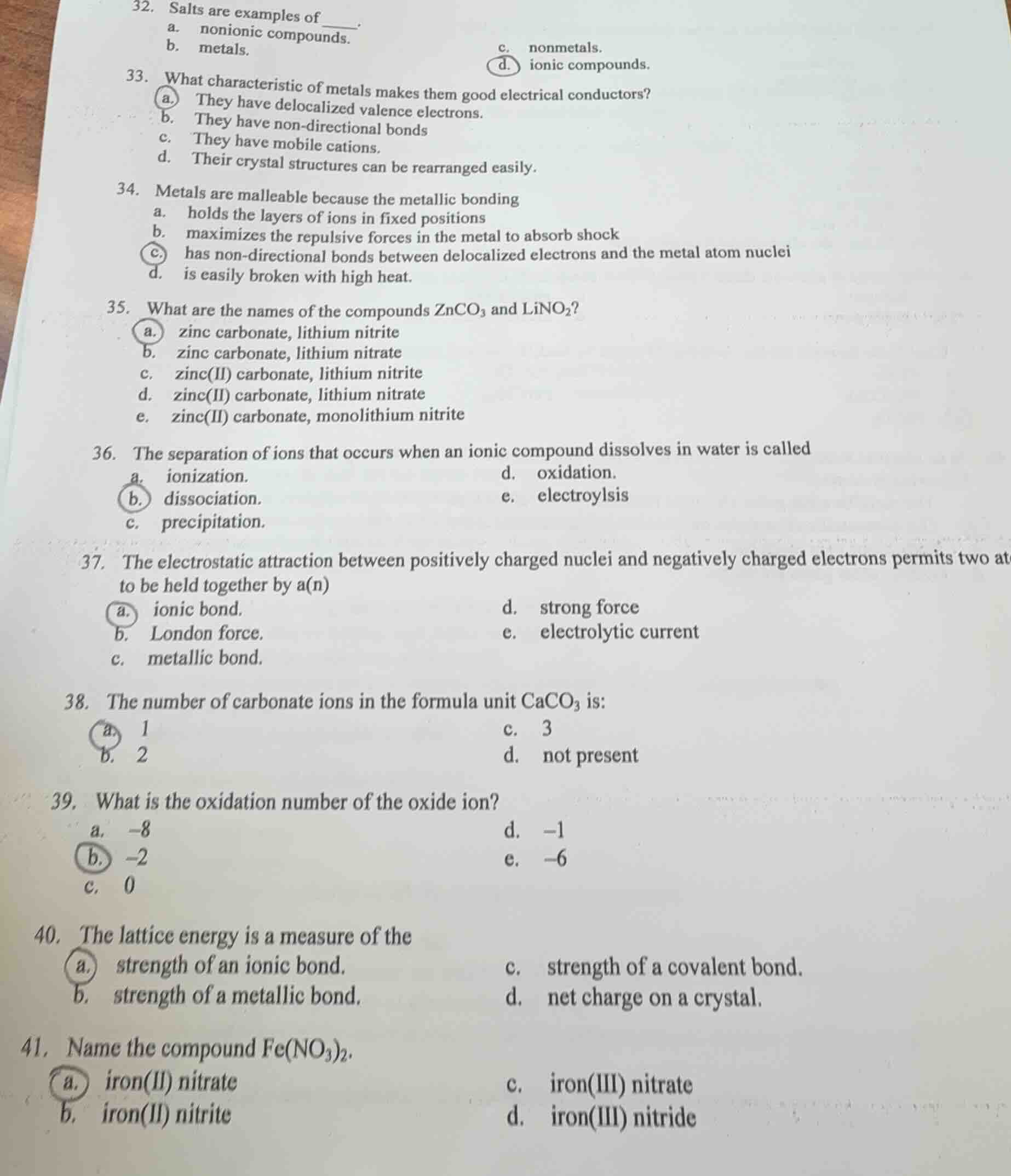
Question
- salts are examples of ____.
a. nonionic compounds.
b. metals.
c. nonmetals.
d. ionic compounds.
- what characteristic of metals makes them good electrical conductors?
a. they have delocalized valence electrons.
b. they have non - directional bonds
c. they have mobile cations.
d. their crystal structures can be rearranged easily.
- metals are malleable because the metallic bonding
a. holds the layers of ions in fixed positions
b. maximizes the repulsive forces in the metal to absorb shock
c. has non - directional bonds between delocalized electrons and the metal atom nuclei
d. is easily broken with high heat.
- what are the names of the compounds $znco_3$ and $lino_2$?
a. zinc carbonate, lithium nitrite
b. zinc carbonate, lithium nitrate
c. zinc(ii) carbonate, lithium nitrite
d. zinc(ii) carbonate, lithium nitrate
e. zinc(ii) carbonate, monolithium nitrite
- the separation of ions that occurs when an ionic compound dissolves in water is called
a. ionization.
b. dissociation.
c. precipitation.
d. oxidation.
e. electroylsis
- the electrostatic attraction between positively charged nuclei and negatively charged electrons permits two at to be held together by a(n)
a. ionic bond.
b. london force.
c. metallic bond.
d. strong force
e. electrolytic current
- the number of carbonate ions in the formula unit $caco_3$ is:
a. 1
b. 2
c. 3
d. not present
- what is the oxidation number of the oxide ion?
a. - 8
b. - 2
c. 0
d. - 1
e. - 6
- the lattice energy is a measure of the
a. strength of an ionic bond.
b. strength of a metallic bond.
c. strength of a covalent bond.
d. net charge on a crystal.
- name the compound $fe(no_3)_2$.
a. iron(ii) nitrate
b. iron(ii) nitrite
c. iron(iii) nitrate
d. iron(iii) nitride
- Salts form via cation-anion electrostatic attraction, fitting ionic compounds.
- Metals conduct via free-moving delocalized valence electrons.
- Metallic bonds are non-directional, letting layers shift without breaking.
- $\text{ZnCO}_3$ uses zinc's fixed +2 charge; $\text{LiNO}_2$ is nitrite ion.
- Ionic compounds split into ions in water, defined as dissociation.
- Ionic bonds come from opposite charge electrostatic attraction.
- $\text{CaCO}_3$ has one polyatomic carbonate ion ($\text{CO}_3^{2-}$).
- Oxide ion ($\text{O}^{2-}$) has an oxidation number of -2.
- Lattice energy quantifies ionic bond strength in crystal lattices.
- $\text{Fe(NO}_3\text{)}_2$ has $\text{Fe}^{2+}$ (iron(II)) and nitrate ion ($\text{NO}_3^-$).

Snap & solve any problem in the app
Get step-by-step solutions on Sovi AI
Photo-based solutions with guided steps
Explore more problems and detailed explanations
- d. ionic compounds.
- a. They have delocalized valence electrons.
- c. has non-directional bonds between delocalized electrons and the metal atom nuclei
- a. zinc carbonate, lithium nitrite
- b. dissociation.
- a. ionic bond.
- a. 1
- b. -2
- a. strength of an ionic bond.
- a. iron(II) nitrate