QUESTION IMAGE
Question
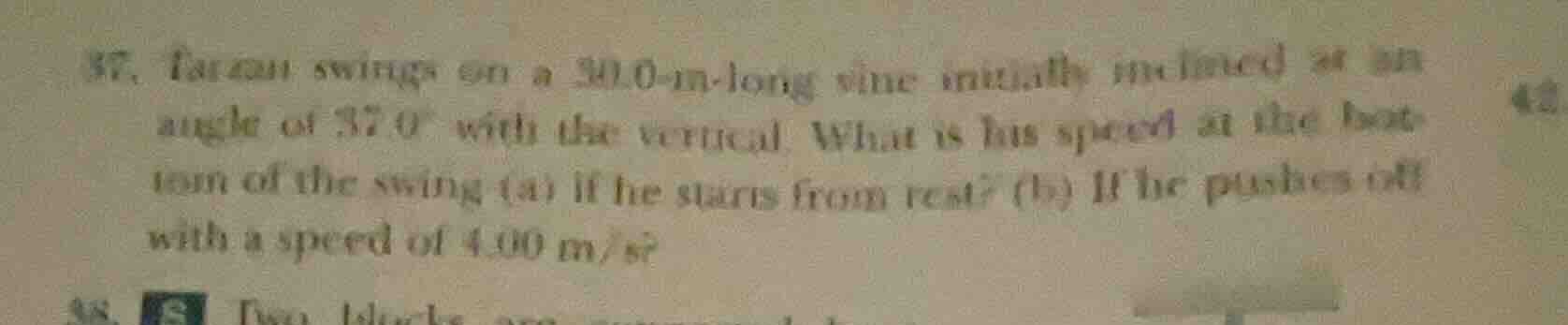
- tarzan swings on a 30.0-m-long vine initially inclined at an angle of 37.0° with the vertical. what is his speed at the bottom of the swing (a) if he starts from rest? (b) if he pushes off with a speed of 4.00 m/s?
Part (a): Starting from rest
Step 1: Find the vertical drop height
The length of the vine is \( L = 30.0\,\text{m} \), and the initial angle with the vertical is \( \theta = 37.0^\circ \). The vertical drop \( h \) can be found using \( h = L - L\cos\theta = L(1 - \cos\theta) \).
\[
h = 30.0(1 - \cos37.0^\circ)
\]
We know that \( \cos37.0^\circ \approx 0.8 \), so:
\[
h = 30.0(1 - 0.8) = 30.0\times0.2 = 6.0\,\text{m}
\]
Step 2: Apply conservation of mechanical energy
Initial kinetic energy \( K_i = 0 \) (starts from rest), initial potential energy \( U_i = mgh \), final kinetic energy \( K_f = \frac{1}{2}mv^2 \), final potential energy \( U_f = 0 \) (at the bottom, height is 0). By conservation of energy \( K_i + U_i = K_f + U_f \):
\[
0 + mgh = \frac{1}{2}mv^2 + 0
\]
We can cancel \( m \) from both sides:
\[
gh = \frac{1}{2}v^2
\]
Solving for \( v \):
\[
v = \sqrt{2gh}
\]
Substitute \( g = 9.8\,\text{m/s}^2 \) and \( h = 6.0\,\text{m} \):
\[
v = \sqrt{2\times9.8\times6.0} = \sqrt{117.6} \approx 10.8\,\text{m/s}
\]
Part (b): Pushing off with initial speed \( v_i = 4.00\,\text{m/s} \)
Step 1: Apply conservation of mechanical energy again
Initial kinetic energy \( K_i = \frac{1}{2}mv_i^2 \), initial potential energy \( U_i = mgh \), final kinetic energy \( K_f = \frac{1}{2}mv_f^2 \), final potential energy \( U_f = 0 \). So:
\[
\frac{1}{2}mv_i^2 + mgh = \frac{1}{2}mv_f^2 + 0
\]
Cancel \( m \):
\[
\frac{1}{2}v_i^2 + gh = \frac{1}{2}v_f^2
\]
Step 2: Solve for \( v_f \)
We know \( v_i = 4.00\,\text{m/s} \), \( g = 9.8\,\text{m/s}^2 \), \( h = 6.0\,\text{m} \). Substitute these values:
\[
\frac{1}{2}(4.00)^2 + 9.8\times6.0 = \frac{1}{2}v_f^2
\]
\[
\frac{1}{2}\times16 + 58.8 = \frac{1}{2}v_f^2
\]
\[
8 + 58.8 = \frac{1}{2}v_f^2
\]
\[
66.8 = \frac{1}{2}v_f^2
\]
Multiply both sides by 2:
\[
133.6 = v_f^2
\]
Take the square root:
\[
v_f = \sqrt{133.6} \approx 11.56\,\text{m/s}
\]

Snap & solve any problem in the app
Get step-by-step solutions on Sovi AI
Photo-based solutions with guided steps
Explore more problems and detailed explanations
s:
(a) \(\boxed{10.8\,\text{m/s}}\)
(b) \(\boxed{11.6\,\text{m/s}}\) (rounded to three significant figures)