QUESTION IMAGE
Question
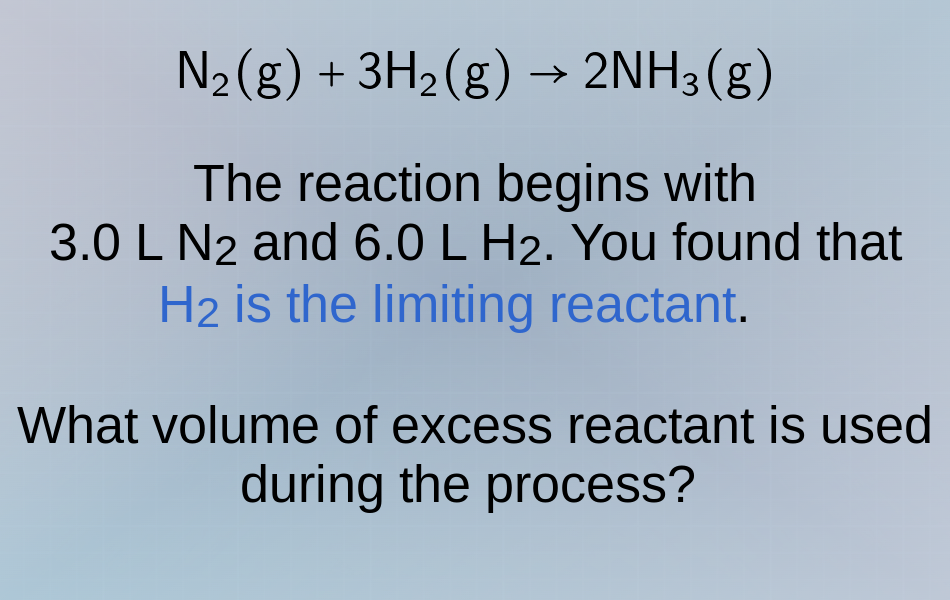
n₂(g) + 3h₂(g) → 2nh₃(g)
the reaction begins with 3.0 l n₂ and 6.0 l h₂. you found that h₂ is the limiting reactant.
what volume of excess reactant is used during the process?
Step1: Relate moles (volume) of H₂ to N₂
From the reaction \( \text{N}_2(\text{g}) + 3\text{H}_2(\text{g})
ightarrow 2\text{NH}_3(\text{g}) \), the mole ratio of \( \text{N}_2 \) to \( \text{H}_2 \) is \( 1:3 \). At constant T and P, volume ratio = mole ratio. Let \( V_{\text{N}_2\text{ used}} \) be volume of \( \text{N}_2 \) used.
\( \frac{V_{\text{N}_2\text{ used}}}{V_{\text{H}_2}} = \frac{1}{3} \)
\( V_{\text{H}_2} = 6.0 \, \text{L} \), so:
\( V_{\text{N}_2\text{ used}} = \frac{1}{3} \times V_{\text{H}_2} \)
Step2: Calculate \( V_{\text{N}_2\text{ used}} \)
Substitute \( V_{\text{H}_2} = 6.0 \, \text{L} \):
\( V_{\text{N}_2\text{ used}} = \frac{1}{3} \times 6.0 \, \text{L} = 2.0 \, \text{L} \)

Snap & solve any problem in the app
Get step-by-step solutions on Sovi AI
Photo-based solutions with guided steps
Explore more problems and detailed explanations
\( 2.0 \, \text{L} \)