QUESTION IMAGE
Question
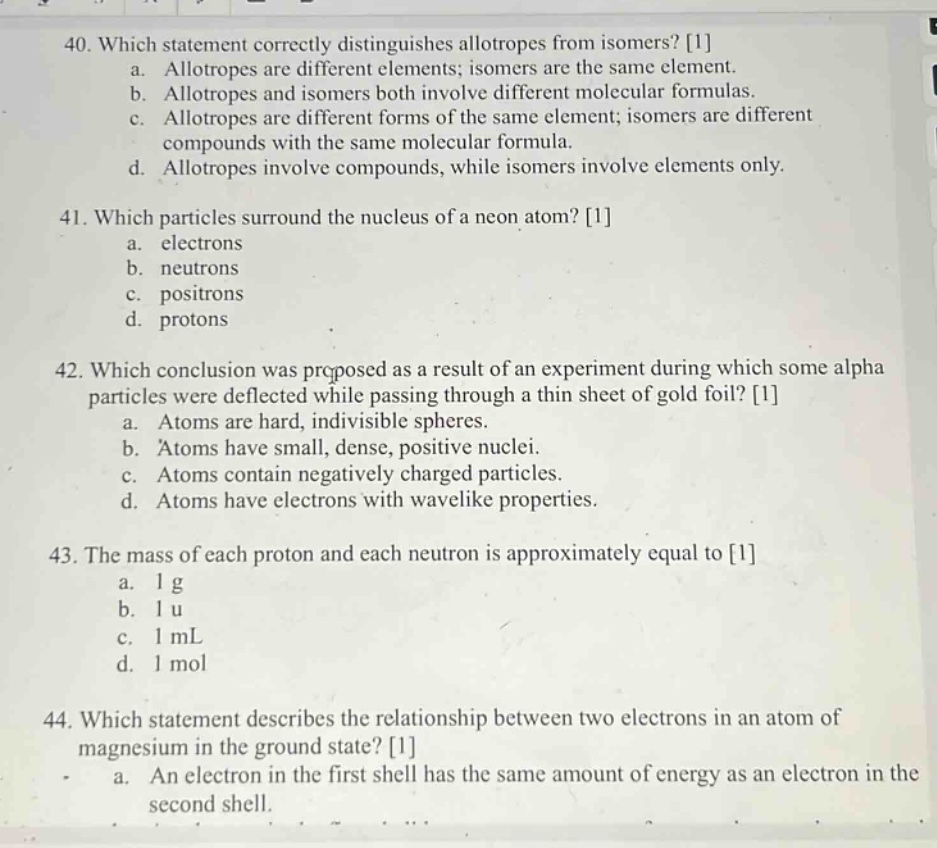
- which statement correctly distinguishes allotropes from isomers? 1
a. allotropes are different elements; isomers are the same element.
b. allotropes and isomers both involve different molecular formulas.
c. allotropes are different forms of the same element; isomers are different compounds with the same molecular formula.
d. allotropes involve compounds, while isomers involve elements only.
- which particles surround the nucleus of a neon atom? 1
a. electrons
b. neutrons
c. positrons
d. protons
- which conclusion was proposed as a result of an experiment during which some alpha particles were deflected while passing through a thin sheet of gold foil? 1
a. atoms are hard, indivisible spheres.
b. atoms have small, dense, positive nuclei.
c. atoms contain negatively charged particles.
d. atoms have electrons with wavelike properties.
- the mass of each proton and each neutron is approximately equal to 1
a. 1 g
b. 1 u
c. 1 ml
d. 1 mol
- which statement describes the relationship between two electrons in an atom of magnesium in the ground state? 1
a. an electron in the first shell has the same amount of energy as an electron in the second shell.
Question 40
To distinguish allotropes and isomers: Allotropes are different structural forms of the same element (e.g., diamond and graphite for carbon). Isomers are different compounds with the same molecular formula (e.g., butane and isobutane). Option a is wrong (allotropes are same element). Option b is wrong (allotropes don't have molecular formulas as they are elements). Option d is wrong (allotropes are elements, isomers are compounds). So option c is correct.
In an atom, the nucleus contains protons and neutrons. Electrons are negatively charged particles that orbit (surround) the nucleus. Neutrons and protons are in the nucleus. Positrons are not part of a neutral neon atom's structure. So electrons surround the nucleus.
The gold foil experiment (Rutherford's) involved alpha particles (positive) hitting gold foil. Most passed through, some deflected. This showed atoms have a small, dense, positive nucleus (since positive alpha particles were deflected by positive nucleus). Option a is wrong (atom is not hard, indivisible sphere). Option c: the experiment didn't show negative particles directly. Option d: relates to electron wave - particle duality, not this experiment. So option b is correct.

Snap & solve any problem in the app
Get step-by-step solutions on Sovi AI
Photo-based solutions with guided steps
Explore more problems and detailed explanations
c. Allotropes are different forms of the same element; isomers are different compounds with the same molecular formula.