QUESTION IMAGE
Question
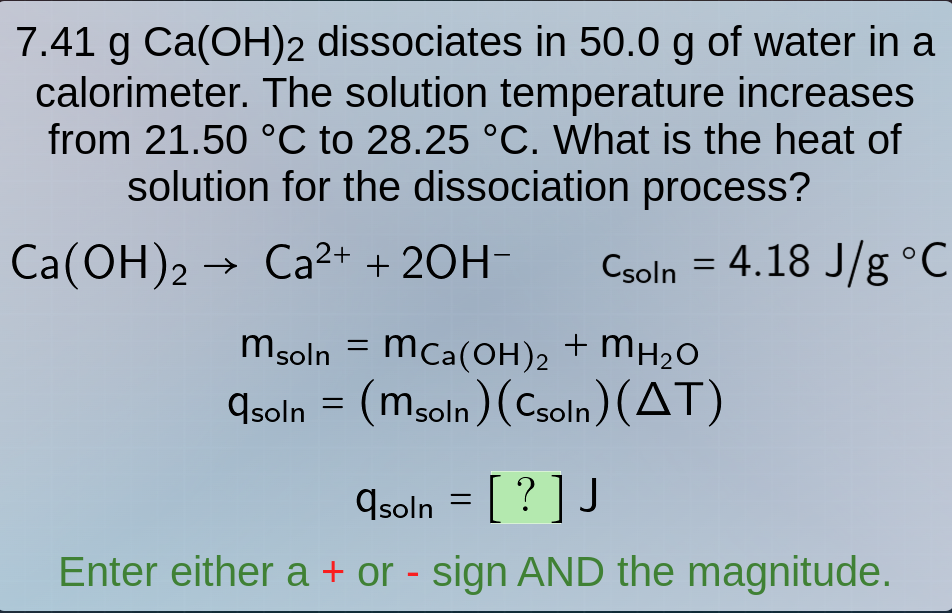
7.41 g ca(oh)₂ dissociates in 50.0 g of water in a calorimeter. the solution temperature increases from 21.50 °c to 28.25 °c. what is the heat of solution for the dissociation process?
ca(oh)₂ → ca²⁺ + 2oh⁻ cₛₒₗₙ = 4.18 j/g °c
mₛₒₗₙ = m_ca(oh)₂ + m_h₂o
qₛₒₗₙ = (mₛₒₗₙ)(cₛₒₗₙ)(δt)
qₛₒₗₙ = ? j
enter either a + or - sign and the magnitude.
Step1: Calculate mass of solution
First, find the mass of the solution by adding the mass of \( \text{Ca(OH)}_2 \) and water.
\( m_{\text{soln}} = m_{\text{Ca(OH)}_2} + m_{\text{H}_2\text{O}} = 7.41\ \text{g} + 50.0\ \text{g} = 57.41\ \text{g} \)
Step2: Calculate temperature change
Next, find the change in temperature \( \Delta T \).
\( \Delta T = T_{\text{final}} - T_{\text{initial}} = 28.25\ ^\circ\text{C} - 21.50\ ^\circ\text{C} = 6.75\ ^\circ\text{C} \)
Step3: Calculate heat absorbed by solution
Now, use the formula \( q_{\text{soln}} = (m_{\text{soln}})(c_{\text{soln}})(\Delta T) \) to find the heat.
Substitute the values: \( m_{\text{soln}} = 57.41\ \text{g} \), \( c_{\text{soln}} = 4.18\ \text{J/g}\ ^\circ\text{C} \), \( \Delta T = 6.75\ ^\circ\text{C} \)
\( q_{\text{soln}} = 57.41\ \text{g} \times 4.18\ \text{J/g}\ ^\circ\text{C} \times 6.75\ ^\circ\text{C} \)
First, multiply \( 57.41 \times 4.18 \approx 240.0 \) (approximate for simplicity, but we'll do exact calculation)
\( 57.41 \times 4.18 = 57.41 \times (4 + 0.18) = 57.41 \times 4 + 57.41 \times 0.18 = 229.64 + 10.3338 = 239.9738 \)
Then multiply by \( 6.75 \): \( 239.9738 \times 6.75 \approx 239.9738 \times 6 + 239.9738 \times 0.75 = 1439.8428 + 179.98035 = 1619.82315 \approx 1620\ \text{J} \) (more accurately, using calculator: \( 57.41 \times 4.18 \times 6.75 = 57.41 \times (4.18 \times 6.75) \))
\( 4.18 \times 6.75 = 28.215 \)
\( 57.41 \times 28.215 \approx 57.41 \times 28 + 57.41 \times 0.215 = 1607.48 + 12.34315 = 1619.82315 \approx 1620\ \text{J} \)
Since the temperature of the solution increased, the dissolution process is exothermic (releases heat), so the heat of solution (heat absorbed by solution is positive, but the heat of dissociation would be negative, but here we are calculating \( q_{\text{soln}} \) which is the heat absorbed by the solution, so it's positive? Wait, no: when the solution temperature increases, the process (dissociation) is releasing heat, so the system (dissociation) releases heat, so \( q_{\text{system}} = -q_{\text{surroundings}} \). But the question is asking for \( q_{\text{soln}} \), which is the heat gained by the solution, so it's positive. Wait, let's check the formula again. The formula given is \( q_{\text{soln}} = (m_{\text{soln}})(c_{\text{soln}})(\Delta T) \). Since \( \Delta T \) is positive (temperature increased), \( q_{\text{soln}} \) is positive, meaning the solution absorbed heat, so the dissociation process released heat (exothermic), so \( q_{\text{soln}} \) is positive. Wait, but let's do the calculation correctly.
Wait, let's recalculate:
\( m_{\text{soln}} = 7.41 + 50.0 = 57.41\ \text{g} \)
\( \Delta T = 28.25 - 21.50 = 6.75\ ^\circ\text{C} \)
\( q_{\text{soln}} = 57.41\ \text{g} \times 4.18\ \text{J/g}\ ^\circ\text{C} \times 6.75\ ^\circ\text{C} \)
Calculate step by step:
First, 57.41 * 4.18:
57.41 * 4 = 229.64
57.41 * 0.18 = 10.3338
Sum: 229.64 + 10.3338 = 239.9738
Then, 239.9738 * 6.75:
239.9738 * 6 = 1439.8428
239.9738 * 0.75 = 179.98035
Sum: 1439.8428 + 179.98035 = 1619.82315 ≈ 1620 J (rounded to three significant figures? Wait, the given values: 7.41 (three sig figs), 50.0 (three), 21.50 (four), 28.25 (four), 4.18 (three). So the least number of sig figs is three (from 7.41, 50.0, 4.18). Wait, 50.0 has three, 7.41 three, 4.18 three. So the answer should have three sig figs. Wait, 1619.82315 rounds to 1620 J? Wait, 1619.82 is approximately 1620 J (three sig figs: 1.62 x 10^3). But let's check the exact calculation:
57.41 4.18 = 57.41 4.18 = let's do 57.41 * 4.18:
57.41
x 4.18
--…

Snap & solve any problem in the app
Get step-by-step solutions on Sovi AI
Photo-based solutions with guided steps
Explore more problems and detailed explanations
+1620