QUESTION IMAGE
Question
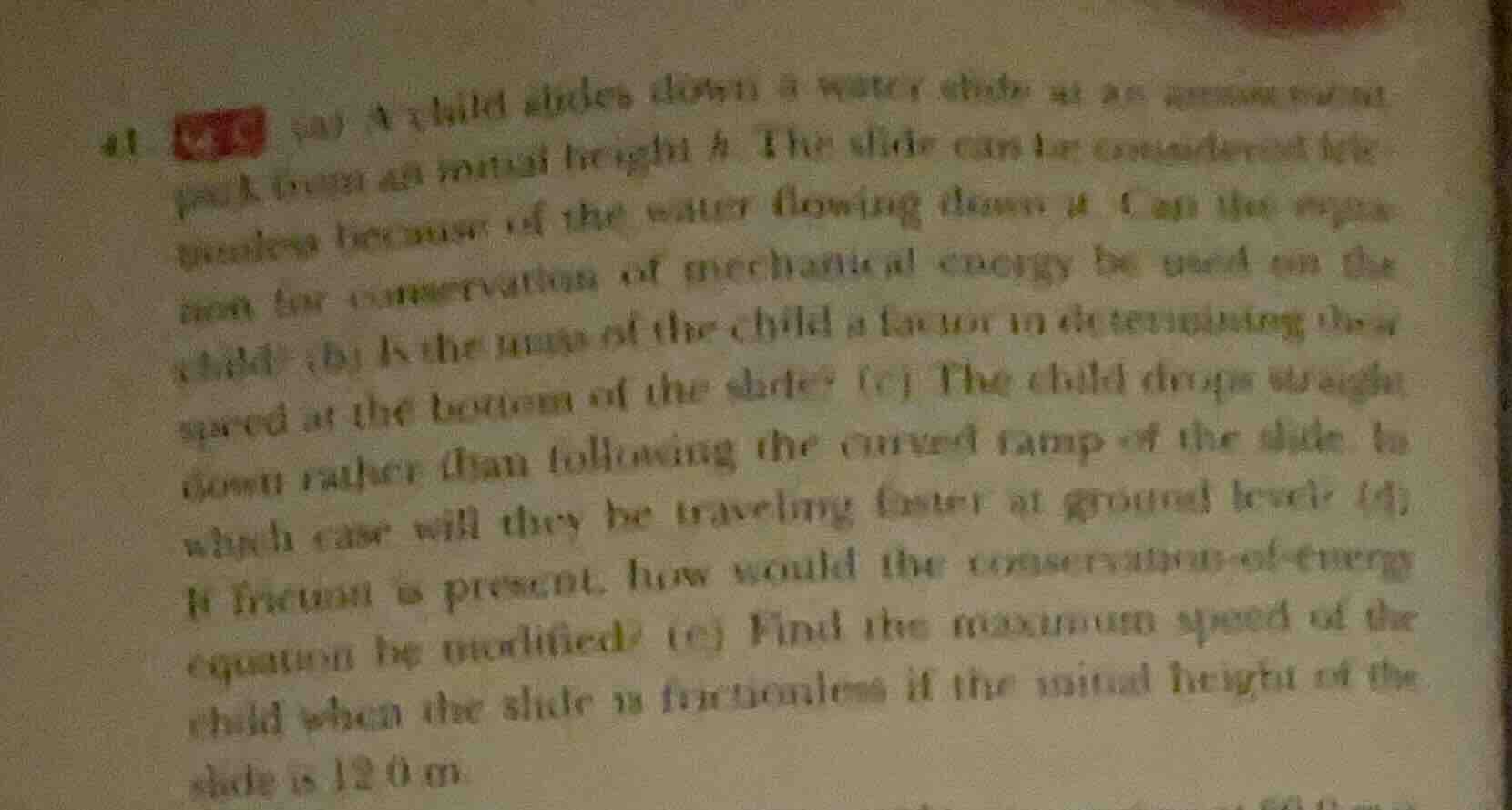
41 (a) a child slides down a water slide at an amusement park from an initial height h. the slide can be considered frictionless because of the water flowing down it. can the principle for conservation of mechanical energy be used on the child? (b) is the mass of the child a factor in determining their speed at the bottom of the slide? (c) the child drops straight down rather than following the curved ramp of the slide. in which case will they be traveling faster at ground level? (d) if friction is present, how would the conservation - of - energy equation be modified? (e) find the maximum speed of the child when the slide is frictionless if the initial height of the slide is 12.0 m.
Part (e) Solution:
Step 1: Identify the energy conservation principle
For a frictionless slide, mechanical energy is conserved. The initial energy is gravitational potential energy (\(U = mgh\)) and the final energy is kinetic energy (\(K=\frac{1}{2}mv^{2}\)) (assuming the child starts from rest, so initial kinetic energy is 0, and at the bottom, potential energy is 0 relative to the ground).
So, \(mgh=\frac{1}{2}mv^{2}\)
Step 2: Solve for velocity \(v\)
Cancel out the mass \(m\) from both sides of the equation \(mgh=\frac{1}{2}mv^{2}\):
\(gh = \frac{1}{2}v^{2}\)
Multiply both sides by 2:
\(2gh=v^{2}\)
Take the square root of both sides:
\(v = \sqrt{2gh}\)
Step 3: Substitute the given height \(h = 12.0\space m\) and \(g = 9.8\space m/s^{2}\)
\(v=\sqrt{2\times9.8\times12.0}\)
First, calculate \(2\times9.8\times12.0 = 235.2\)
Then, \(v=\sqrt{235.2}\approx15.34\space m/s\)

Snap & solve any problem in the app
Get step-by-step solutions on Sovi AI
Photo-based solutions with guided steps
Explore more problems and detailed explanations
The maximum speed of the child is approximately \(\boldsymbol{15.3\space m/s}\) (or more precisely \(15.34\space m/s\))