QUESTION IMAGE
Question
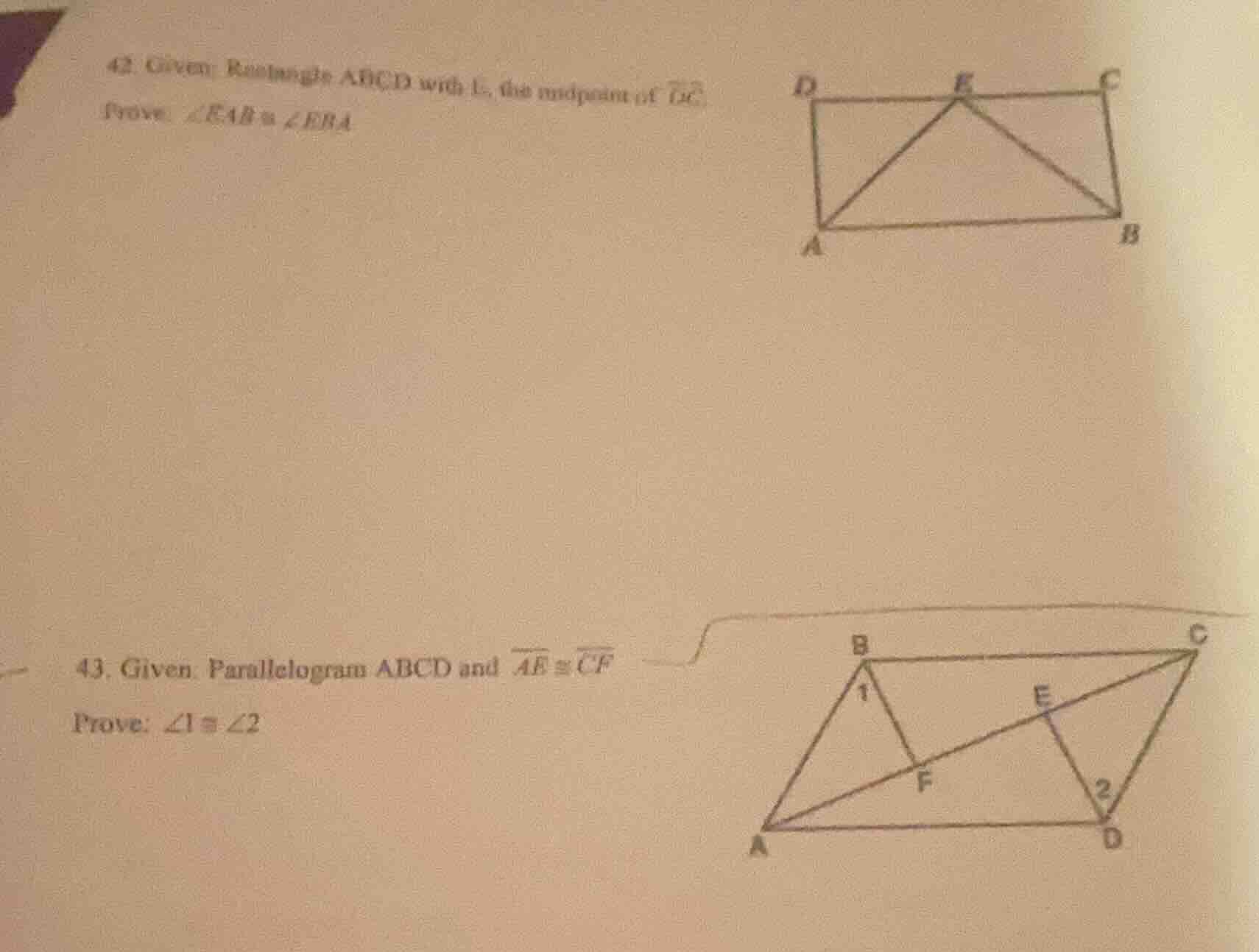
- given: rectangle abcd with e, the midpoint of \\(\overline{dc}\\). prove: \\(\angle eab \cong \angle eba\\) 43. given: parallelogram abcd and \\(\overline{ae} \cong \overline{cf}\\) prove: \\(\angle 1 \cong \angle 2\\)
Problem 42
Step1: Recall rectangle properties
In rectangle \(ABCD\), \(AD = BC\), \(\angle D = \angle C = 90^\circ\), \(AB = DC\).
Step2: Use midpoint definition
Since \(E\) is midpoint of \(\overline{DC}\), \(DE = EC = \frac{1}{2}DC\).
Step3: Prove \(\triangle ADE \cong \triangle BCE\)
By SAS congruence: \(AD = BC\), \(\angle D = \angle C\), \(DE = EC\), so \(\triangle ADE \cong \triangle BCE\).
Step4: Corresponding parts of congruent triangles
From congruence, \(\overline{AE} = \overline{BE}\).
Step5: Base angles of isosceles triangle
In \(\triangle EAB\), \(\overline{AE} = \overline{BE}\), so \(\angle EAB \cong \angle EBA\).
Step1: Recall parallelogram properties
In parallelogram \(ABCD\), \(AB = CD\), \(AB \parallel CD\), so \(\angle BAF = \angle DCE\).
Step2: Derive \(BF = DE\)
Given \(\overline{AF} \cong \overline{CF}\), and \(AC = AC\), so \(AC - AF = AC - CF\), i.e., \(\overline{BF} = \overline{DE}\).
Step3: Prove \(\triangle ABF \cong \triangle CDE\)
By SAS congruence: \(AB = CD\), \(\angle BAF = \angle DCE\), \(AF = CE\), so \(\triangle ABF \cong \triangle CDE\).
Step4: Corresponding parts of congruent triangles
From congruence, \(\angle ABF = \angle CDE\).
Step5: Use parallel line alternate angles
Since \(AB \parallel CD\), \(\angle ABD = \angle CDB\). Subtract: \(\angle ABD - \angle ABF = \angle CDB - \angle CDE\), so \(\angle 1 \cong \angle 2\).

Snap & solve any problem in the app
Get step-by-step solutions on Sovi AI
Photo-based solutions with guided steps
Explore more problems and detailed explanations
\(\angle EAB \cong \angle EBA\) is proven.
---