QUESTION IMAGE
Question
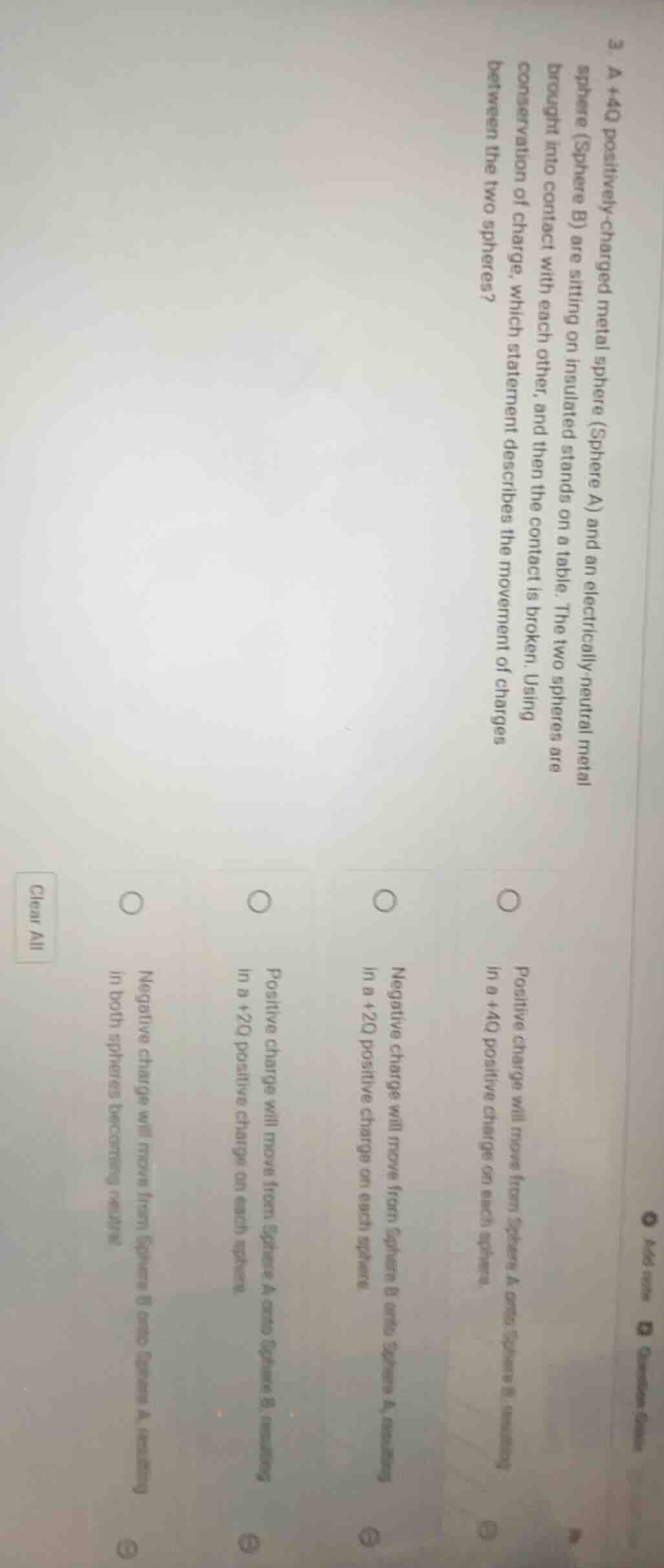
- a +4q positively-charged metal sphere (sphere a) and an electrically-neutral metal sphere (sphere b) are sitting on insulated stands on a table. the two spheres are brought into contact with each other, and then the contact is broken. using conservation of charge, which statement describes the movement of charges between the two spheres?○ positive charge will move from sphere a onto sphere b, resulting in a +4q positive charge on each sphere.○ negative charge will move from sphere b onto sphere a, resulting in a +2q positive charge on each sphere.○ positive charge will move from sphere a onto sphere b, resulting in a +2q positive charge on each sphere.○ negative charge will move from sphere b onto sphere a, resulting in both spheres becoming neutral
Step1: Recall charge movement rules
In conductors, only negative charges (electrons) move; positive charges are fixed in the atomic nucleus. A positively charged sphere has a deficit of electrons, and a neutral sphere has an equal number of positive and negative charges.
Step2: Analyze charge transfer
When the neutral Sphere B touches positively charged Sphere A, electrons (negative charge) from Sphere B move to Sphere A to reduce the charge imbalance.
Step3: Calculate final charge
Total charge is conserved: $Q_{total} = +4Q + 0 = +4Q$. When separated, the charge distributes equally between the two identical metal spheres: $\frac{+4Q}{2} = +2Q$ on each sphere.

Snap & solve any problem in the app
Get step-by-step solutions on Sovi AI
Photo-based solutions with guided steps
Explore more problems and detailed explanations
Negative charge will move from Sphere B onto Sphere A, resulting in a +2Q positive charge on each sphere.