QUESTION IMAGE
Question
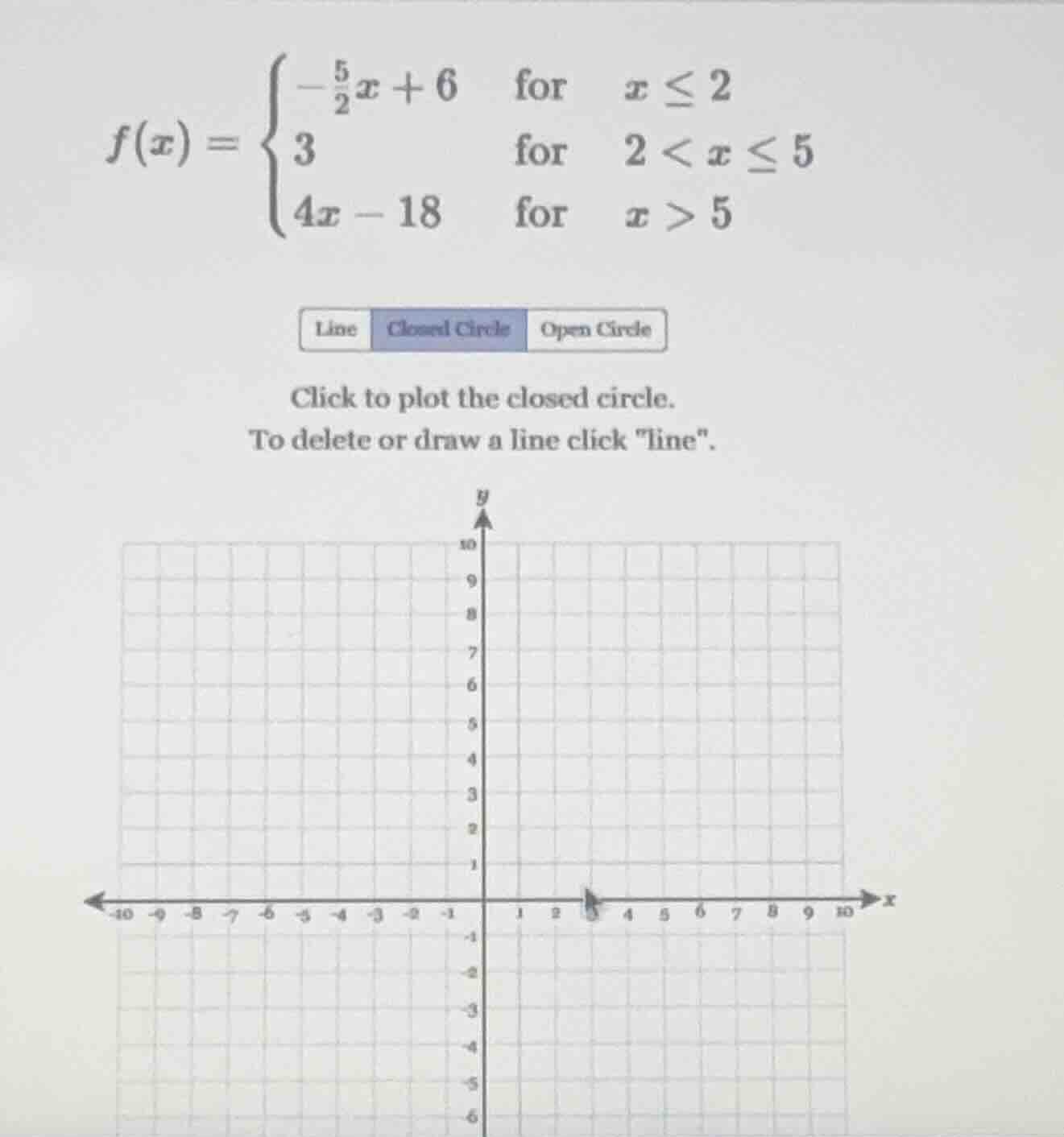
f(x) = \
line closed circle open circle
click to plot the closed circle.
to delete or draw a line click \line\.
To plot the closed circles for the piecewise function \( f(x) \), we need to find the points where the function has a closed circle (i.e., where the domain includes the endpoint).
Step 1: For \( x \leq 2 \) (function \( -\frac{5}{2}x + 6 \))
The endpoint is \( x = 2 \). Substitute \( x = 2 \) into \( -\frac{5}{2}x + 6 \):
\[
-\frac{5}{2}(2) + 6 = -5 + 6 = 1
\]
So, there is a closed circle at \( (2, 1) \) (since \( x = 2 \) is included in \( x \leq 2 \)).
Step 2: For \( 2 < x \leq 5 \) (function \( 3 \))
The left endpoint \( x = 2 \) is not included (open circle), but the right endpoint \( x = 5 \) is included. Substitute \( x = 5 \) into \( 3 \):
\[
f(5) = 3
\]
So, there is a closed circle at \( (5, 3) \) (since \( x = 5 \) is included in \( 2 < x \leq 5 \)).
Step 3: For \( x > 5 \) (function \( 4x - 18 \))
The endpoint \( x = 5 \) is not included (open circle), so we do not plot a closed circle here.
Final Closed Circles:
- At \( (2, 1) \) (from \( x \leq 2 \))
- At \( (5, 3) \) (from \( 2 < x \leq 5 \))
To plot these:
- Click “Closed Circle” in the toolbar.
- Plot \( (2, 1) \) and \( (5, 3) \) on the graph.
(Note: For the lines, draw \( -\frac{5}{2}x + 6 \) for \( x \leq 2 \), a horizontal line \( y = 3 \) for \( 2 < x \leq 5 \), and \( 4x - 18 \) for \( x > 5 \).)

Snap & solve any problem in the app
Get step-by-step solutions on Sovi AI
Photo-based solutions with guided steps
Explore more problems and detailed explanations
To plot the closed circles for the piecewise function \( f(x) \), we need to find the points where the function has a closed circle (i.e., where the domain includes the endpoint).
Step 1: For \( x \leq 2 \) (function \( -\frac{5}{2}x + 6 \))
The endpoint is \( x = 2 \). Substitute \( x = 2 \) into \( -\frac{5}{2}x + 6 \):
\[
-\frac{5}{2}(2) + 6 = -5 + 6 = 1
\]
So, there is a closed circle at \( (2, 1) \) (since \( x = 2 \) is included in \( x \leq 2 \)).
Step 2: For \( 2 < x \leq 5 \) (function \( 3 \))
The left endpoint \( x = 2 \) is not included (open circle), but the right endpoint \( x = 5 \) is included. Substitute \( x = 5 \) into \( 3 \):
\[
f(5) = 3
\]
So, there is a closed circle at \( (5, 3) \) (since \( x = 5 \) is included in \( 2 < x \leq 5 \)).
Step 3: For \( x > 5 \) (function \( 4x - 18 \))
The endpoint \( x = 5 \) is not included (open circle), so we do not plot a closed circle here.
Final Closed Circles:
- At \( (2, 1) \) (from \( x \leq 2 \))
- At \( (5, 3) \) (from \( 2 < x \leq 5 \))
To plot these:
- Click “Closed Circle” in the toolbar.
- Plot \( (2, 1) \) and \( (5, 3) \) on the graph.
(Note: For the lines, draw \( -\frac{5}{2}x + 6 \) for \( x \leq 2 \), a horizontal line \( y = 3 \) for \( 2 < x \leq 5 \), and \( 4x - 18 \) for \( x > 5 \).)