QUESTION IMAGE
Question
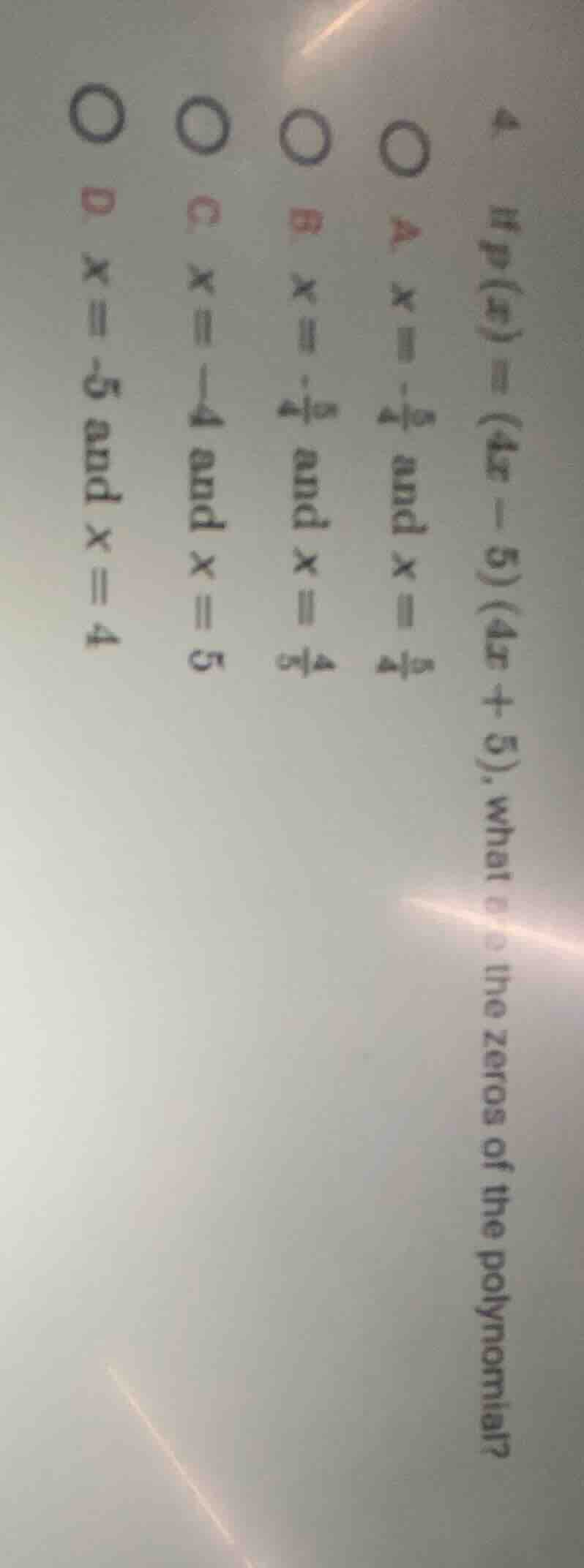
- if ( p(x) = (4x - 5)(4x + 5) ), what are the zeros of the polynomial?
a ( x = -\frac{5}{4} ) and ( x = \frac{5}{4} )
b ( x = -\frac{5}{4} ) and ( x = \frac{4}{5} )
c ( x = -4 ) and ( x = 5 )
d ( x = -5 ) and ( x = 4 )
Step1: Recall the zero - product property
The zero - product property states that if \(ab = 0\), then either \(a=0\) or \(b = 0\) (or both). For a polynomial \(p(x)=(4x - 5)(4x+5)\), to find the zeros of the polynomial, we set \(p(x)=0\), so \((4x - 5)(4x + 5)=0\).
Step2: Apply the zero - product property
According to the zero - product property, if \((4x - 5)(4x + 5)=0\), then either \(4x-5 = 0\) or \(4x + 5=0\).
For \(4x-5=0\):
Solve the equation \(4x-5 = 0\) for \(x\). Add 5 to both sides of the equation: \(4x=5\). Then divide both sides by 4: \(x=\frac{5}{4}\).
For \(4x + 5=0\):
Solve the equation \(4x+5 = 0\) for \(x\). Subtract 5 from both sides: \(4x=-5\). Then divide both sides by 4: \(x =-\frac{5}{4}\). Wait, no, let's correct that. Wait, the options are given as:
Wait, the polynomial is \(p(x)=(4x - 5)(4x + 5)\). Let's set \(p(x)=0\), so \((4x - 5)(4x+5)=0\).
By zero - product property, \(4x - 5=0\) or \(4x+5 = 0\).
- Solve \(4x-5=0\):
Add 5 to both sides: \(4x=5\), then \(x=\frac{5}{4}\).
- Solve \(4x + 5=0\):
Subtract 5 from both sides: \(4x=-5\), then \(x=-\frac{5}{4}\).
Wait, the options are:
A. \(x =-\frac{5}{4}\) and \(x=\frac{5}{4}\)
B. \(x =-\frac{5}{4}\) and \(x=\frac{4}{5}\) (This is wrong)
C. \(x=-4\) and \(x = 5\) (Wrong)
D. \(x=-5\) and \(x = 4\) (Wrong)
Wait, the correct zeros are found by setting each factor equal to zero:
For \(4x-5=0\), \(4x=5\), \(x=\frac{5}{4}\)
For \(4x + 5=0\), \(4x=-5\), \(x=-\frac{5}{4}\)
So the zeros are \(x =-\frac{5}{4}\) and \(x=\frac{5}{4}\), which is option A.

Snap & solve any problem in the app
Get step-by-step solutions on Sovi AI
Photo-based solutions with guided steps
Explore more problems and detailed explanations
A. \(x =-\frac{5}{4}\) and \(x=\frac{5}{4}\)