QUESTION IMAGE
Question
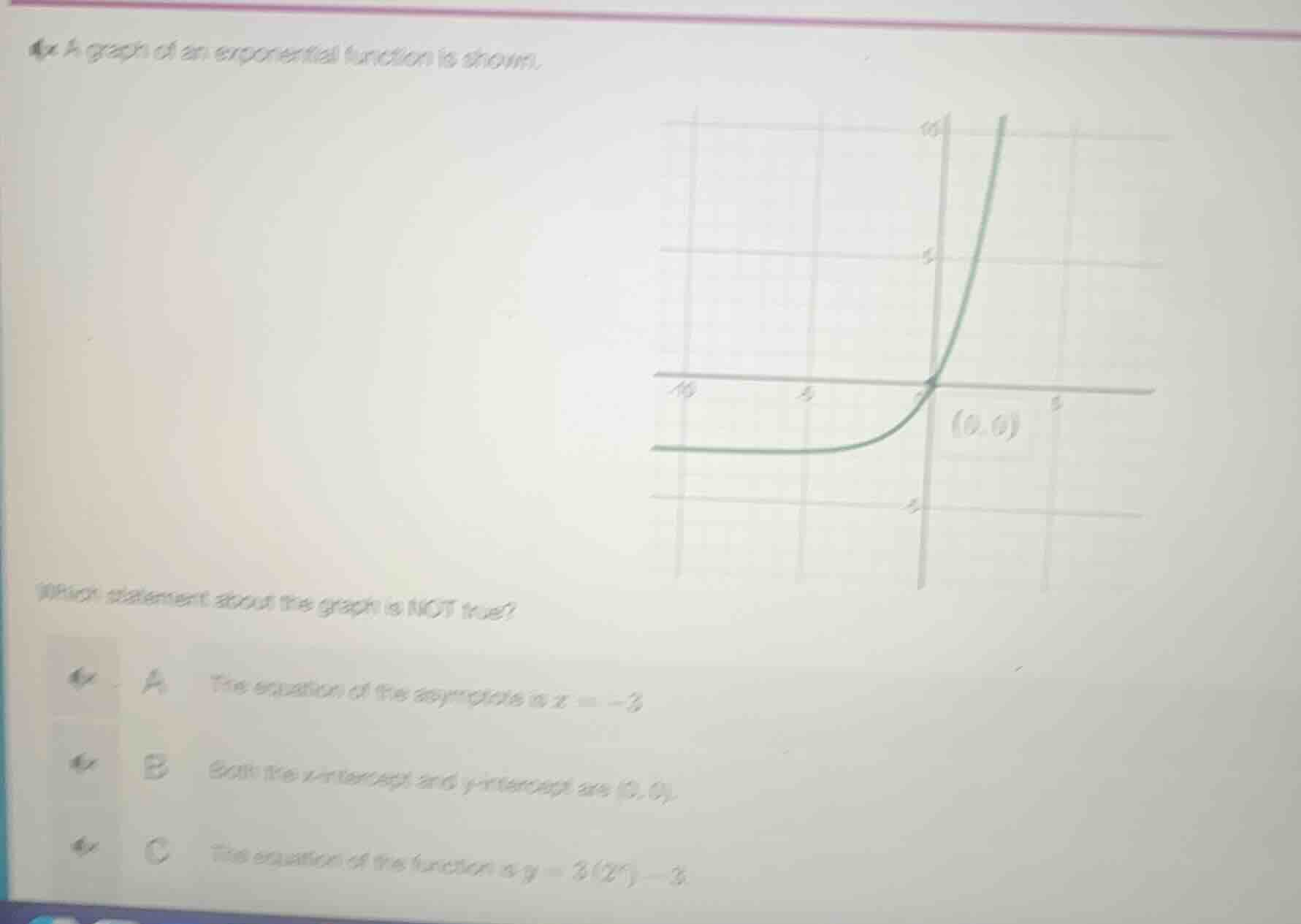
4x a graph of an exponential function is shown. which statement about the graph is not true? a the equation of the asymptote is ( y = -3 ) b both the x - intercept and y - intercept are ( (0, 0) ). c the equation of the function is ( y = 3(2^x) - 3 ).
Step1: Analyze Option A
Exponential functions of the form \(y = a(b^x)+k\) have horizontal asymptotes (not vertical) at \(y = k\). The graph shown has a horizontal asymptote. If we check the asymptote, from the graph, the horizontal asymptote should be a horizontal line (equation \(y = - 3\) maybe? But option A says \(x=-3\) which is a vertical line. Vertical asymptotes are for rational functions, not exponential functions. So this statement is false. But let's check other options too.
Step2: Analyze Option B
The x - intercept is where \(y = 0\) and y - intercept is where \(x = 0\). From the graph, the point \((0,0)\) is on the graph. So when \(x = 0\), \(y=0\) (y - intercept) and when \(y = 0\), \(x = 0\) (x - intercept). So this statement is true.
Step3: Analyze Option C
Let's check the function \(y=3(2^x)-3\). When \(x = 0\), \(y=3(1)-3=0\), which matches the point \((0,0)\). The horizontal asymptote of \(y = 3(2^x)-3\) is \(y=-3\) (since as \(x
ightarrow-\infty\), \(2^x
ightarrow0\), so \(y
ightarrow - 3\)). The graph is an exponential growth (since the base \(2>1\)) after the asymptote, which matches the graph. So this function could represent the graph. So this statement is true.

Snap & solve any problem in the app
Get step-by-step solutions on Sovi AI
Photo-based solutions with guided steps
Explore more problems and detailed explanations
A. The equation of the asymptote is \(x=-3\)