QUESTION IMAGE
Question
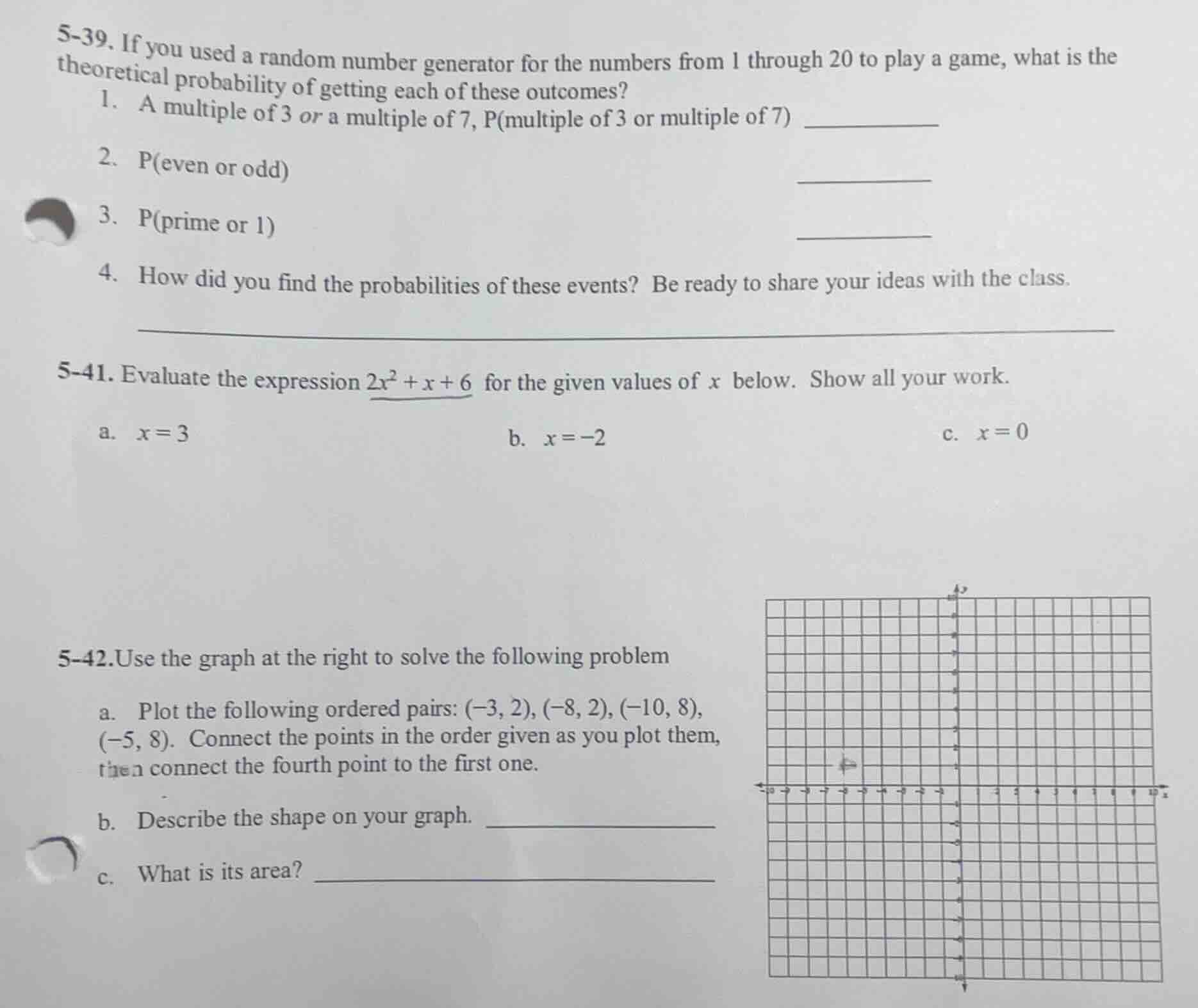
5-39. if you used a random number generator for the numbers from 1 through 20 to play a game, what is the theoretical probability of getting each of these outcomes?
- a multiple of 3 or a multiple of 7, p(multiple of 3 or multiple of 7)
- p(even or odd)
- p(prime or 1)
- how did you find the probabilities of these events? be ready to share your ideas with the class.
5-41. evaluate the expression $2x^2 + x + 6$ for the given values of $x$ below. show all your work.
a. $x = 3$ b. $x = -2$ c. $x = 0$
5-42.use the graph at the right to solve the following problem
a. plot the following ordered pairs: $(-3, 2), (-8, 2), (-10, 8), (-5, 8)$. connect the points in the order given as you plot them, then connect the fourth point to the first one.
b. describe the shape on your graph.
c. what is its area?
For 5-39:
Step1: Define total outcomes
Total numbers: $n(S)=20$
Step2: Find multiples of 3
Multiples of 3: $\{3,6,9,12,15,18\}$, $n(A)=6$
Step3: Find multiples of 7
Multiples of 7: $\{7,14\}$, $n(B)=2$
Step4: No overlap, apply addition rule
$P(A\cup B)=\frac{n(A)+n(B)}{n(S)}=\frac{6+2}{20}=\frac{8}{20}=\frac{2}{5}$
Step5: Even or odd covers all numbers
All numbers are even/odd: $P=\frac{20}{20}=1$
Step6: Count primes + 1
Primes 1-20: $\{2,3,5,7,11,13,17,19\}$, plus 1: $n=9$
$P=\frac{9}{20}$
Step7: Explain probability method
Use theoretical probability: count favorable outcomes, divide by total outcomes; use addition rule for non-overlapping events.
Step1: Substitute $x=3$
$2(3)^2 + 3 + 6 = 2(9)+3+6=18+3+6$
Step2: Calculate result for $x=3$
$18+3+6=27$
Step3: Substitute $x=-2$
$2(-2)^2 + (-2) + 6 = 2(4)-2+6=8-2+6$
Step4: Calculate result for $x=-2$
$8-2+6=12$
Step5: Substitute $x=0$
$2(0)^2 + 0 + 6 = 0+0+6$
Step6: Calculate result for $x=0$
$0+0+6=6$
a. Plot each point on the coordinate grid: $(-3,2)$ (3 left, 2 up), $(-8,2)$ (8 left, 2 up), $(-10,8)$ (10 left, 8 up), $(-5,8)$ (5 left, 8 up), then connect them in order and close the shape by linking $(-5,8)$ back to $(-3,2)$.
b. The shape has two pairs of parallel sides, with opposite sides equal in length, so it is a parallelogram.
c. For a parallelogram, area = base × height. The base length is the horizontal distance between $(-3,2)$ and $(-8,2)$: $|-3 - (-8)|=5$. The vertical height is the distance between the two horizontal sides: $|8-2|=6$. Area = $5×6=30$.

Snap & solve any problem in the app
Get step-by-step solutions on Sovi AI
Photo-based solutions with guided steps
Explore more problems and detailed explanations
- $\frac{2}{5}$
- $1$
- $\frac{9}{20}$
- I used theoretical probability: first identify the total number of possible outcomes (20 numbers total). For each event, count the number of favorable outcomes, then divide that count by 20. For "or" events with no overlapping outcomes, add the counts of each individual favorable set before dividing by the total number of outcomes.
---