QUESTION IMAGE
Question
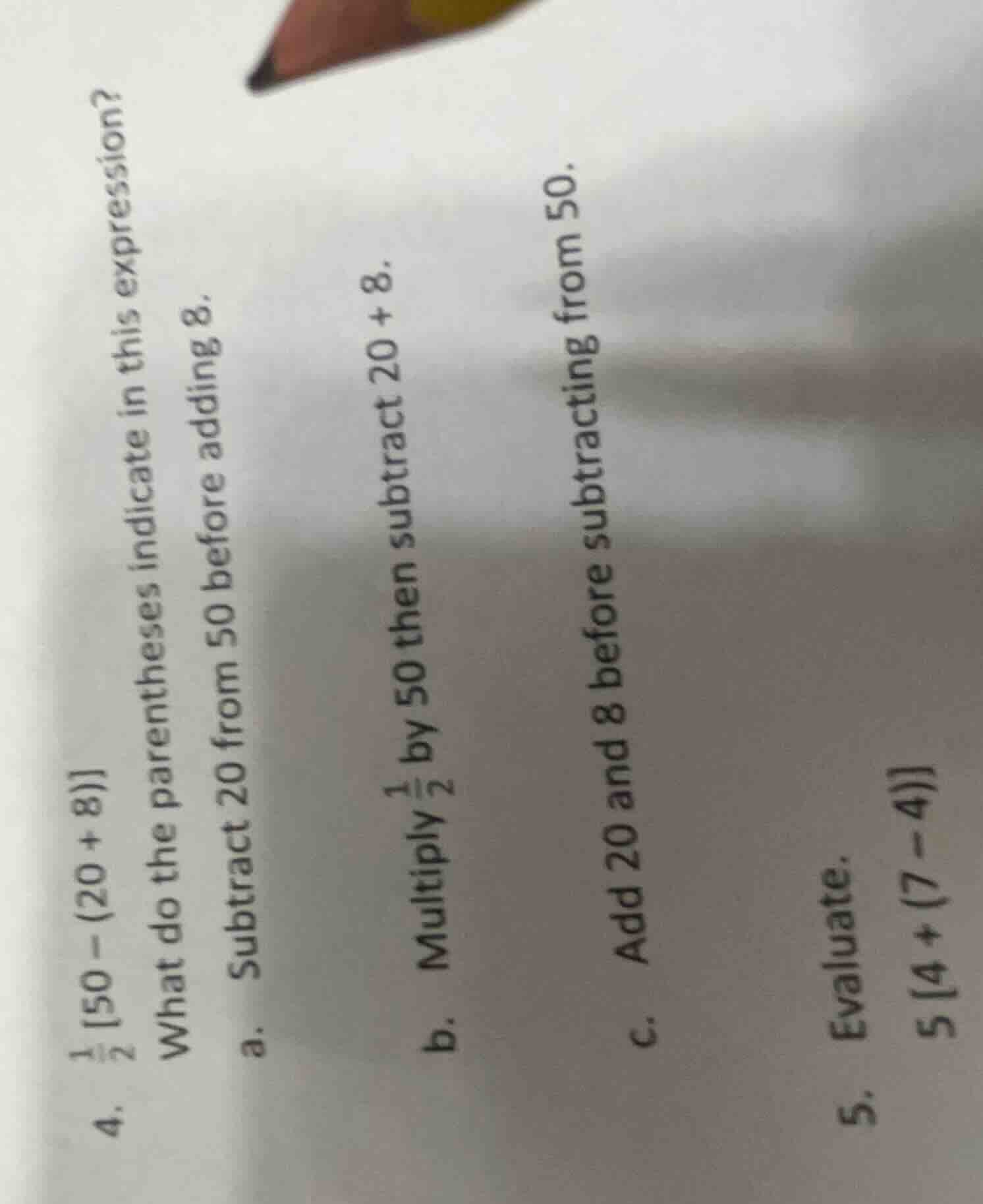
- \\(\frac{1}{2}50 - (20 + 8)\\)\
what do the parentheses indicate in this expression?\
\\(\boldsymbol{a}\\). subtract 20 from 50 before adding 8.\
\\(\boldsymbol{b}\\). multiply \\(\frac{1}{2}\\) by 50 then subtract 20 + 8.\
\\(\boldsymbol{c}\\). add 20 and 8 before subtracting from 50.\
- evaluate.\
\\(54 + (7 - 4)\\)
Response
Question 4
Step1: Analyze the expression $\frac{1}{2}[50 - (20 + 8)]$
The parentheses around $(20 + 8)$ mean we perform the addition of 20 and 8 first, then subtract that result from 50, and finally multiply by $\frac{1}{2}$. Let's check the options:
- Option a: Says "Subtract 20 from 50 before adding 8" – but the parentheses are around 20 + 8, so we add first, not subtract 20 from 50 first. So a is wrong.
- Option b: Says "Multiply $\frac{1}{2}$ by 50 then subtract 20 + 8" – the order here is multiply first, but the parentheses are about the addition inside the subtraction. The correct order from parentheses is add 20 and 8 first, then subtract from 50, then multiply by $\frac{1}{2}$. But let's check option c.
- Option c: Says "Add 20 and 8 before subtracting from 50" – the parentheses around $(20 + 8)$ indicate that we add 20 and 8 first, then subtract that sum (28) from 50 (so 50 - 28), and then multiply by $\frac{1}{2}$. So this matches the order of operations (PEMDAS/BODMAS: parentheses first, then subtraction inside the brackets, then multiplication). So option c is correct.
Step1: Evaluate the innermost parentheses first: $(7 - 4)$
$7 - 4 = 3$
Step2: Now evaluate the next parentheses: $[4 + (7 - 4)] = [4 + 3]$
$4 + 3 = 7$
Step3: Finally, multiply by 5: $5[4 + (7 - 4)] = 5\times7$
$5\times7 = 35$

Snap & solve any problem in the app
Get step-by-step solutions on Sovi AI
Photo-based solutions with guided steps
Explore more problems and detailed explanations
c. Add 20 and 8 before subtracting from 50.