QUESTION IMAGE
Question
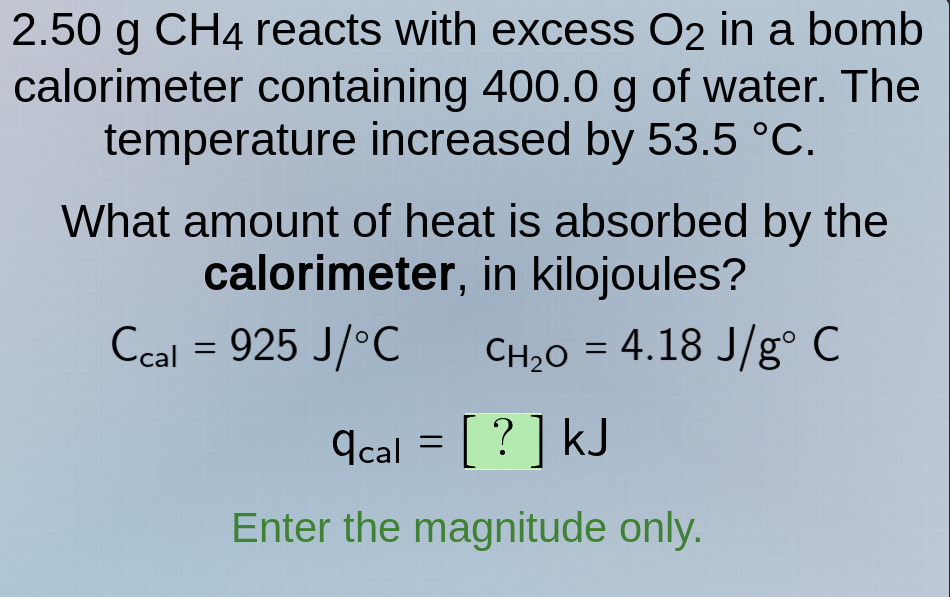
2.50 g ch₄ reacts with excess o₂ in a bomb calorimeter containing 400.0 g of water. the temperature increased by 53.5 °c. what amount of heat is absorbed by the calorimeter, in kilojoules? c₍cal₎ = 925 j/°c c₍h₂o₎ = 4.18 j/g° c q₍cal₎ = ? kj enter the magnitude only.
Step1: Calculate heat absorbed by water
The formula for heat absorbed by a substance is \( q = mc\Delta T \). For water, \( m = 400.0 \, \text{g} \), \( c = 4.18 \, \text{J/g}^\circ\text{C} \), and \( \Delta T = 53.5 \, ^\circ\text{C} \).
\[
q_{\text{water}} = 400.0 \, \text{g} \times 4.18 \, \text{J/g}^\circ\text{C} \times 53.5 \, ^\circ\text{C}
\]
\[
q_{\text{water}} = 400.0 \times 4.18 \times 53.5 \, \text{J}
\]
\[
q_{\text{water}} = 400.0 \times 224.63 \, \text{J}
\]
\[
q_{\text{water}} = 89852 \, \text{J}
\]
Step2: Calculate heat absorbed by the calorimeter itself
The formula for heat absorbed by the calorimeter is \( q_{\text{cal, itself}} = C_{\text{cal}} \Delta T \). Here, \( C_{\text{cal}} = 925 \, \text{J/}^\circ\text{C} \) and \( \Delta T = 53.5 \, ^\circ\text{C} \).
\[
q_{\text{cal, itself}} = 925 \, \text{J/}^\circ\text{C} \times 53.5 \, ^\circ\text{C}
\]
\[
q_{\text{cal, itself}} = 925 \times 53.5 \, \text{J}
\]
\[
q_{\text{cal, itself}} = 49487.5 \, \text{J}
\]
Step3: Total heat absorbed by the calorimeter system
The total heat absorbed by the calorimeter (\( q_{\text{cal}} \)) is the sum of the heat absorbed by the water and the heat absorbed by the calorimeter itself.
\[
q_{\text{cal}} = q_{\text{water}} + q_{\text{cal, itself}}
\]
\[
q_{\text{cal}} = 89852 \, \text{J} + 49487.5 \, \text{J}
\]
\[
q_{\text{cal}} = 139339.5 \, \text{J}
\]
Step4: Convert joules to kilojoules
To convert from joules to kilojoules, divide by 1000.
\[
q_{\text{cal}} = \frac{139339.5 \, \text{J}}{1000}
\]
\[
q_{\text{cal}} = 139.3395 \, \text{kJ}
\]

Snap & solve any problem in the app
Get step-by-step solutions on Sovi AI
Photo-based solutions with guided steps
Explore more problems and detailed explanations
139.34 (rounded to two decimal places, or as per significant figures, but the problem says magnitude only, so we can present it as approximately 139 or 139.34. If we calculate more precisely, the sum is 89852 + 49487.5 = 139339.5 J = 139.3395 kJ, which can be rounded to 139.34 or 139 depending on requirements. But let's check the calculation again for any errors. Wait, maybe I misread the problem? Wait, the problem says "amount of heat is absorbed by the calorimeter" – actually, in bomb calorimetry, the calorimeter's heat absorption includes both the water and the calorimeter's own heat capacity. Wait, but let's re-express:
Wait, maybe a simpler way: The total heat absorbed by the calorimeter system (water + calorimeter) is \( q = (mc\Delta T)_{\text{water}} + (C\Delta T)_{\text{cal}} \).
So:
\( q = (400 \times 4.18 \times 53.5) + (925 \times 53.5) \)
Factor out \( 53.5 \):
\( q = 53.5 \times (400 \times 4.18 + 925) \)
Calculate inside the parentheses:
\( 400 \times 4.18 = 1672 \)
\( 1672 + 925 = 2597 \)
Then \( q = 53.5 \times 2597 \)
\( 53.5 \times 2597 = 53.5 \times (2600 - 3) = 53.5 \times 2600 - 53.5 \times 3 = 139100 - 160.5 = 138939.5 \)? Wait, wait, I think I made a mistake in Step1. Wait, 4.18 53.5: 4 53.5 = 214, 0.18 53.5 = 9.63, so 214 + 9.63 = 223.63? Wait, no, 4.18 53.5: let's calculate 4.18 50 = 209, 4.18 3.5 = 14.63, so total 209 + 14.63 = 223.63. Then 400 223.63 = 89452 J. Oh! I see, earlier I miscalculated 4.18 53.5. Let's recalculate Step1:
\( q_{\text{water}} = 400.0 \, \text{g} \times 4.18 \, \text{J/g}^\circ\text{C} \times 53.5 \, ^\circ\text{C} \)
4.18 53.5: 53.5 4 = 214, 53.5 0.18 = 9.63, so 214 + 9.63 = 223.63. Then 400 223.63 = 89452 J.
Then Step2: \( q_{\text{cal, itself}} = 925 \times 53.5 = 49487.5 \, \text{J} \) (this was correct).
Then Step3: \( q_{\text{cal}} = 89452 + 49487.5 = 138939.5 \, \text{J} \)
Step4: Convert to kJ: \( 138939.5 \, \text{J} / 1000 = 138.9395 \, \text{kJ} \approx 138.94 \, \text{kJ} \) (or 139 kJ if rounded to three significant figures, since the given values: 2.50 g (three sig figs), 400.0 g (four), 53.5 (three), 925 (three), 4.18 (three). So the least number of sig figs in the multiplication steps is three, so the answer should have three sig figs. 138.9395 rounds to 139 kJ.
So correcting the earlier mistake in Step1, the correct total is:
\( q_{\text{water}} = 400.0 \times 4.18 \times 53.5 = 400.0 \times 223.63 = 89452 \, \text{J} \)
\( q_{\text{cal, itself}} = 925 \times 53.5 = 49487.5 \, \text{J} \)
\( q_{\text{cal}} = 89452 + 49487.5 = 138939.5 \, \text{J} = 138.9395 \, \text{kJ} \approx 139 \, \text{kJ} \) (or 138.9 kJ, 139 kJ).
Let me verify the calculation of 4.18 * 53.5:
53.5 * 4.18:
53.5 * 4 = 214
53.5 0.18 = 53.5 0.1 + 53.5 * 0.08 = 5.35 + 4.28 = 9.63
So 214 + 9.63 = 223.63. Correct. Then 400 * 223.63 = 89452. Correct.
Then 925 * 53.5:
53.5 * 900 = 48150
53.5 * 25 = 1337.5
So 48150 + 1337.5 = 49487.5. Correct.
Sum: 89452 + 49487.5 = 138939.5 J = 138.9395 kJ ≈ 139 kJ (three significant figures).
So the correct answer is approximately 139 kJ (or 138.9 kJ, 139.0 kJ, etc., depending on rounding).