QUESTION IMAGE
Question
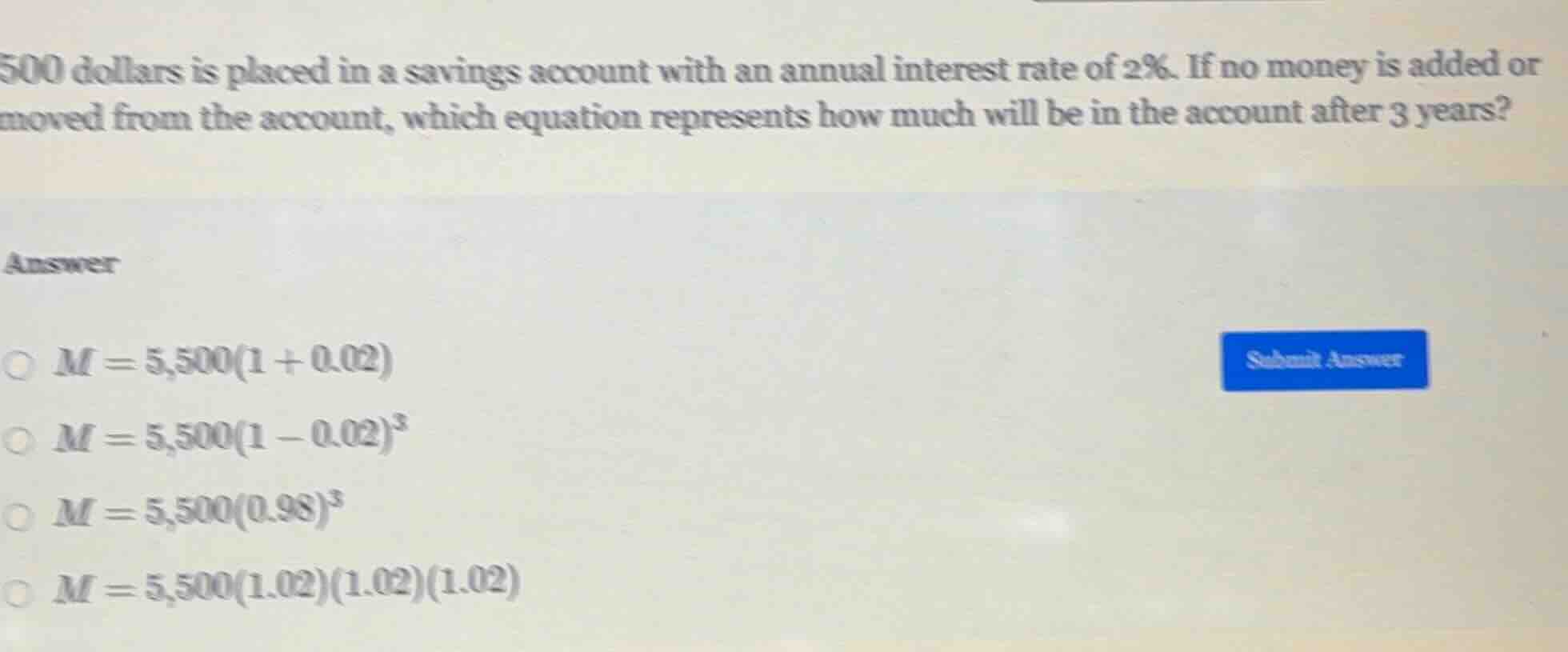
500 dollars is placed in a savings account with an annual interest rate of 2%. if no money is added or moved from the account, which equation represents how much will be in the account after 3 years?
answer
\\( m = 5,500(1 + 0.02) \\)
\\( m = 5,500(1 - 0.02)^3 \\)
\\( m = 5,500(0.98)^3 \\)
\\( m = 5,500(1.02)(1.02)(1.02) \\)
Step1: Recall compound interest formula
The formula for compound interest (annual compounding, no additional deposits/withdrawals) is $M = P(1 + r)^t$, where $P$ is principal, $r$ is annual interest rate, $t$ is time in years.
Step2: Identify given values
$P = 5500$, $r = 0.02$, $t = 3$
Step3: Match to options
Substitute values: $M = 5500(1 + 0.02)^3$, which is equivalent to $M = 5500(1.02)(1.02)(1.02)$ (since $(1.02)^3 = 1.02 \times 1.02 \times 1.02$). Other options are incorrect: first uses $t=1$, second/third use a decay factor (subtracting rate, which is for loss, not interest gain).

Snap & solve any problem in the app
Get step-by-step solutions on Sovi AI
Photo-based solutions with guided steps
Explore more problems and detailed explanations
$M = 5,500(1.02)(1.02)(1.02)$