QUESTION IMAGE
Question
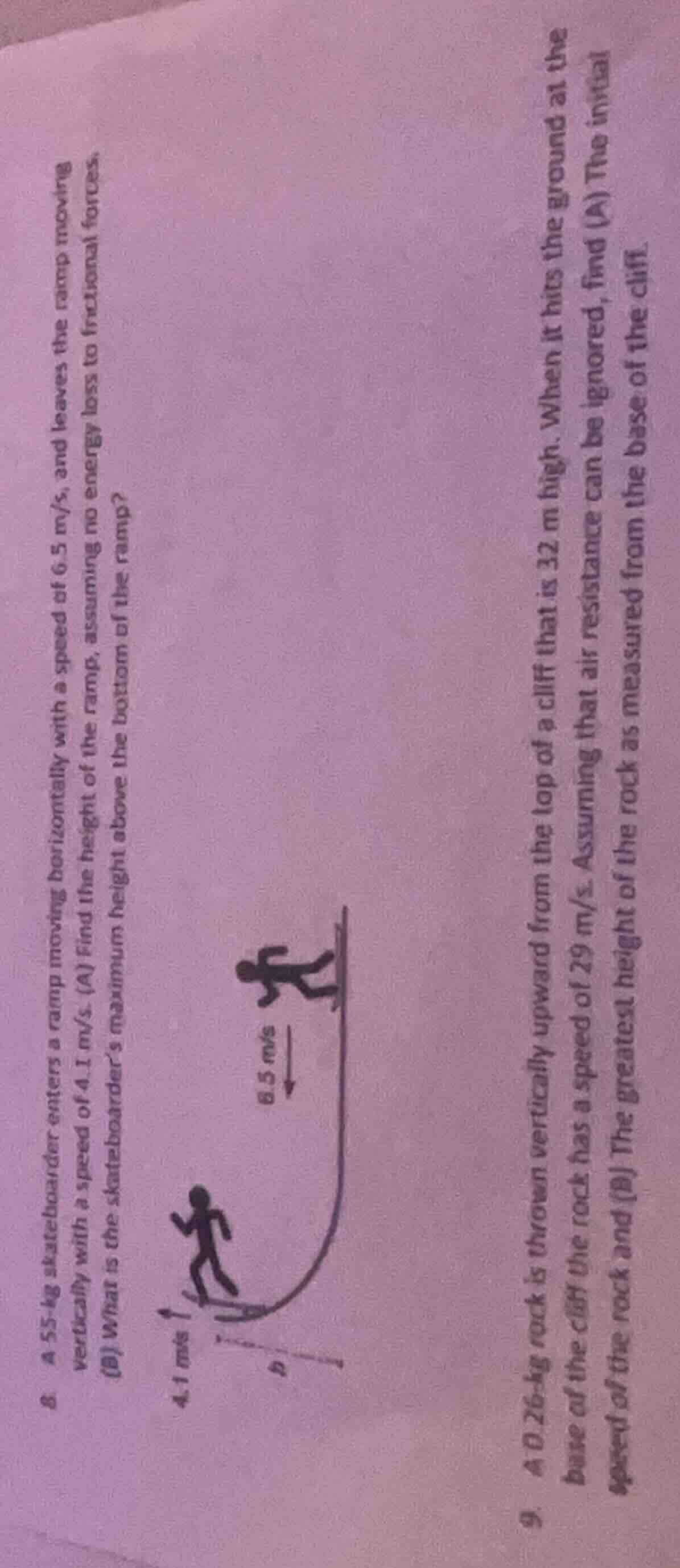
- a 55-kg skateboarder enters a ramp moving horizontally with a speed of 6.5 m/s, and leaves the ramp moving vertically with a speed of 4.1 m/s. (a) find the height of the ramp, assuming no energy loss to frictional forces. (b) what is the skateboarder’s maximum height above the bottom of the ramp?
- a 0.26-kg rock is thrown vertically upward from the top of a cliff that is 32 m high. when it hits the ground at the base of the cliff the rock has a speed of 29 m/s. assuming that air resistance can be ignored, find (a) the initial speed of the rock and (b) the greatest height of the rock as measured from the base of the cliff.
Problem 8 (Skateboarder on Ramp)
Part (A): Height of the Ramp
Step 1: Identify Energy Conservation
We use conservation of mechanical energy (kinetic to potential) since no energy loss to friction. Initial kinetic energy (vertical component) converts to gravitational potential energy at the top.
The vertical initial velocity is \( v_y = 4.1 \, \text{m/s} \), mass \( m = 55 \, \text{kg} \) (though mass cancels out). The formula for kinetic energy is \( KE = \frac{1}{2}mv^2 \) and potential energy is \( PE = mgh \). Setting \( KE_i = PE_f \):
\[ \frac{1}{2}mv_y^2 = mgh \]
Step 2: Solve for Height \( h \)
Cancel \( m \) from both sides:
\[ \frac{1}{2}v_y^2 = gh \]
Solve for \( h \):
\[ h = \frac{v_y^2}{2g} \]
Substitute \( v_y = 4.1 \, \text{m/s} \), \( g = 9.8 \, \text{m/s}^2 \):
\[ h = \frac{(4.1)^2}{2 \times 9.8} = \frac{16.81}{19.6} \approx 0.858 \, \text{m} \]
Part (B): Maximum Height Above Ramp Bottom
Step 1: Total Initial Vertical Kinetic Energy
The skateboarder has vertical velocity \( v_y = 4.1 \, \text{m/s} \) at the ramp bottom. At maximum height, vertical velocity is 0. Use \( v_f^2 = v_i^2 - 2gh' \) (upward motion, acceleration \( -g \)).
Set \( v_f = 0 \), solve for \( h' \) (height above ramp bottom):
\[ 0 = (4.1)^2 - 2 \times 9.8 \times h' \]
Step 2: Solve for \( h' \)
\[ 2 \times 9.8 \times h' = (4.1)^2 \]
\[ h' = \frac{16.81}{19.6} \approx 0.858 \, \text{m} \]
Wait, no—wait, the ramp's height is \( h \) from bottom to top, and then the skateboarder leaves the ramp with vertical velocity? Wait, no, re-reading: "enters a ramp moving horizontally with 6.5 m/s, leaves the ramp moving vertically with 4.1 m/s". Wait, maybe part (A) is the ramp's height: when entering horizontally (KE horizontal) and leaving vertically (KE vertical), so energy conservation: initial KE (horizontal) + initial PE (0) = final KE (vertical) + final PE (mgh). Wait, no, maybe I misread. Wait, the skateboarder enters the ramp with horizontal speed \( v_x = 6.5 \, \text{m/s} \) (so horizontal KE \( \frac{1}{2}mv_x^2 \)) and leaves with vertical speed \( v_y = 4.1 \, \text{m/s} \) (vertical KE \( \frac{1}{2}mv_y^2 \)) and height \( h \) above ramp bottom. So conservation of energy: initial mechanical energy (at ramp bottom: KE horizontal, PE 0) = final mechanical energy (at ramp top: KE vertical, PE \( mgh \)). Wait, no, horizontal and vertical? Wait, maybe the ramp converts horizontal motion to vertical? So initial KE is \( \frac{1}{2}m(6.5)^2 \), final energy is \( \frac{1}{2}m(4.1)^2 + mgh \). Wait, that makes more sense—energy conservation:
\[ \frac{1}{2}m(6.5)^2 = \frac{1}{2}m(4.1)^2 + mgh \]
Cancel \( m \):
\[ \frac{1}{2}(6.5^2 - 4.1^2) = gh \]
Calculate \( 6.5^2 = 42.25 \), \( 4.1^2 = 16.81 \), difference \( 42.25 - 16.81 = 25.44 \)
\[ \frac{25.44}{2} = 9.8h \]
\[ 12.72 = 9.8h \]
\[ h = \frac{12.72}{9.8} \approx 1.30 \, \text{m} \]
Ah, I made a mistake earlier—initial motion is horizontal (KE \( \frac{1}{2}mv_x^2 \)), final is vertical (KE \( \frac{1}{2}mv_y^2 \)) and PE \( mgh \). So correct part (A):
Step 1 (Correct for Part A): Energy Conservation
Initial KE (horizontal): \( KE_i = \frac{1}{2}mv_x^2 \)
Final Energy: \( KE_f + PE_f = \frac{1}{2}mv_y^2 + mgh \)
Set equal (no energy loss):
\[ \frac{1}{2}mv_x^2 = \frac{1}{2}mv_y^2 + mgh \]
Cancel \( m \):
\[ \frac{1}{2}(v_x^2 - v_y^2) = gh \]
Step 2: Solve for \( h \)
\[ h = \frac{v_x^2 - v_y^2}{2g} \]
Substitute \( v_x = 6.5 \, \text{m/s} \), \( v_y = 4.1 \, \text{m/s} \), \( g = 9.8 \, \text{m/s}^2 \):
\[ h = \frac{(6.5)^2 - (4.1)^2}{2 \times 9.8} = \frac{42.25 - 16.81}{19.6} = \frac{25.44}{19.6} \approx 1.30 \, \text{m} \]
Part (B): Maximum Height Above Ramp Bottom
After leaving the ramp, the skateboarder moves vertically upward with \( v_y = 4.1 \, \text{m/s} \). Use \( v_f^2 = v_i^2 - 2gh'' \), \( v_f = 0 \):
\[ 0 = (4.1)^2 - 2 \times 9.8 \times h'' \]
\[ h'' = \frac{(4.1)^2}{2 \times 9.8} = \frac{16.81}{19.6} \approx 0.858 \, \text{m} \]
Total maximum height above ramp bottom: \( h + h'' = 1.30 + 0.858 \approx 2.16 \, \text{m} \)? Wait, no—wait, when leaving the ramp, the skateboarder's vertical velocity is 4.1 m/s, and the ramp's height is \( h = 1.30 \, \text{m} \) above the bottom. Then, moving upward from the ramp's top (height \( h \) above bottom) with velocity 4.1 m/s, so maximum height above bottom is \( h + h'' \), where \( h'' \) is the height gained after leaving the ramp.
Problem 9 (Rock Thrown Vertically)
Part (A): Initial Speed of the Rock
Wait, the…

Snap & solve any problem in the app
Get step-by-step solutions on Sovi AI
Photo-based solutions with guided steps
Explore more problems and detailed explanations
Step 1: Total Initial Vertical Kinetic Energy
The skateboarder has vertical velocity \( v_y = 4.1 \, \text{m/s} \) at the ramp bottom. At maximum height, vertical velocity is 0. Use \( v_f^2 = v_i^2 - 2gh' \) (upward motion, acceleration \( -g \)).
Set \( v_f = 0 \), solve for \( h' \) (height above ramp bottom):
\[ 0 = (4.1)^2 - 2 \times 9.8 \times h' \]
Step 2: Solve for \( h' \)
\[ 2 \times 9.8 \times h' = (4.1)^2 \]
\[ h' = \frac{16.81}{19.6} \approx 0.858 \, \text{m} \]
Wait, no—wait, the ramp's height is \( h \) from bottom to top, and then the skateboarder leaves the ramp with vertical velocity? Wait, no, re-reading: "enters a ramp moving horizontally with 6.5 m/s, leaves the ramp moving vertically with 4.1 m/s". Wait, maybe part (A) is the ramp's height: when entering horizontally (KE horizontal) and leaving vertically (KE vertical), so energy conservation: initial KE (horizontal) + initial PE (0) = final KE (vertical) + final PE (mgh). Wait, no, maybe I misread. Wait, the skateboarder enters the ramp with horizontal speed \( v_x = 6.5 \, \text{m/s} \) (so horizontal KE \( \frac{1}{2}mv_x^2 \)) and leaves with vertical speed \( v_y = 4.1 \, \text{m/s} \) (vertical KE \( \frac{1}{2}mv_y^2 \)) and height \( h \) above ramp bottom. So conservation of energy: initial mechanical energy (at ramp bottom: KE horizontal, PE 0) = final mechanical energy (at ramp top: KE vertical, PE \( mgh \)). Wait, no, horizontal and vertical? Wait, maybe the ramp converts horizontal motion to vertical? So initial KE is \( \frac{1}{2}m(6.5)^2 \), final energy is \( \frac{1}{2}m(4.1)^2 + mgh \). Wait, that makes more sense—energy conservation:
\[ \frac{1}{2}m(6.5)^2 = \frac{1}{2}m(4.1)^2 + mgh \]
Cancel \( m \):
\[ \frac{1}{2}(6.5^2 - 4.1^2) = gh \]
Calculate \( 6.5^2 = 42.25 \), \( 4.1^2 = 16.81 \), difference \( 42.25 - 16.81 = 25.44 \)
\[ \frac{25.44}{2} = 9.8h \]
\[ 12.72 = 9.8h \]
\[ h = \frac{12.72}{9.8} \approx 1.30 \, \text{m} \]
Ah, I made a mistake earlier—initial motion is horizontal (KE \( \frac{1}{2}mv_x^2 \)), final is vertical (KE \( \frac{1}{2}mv_y^2 \)) and PE \( mgh \). So correct part (A):
Step 1 (Correct for Part A): Energy Conservation
Initial KE (horizontal): \( KE_i = \frac{1}{2}mv_x^2 \)
Final Energy: \( KE_f + PE_f = \frac{1}{2}mv_y^2 + mgh \)
Set equal (no energy loss):
\[ \frac{1}{2}mv_x^2 = \frac{1}{2}mv_y^2 + mgh \]
Cancel \( m \):
\[ \frac{1}{2}(v_x^2 - v_y^2) = gh \]
Step 2: Solve for \( h \)
\[ h = \frac{v_x^2 - v_y^2}{2g} \]
Substitute \( v_x = 6.5 \, \text{m/s} \), \( v_y = 4.1 \, \text{m/s} \), \( g = 9.8 \, \text{m/s}^2 \):
\[ h = \frac{(6.5)^2 - (4.1)^2}{2 \times 9.8} = \frac{42.25 - 16.81}{19.6} = \frac{25.44}{19.6} \approx 1.30 \, \text{m} \]
Part (B): Maximum Height Above Ramp Bottom
After leaving the ramp, the skateboarder moves vertically upward with \( v_y = 4.1 \, \text{m/s} \). Use \( v_f^2 = v_i^2 - 2gh'' \), \( v_f = 0 \):
\[ 0 = (4.1)^2 - 2 \times 9.8 \times h'' \]
\[ h'' = \frac{(4.1)^2}{2 \times 9.8} = \frac{16.81}{19.6} \approx 0.858 \, \text{m} \]
Total maximum height above ramp bottom: \( h + h'' = 1.30 + 0.858 \approx 2.16 \, \text{m} \)? Wait, no—wait, when leaving the ramp, the skateboarder's vertical velocity is 4.1 m/s, and the ramp's height is \( h = 1.30 \, \text{m} \) above the bottom. Then, moving upward from the ramp's top (height \( h \) above bottom) with velocity 4.1 m/s, so maximum height above bottom is \( h + h'' \), where \( h'' \) is the height gained after leaving the ramp.
Problem 9 (Rock Thrown Vertically)
Part (A): Initial Speed of the Rock
Wait, the problem says: "A 0.26-kg rock is thrown vertically upward from the top of a cliff that is 32 m high. When it hits the ground at the base of the cliff the rock has a speed of 29 m/s. Assuming air resistance ignored, find (A) The initial speed of the rock and (B) The greatest height of the rock as measured from the base of the cliff."
Part (A): Initial Speed \( v_0 \)
Use conservation of energy: initial energy (at top of cliff: KE \( \frac{1}{2}mv_0^2 \) + PE \( mgh \)) = final energy (at ground: KE \( \frac{1}{2}mv_f^2 \), PE 0).
\[ \frac{1}{2}mv_0^2 + mgh = \frac{1}{2}mv_f^2 \]
Cancel \( m \):
\[ \frac{1}{2}v_0^2 + gh = \frac{1}{2}v_f^2 \]
Solve for \( v_0 \):
\[ \frac{1}{2}v_0^2 = \frac{1}{2}v_f^2 - gh \]
\[ v_0^2 = v_f^2 - 2gh \]
\[ v_0 = \sqrt{v_f^2 - 2gh} \]
Substitute \( v_f = 29 \, \text{m/s} \), \( h = 32 \, \text{m} \), \( g = 9.8 \, \text{m/s}^2 \):
\[ v_0 = \sqrt{(29)^2 - 2 \times 9.8 \times 32} \]
\[ (29)^2 = 841 \]
\[ 2 \times 9.8 \times 32 = 627.2 \]
\[ v_0 = \sqrt{841 - 627.2} = \sqrt{213.8} \approx 14.62 \, \text{m/s} \]
Part (B): Greatest Height from Base of Cliff
First, find height above cliff top: \( h_1 = \frac{v_0^2}{2g} \) (from \( v_f^2 = v_0^2 - 2gh_1 \), \( v_f = 0 \))
\[ h_1 = \frac{(14.62)^2}{2 \times 9.8} \approx \frac{213.8}{19.6} \approx 10.91 \, \text{m} \]
Total height from base: \( 32 + 10.91 \approx 42.91 \, \text{m} \)