QUESTION IMAGE
Question
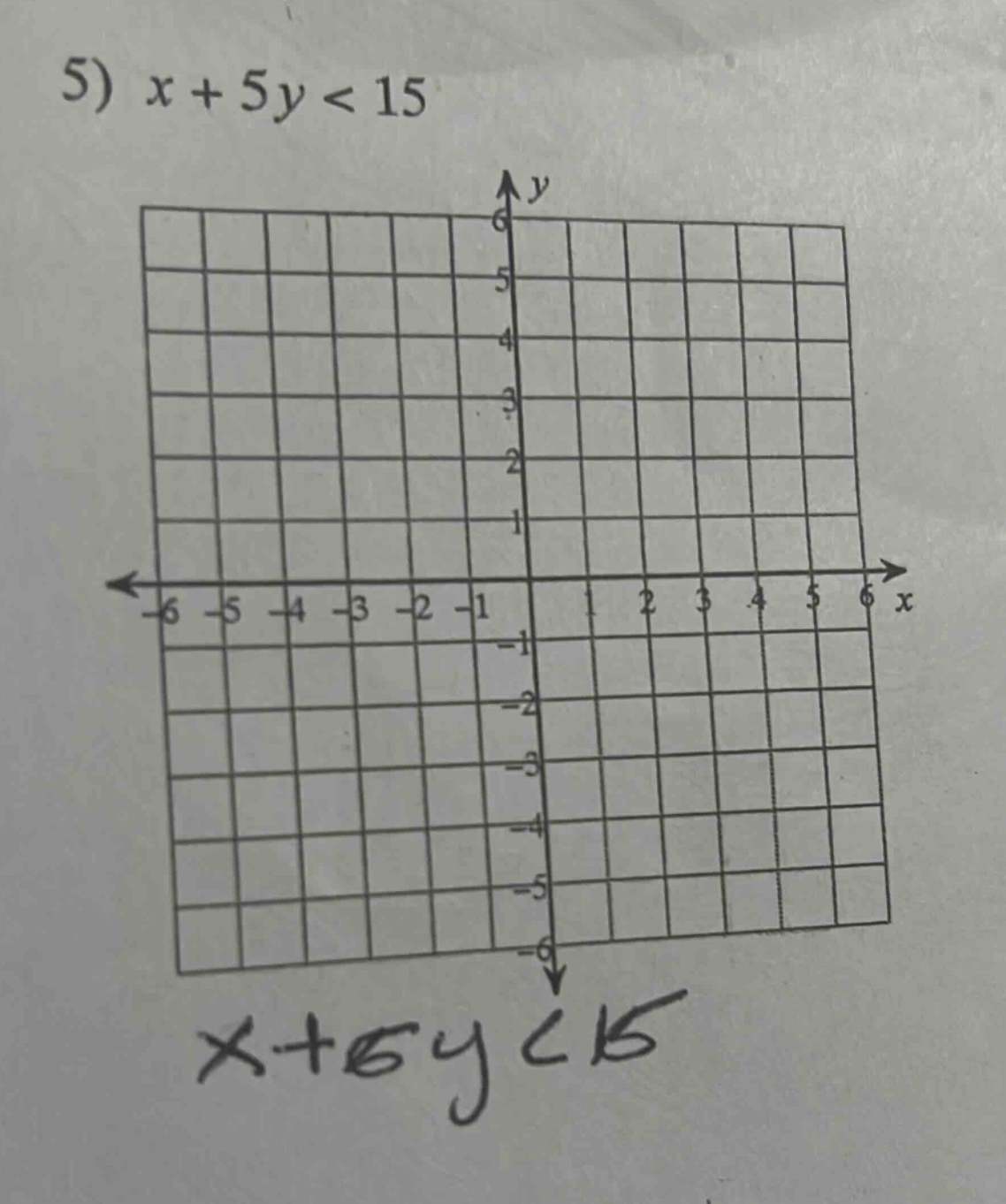
- ( x + 5y < 15 )
Step1: Rewrite the inequality in slope - intercept form
We start with the inequality \(x + 5y<15\). To get it in the form \(y = mx + b\) (or in this case, an inequality), we solve for \(y\).
Subtract \(x\) from both sides: \(5y<-x + 15\).
Then divide each term by \(5\): \(y<-\frac{1}{5}x + 3\).
Step2: Graph the boundary line
The boundary line is \(y = -\frac{1}{5}x+3\) (since the inequality is strict, \(<\), we use a dashed line).
- Find the \(y\) - intercept: When \(x = 0\), \(y=3\). So the line passes through the point \((0,3)\).
- Find the \(x\) - intercept: When \(y = 0\), \(0=-\frac{1}{5}x + 3\). Add \(\frac{1}{5}x\) to both sides: \(\frac{1}{5}x=3\). Multiply both sides by \(5\): \(x = 15\). But since our graph only goes up to \(x = 6\) and \(y=6\), we can also use another point. For example, when \(x = 5\), \(y=-\frac{1}{5}(5)+3=- 1 + 3=2\). So the line also passes through \((5,2)\).
Step3: Determine the region to shade
We test a point not on the line. A common test point is the origin \((0,0)\).
Substitute \(x = 0\) and \(y = 0\) into the inequality \(y<-\frac{1}{5}x + 3\):
\(0<-\frac{1}{5}(0)+3\), which simplifies to \(0 < 3\). This is true.
So we shade the region that contains the origin \((0,0)\) (the region below the dashed line \(y=-\frac{1}{5}x + 3\)).
To graph \(x + 5y<15\):
- Draw the dashed line \(y=-\frac{1}{5}x + 3\) (passing through \((0,3)\) and \((5,2)\) (or other points on the line)).
- Shade the region below the dashed line (since the test point \((0,0)\) satisfies the inequality).

Snap & solve any problem in the app
Get step-by-step solutions on Sovi AI
Photo-based solutions with guided steps
Explore more problems and detailed explanations
Step1: Rewrite the inequality in slope - intercept form
We start with the inequality \(x + 5y<15\). To get it in the form \(y = mx + b\) (or in this case, an inequality), we solve for \(y\).
Subtract \(x\) from both sides: \(5y<-x + 15\).
Then divide each term by \(5\): \(y<-\frac{1}{5}x + 3\).
Step2: Graph the boundary line
The boundary line is \(y = -\frac{1}{5}x+3\) (since the inequality is strict, \(<\), we use a dashed line).
- Find the \(y\) - intercept: When \(x = 0\), \(y=3\). So the line passes through the point \((0,3)\).
- Find the \(x\) - intercept: When \(y = 0\), \(0=-\frac{1}{5}x + 3\). Add \(\frac{1}{5}x\) to both sides: \(\frac{1}{5}x=3\). Multiply both sides by \(5\): \(x = 15\). But since our graph only goes up to \(x = 6\) and \(y=6\), we can also use another point. For example, when \(x = 5\), \(y=-\frac{1}{5}(5)+3=- 1 + 3=2\). So the line also passes through \((5,2)\).
Step3: Determine the region to shade
We test a point not on the line. A common test point is the origin \((0,0)\).
Substitute \(x = 0\) and \(y = 0\) into the inequality \(y<-\frac{1}{5}x + 3\):
\(0<-\frac{1}{5}(0)+3\), which simplifies to \(0 < 3\). This is true.
So we shade the region that contains the origin \((0,0)\) (the region below the dashed line \(y=-\frac{1}{5}x + 3\)).
To graph \(x + 5y<15\):
- Draw the dashed line \(y=-\frac{1}{5}x + 3\) (passing through \((0,3)\) and \((5,2)\) (or other points on the line)).
- Shade the region below the dashed line (since the test point \((0,0)\) satisfies the inequality).