QUESTION IMAGE
Question
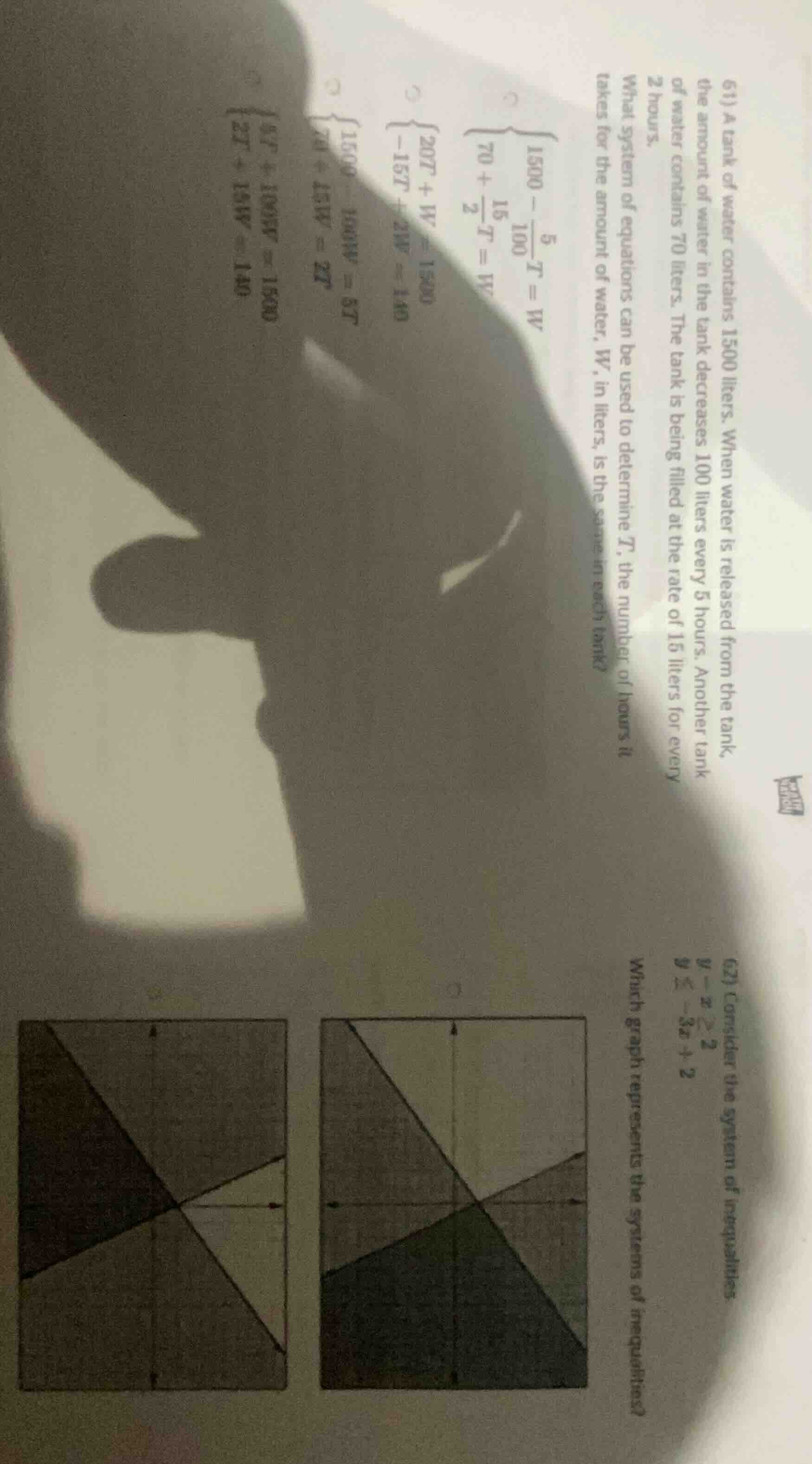
- a tank of water contains 1500 liters. when water is released from the tank, the amount of water in the tank decreases 100 liters every 5 hours. another tank of water contains 70 liters. the tank is being filled at the rate of 15 liters for every 2 hours. what system of equations can be used to determine ( t ), the number of hours it takes for the amount of water, ( w ), in liters, is the same in each tank?
options:
( \begin{cases} 1500 - \frac{5}{100}t = w \\ 70 + \frac{15}{2}t = w end{cases} )
( \begin{cases} 20t + w = 1500 \\ -15t + 2w = 140 end{cases} )
( \begin{cases} 1500 - 100w = 5t \\ 70 + 15w = 2t end{cases} )
( \begin{cases} 5t + 100w = 1500 \\ 2t + 15w = 140 end{cases} )
- consider the system of inequalities
( \begin{cases} y - x geq 2 \\ y leq -3x + 2 end{cases} )
which graph represents the system of inequalities? (images of graphs are shown but omitted here)
Step1: Analyze the first tank (releasing water)
The first tank starts with 1500 liters and releases 100 liters every 5 hours. The rate of water release per hour is $\frac{100}{5} = 20$ liters per hour? Wait, no, wait. Wait, the problem says "the amount of water in the tank decreases 100 liters every 5 hours". So the rate of decrease is $\frac{100}{5} = 20$ liters per hour? Wait, no, the equation for the first tank: initial volume is 1500, and it decreases by $\frac{100}{5}T$? Wait, no, let's re - read. The first tank: "A tank of water contains 1500 liters. When water is released from the tank, the amount of water in the tank decreases 100 liters every 5 hours." So the rate of decrease is $\frac{100}{5}=20$ liters per hour? Wait, no, the time is T hours. So the amount of water released in T hours is $\frac{100}{5}T$ (since 100 liters in 5 hours, so per hour it's 20 liters, so in T hours it's 20T? Wait, no, the first equation in the options is $1500-\frac{5}{100}T = W$? Wait, no, maybe I misread. Wait, the first tank: the amount of water decreases 100 liters every 5 hours. So the rate of decrease is $\frac{100}{5} = 20$ liters per hour. So the amount of water in the first tank after T hours is $W=1500 - 20T$? Wait, but the first option's first equation is $1500-\frac{5}{100}T=W$? Wait, no, maybe the problem has a typo, or I misread. Wait, the second tank: "Another tank of water contains 70 liters. The tank is being filled at the rate of 15 liters for every 2 hours." So the rate of filling is $\frac{15}{2}$ liters per hour. So the amount of water in the second tank after T hours is $W = 70+\frac{15}{2}T$. Now let's check the first option:
Wait, $\frac{5}{100}T=\frac{1}{20}T$, which is not 20T. Wait, maybe the first tank's rate is 100 liters every 5 hours, so the time to release 100 liters is 5 hours, so the rate is $\frac{100}{5}=20$ liters per hour. So the amount of water in the first tank is $W = 1500-20T$. But the first option's first equation is $1500-\frac{5}{100}T=W$, which is $1500 - 0.05T=W$, which is not correct. Wait, maybe the problem meant that the amount of water decreases 5 liters every 100 hours? No, that doesn't make sense. Wait, maybe the first tank: the amount of water decreases 100 liters every 5 hours, so the rate is $\frac{100}{5}=20$ liters per hour. So the equation for the first tank is $W = 1500-20T$. The second tank: 70 liters initial, filled at 15 liters every 2 hours, so rate is $\frac{15}{2}$ liters per hour, so equation is $W=70+\frac{15}{2}T$. Now let's check the options. The first option is
. Wait, $\frac{5}{100}T=\frac{1}{20}T = 0.05T$, which is not 20T. Wait, maybe the problem has a mistake, or I misread the first tank's rate. Wait, maybe the first tank's rate is 5 liters every 100 hours? No, that's too slow. Wait, let's check the other options. The second option:
. Let's rearrange the first equation: $W = 1500 - 20T$, which matches our first - tank equation (since 20T is the amount released). The second tank: $W=70+\frac{15}{2}T$, multiply both sides by 2: $2W=140 + 15T$, or $-15T+2W = 140$, which matches the second equation of the second option. Wait, so let's verify:
First tank: initial volume 1500, rate of decrease 20 liters per hour (100 liters in 5 hours, so 100/5 = 20). So $W=1500 - 20T$, which can be rewritten as $20T+W = 1500$.
Second tank: initial volume 70, rate of increase $\frac{15}{2}$ liters per…

Snap & solve any problem in the app
Get step-by-step solutions on Sovi AI
Photo-based solutions with guided steps
Explore more problems and detailed explanations
The second option (the system
)