QUESTION IMAGE
Question
625 - 34
break a ten
break a hundred
break a ten and a hundred
none of these
Step1: Analyze the subtraction \(625 - 34\)
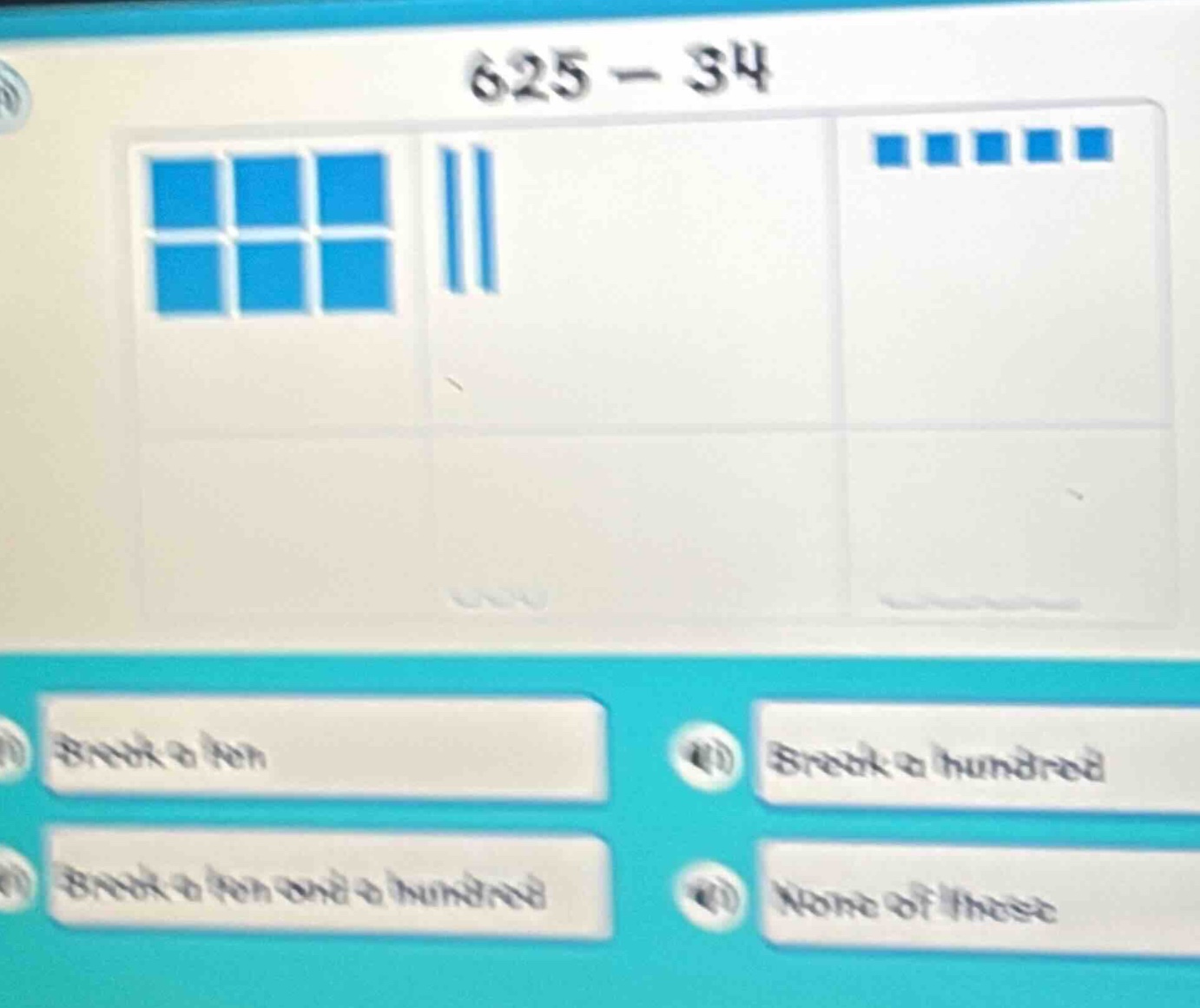
We look at the digits in the tens and ones places. The number \(625\) has \(2\) tens and \(5\) ones, and we are subtracting \(3\) tens and \(4\) ones? Wait, no, \(34\) is \(3\) tens and \(4\) ones. Wait, actually, \(625\) is \(6\) hundreds, \(2\) tens, and \(5\) ones. \(34\) is \(0\) hundreds, \(3\) tens, and \(4\) ones. But when subtracting the tens place, we have \(2\) tens and we need to subtract \(3\) tens? Wait, no, maybe the model is using base - ten blocks. The \(625\) can be represented as \(6\) hundreds (maybe the 6 squares, but wait the first part has 6 squares? Wait, the first part has 6 blue squares (maybe hundreds), then 2 blue lines (tens), and 5 blue small squares (ones). We need to subtract \(34\), which is \(3\) tens and \(4\) ones. But we only have \(2\) tens. So we need to "break a hundred" (since 1 hundred is 10 tens) to get more tens. Wait, no, if we have \(2\) tens and we need \(3\) tens, we can take 1 hundred (from the 6 hundreds) and convert it to 10 tens. So we break a hundred (100) into 10 tens. Then we have \(6 - 1=5\) hundreds, \(2 + 10 = 12\) tens, and \(5\) ones. Then we can subtract \(3\) tens and \(4\) ones. But wait, the options are "Break a ten", "Break a hundred", "Break a ten and a hundred", "None of these". Wait, maybe I misread the number. Wait, \(625\): the first block (hundreds) has 6, tens has 2, ones has 5. \(34\) is 3 tens and 4 ones. So in the tens place, we have 2 tens, need to subtract 3 tens. So we need to get 10 more tens by breaking a hundred (since 1 hundred = 10 tens). So we break a hundred. Wait, but let's check the options. Wait, maybe the number is \(625\), and we are subtracting \(34\). Let's do the subtraction: \(625-34 = 591\). But in terms of base - ten blocks, when subtracting the tens digit: we have 2 tens, need to subtract 3 tens. So we need to borrow from the hundreds place (break a hundred into 10 tens). So the correct option is "Break a hundred"? Wait, no, wait the tens digit in \(625\) is 2, and in \(34\) is 3. So 2 < 3, so we need to borrow from the hundreds place (break a hundred) to get 10 more tens. So the operation is to break a hundred. Wait, but let's check the options again. The options are:
- Break a ten: If we break a ten, we get 10 ones, but we need more tens, not ones (since we have 5 ones and we are subtracting 4 ones, so ones place is okay: \(5 - 4=1\)). The problem is in the tens place: \(2\) tens - \(3\) tens. So we need to get more tens, which comes from breaking a hundred (1 hundred = 10 tens). So we break a hundred.
Wait, but maybe the number is different. Wait, the first block (hundreds) has 6, tens has 2, ones has 5. \(34\) is 3 tens and 4 ones. So ones: \(5 - 4 = 1\) (no problem). Tens: \(2-3\), can't do, so we need to borrow from hundreds. So we take 1 hundred (from 6) and make it 10 tens. So we break a hundred. So the correct option is "Break a hundred". Wait, but let's check the options. The options are:
- Break a ten
- Break a hundred
- Break a ten and a hundred
- None of these
So the answer should be "Break a hundred". Wait, but maybe I made a mistake. Wait, \(625-34\):
\(625-30 = 595\), then \(595 - 4=591\). But in terms of base - ten subtraction, when subtracting the tens: 2 tens - 3 tens. So we need to borrow 1 hundred (100) to get 10 tens. So we break a hundred. So the correct option is "Break a hundred".
Wait, but let's re - examine the base - ten blocks. The hundreds place has 6, tens has 2, ones has 5. We need to subtract 3 tens and 4 ones. Ones: 5 - 4 = 1 (okay). Tens: 2 - 3. We…
To subtract \(625-34\) using base - ten blocks, we analyze the place values. \(625\) has \(2\) tens, and we need to subtract \(3\) tens (from \(34\)). Since \(2<3\), we borrow \(1\) hundred (equivalent to \(10\) tens) from the hundreds place. This means we "Break a hundred" to get enough tens for the subtraction in the tens place.

Snap & solve any problem in the app
Get step-by-step solutions on Sovi AI
Photo-based solutions with guided steps
Explore more problems and detailed explanations
B. Break a hundred