QUESTION IMAGE
Question
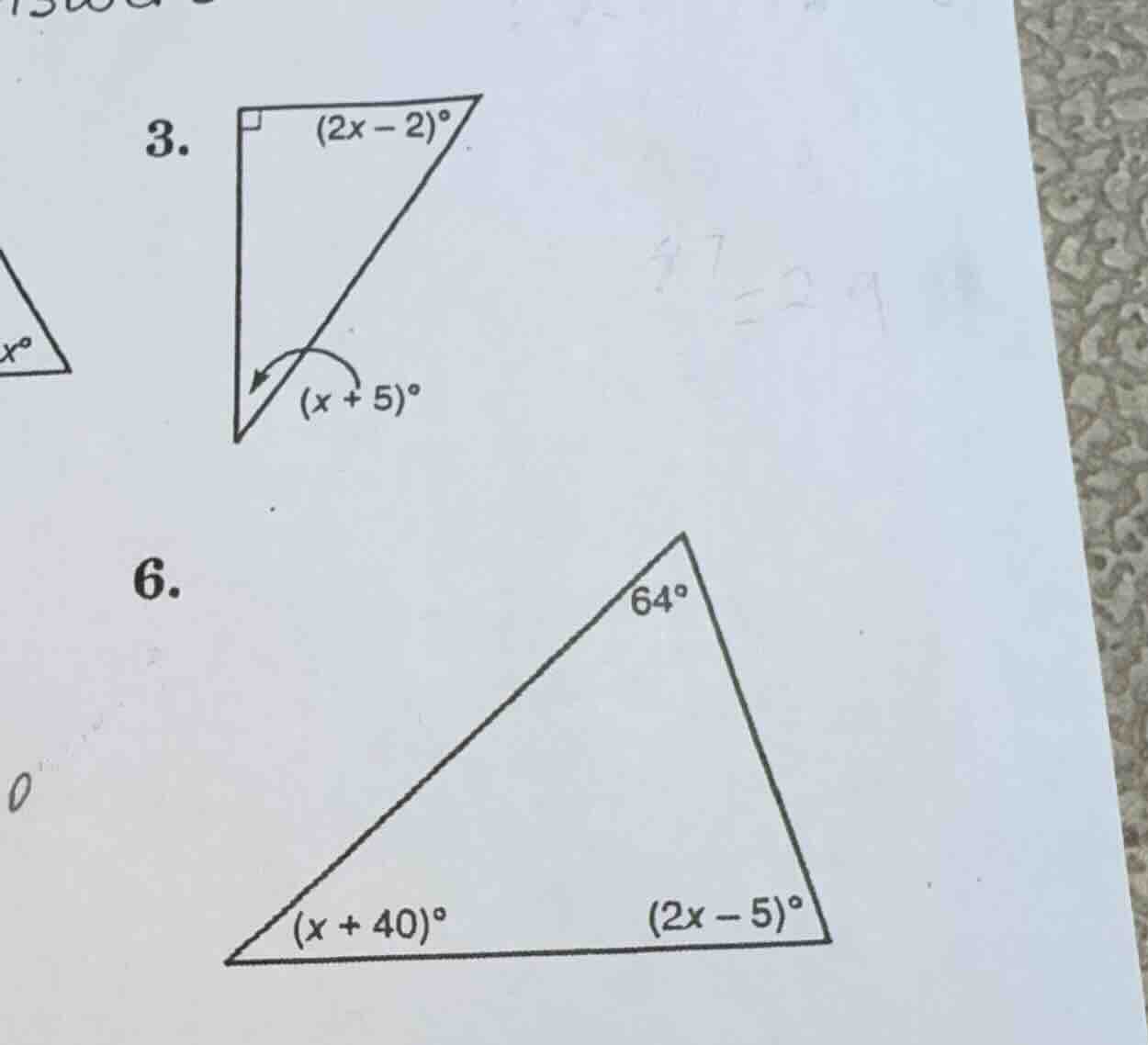
3.
6.
64°
(x + 40)°
(2x - 5)°
Problem 3:
Step1: Recall triangle angle sum (right triangle)
In a right triangle, the sum of the two non - right angles and the right angle (90°) is 180°. But also, the exterior angle is equal to the sum of the two non - adjacent interior angles. Wait, actually, for the right triangle, the two acute angles should add up to 90°, and the exterior angle \((x + 5)^{\circ}\) is equal to the sum of the two non - adjacent interior angles of the right triangle. The right triangle has a right angle (90°) and an angle \((2x-2)^{\circ}\), so the third angle (the one not adjacent to the exterior angle) is \(90-(2x - 2)=92 - 2x\) degrees. But the exterior angle \((x + 5)^{\circ}\) is equal to the sum of the two non - adjacent interior angles of the triangle, which are \((2x-2)^{\circ}\) and \(90^{\circ}\)? Wait, no, let's correct. In a right triangle, the two acute angles sum to 90°, so \((2x - 2)+ \text{the other acute angle}=90\). And the exterior angle \((x + 5)\) is equal to the sum of the two non - adjacent interior angles of the triangle, which are the right angle (90°) and \((2x-2)^{\circ}\)? Wait, no, the exterior angle theorem states that an exterior angle of a triangle is equal to the sum of the two non - adjacent interior angles. So for the right triangle, the exterior angle \((x + 5)^{\circ}\) is equal to the sum of the right angle (90°) and \((2x-2)^{\circ}\)? Wait, no, that can't be. Wait, maybe I misread the diagram. The right triangle has angles: 90°, \((2x - 2)^{\circ}\), and the third angle (let's call it \(A\)). Then the exterior angle \((x + 5)^{\circ}\) is adjacent to angle \(A\), so \(A+(x + 5)=180\), and also \(90+(2x - 2)+A = 180\). Let's solve the second equation: \(90+2x-2+A=180\Rightarrow 88 + 2x+A=180\Rightarrow A = 92 - 2x\). Then from the first equation: \((92 - 2x)+(x + 5)=180\Rightarrow97 - x=180\), which gives a negative \(x\), so that's wrong. Wait, maybe the exterior angle is equal to the sum of the two acute angles of the right triangle. So \((x + 5)=(2x - 2)+90\)? No, that would be if the exterior angle is outside the right angle. Wait, maybe the triangle is a right triangle, so the two acute angles sum to 90°, so \((2x - 2)+(x + 5)=90\)? Let's try that.
Step2: Solve the equation
If \((2x-2)+(x + 5)=90\)
Combine like terms: \(2x+x-2 + 5=90\)
\(3x+3 = 90\)
Subtract 3 from both sides: \(3x=90 - 3=87\)
Divide by 3: \(x=\frac{87}{3}=29\)
Problem 6:
Step1: Recall triangle angle sum theorem
The sum of the interior angles of a triangle is 180°. So we have the angles \(64^{\circ}\), \((x + 40)^{\circ}\), and \((2x-5)^{\circ}\). So the equation is \(64+(x + 40)+(2x-5)=180\)
Step2: Simplify the left - hand side
Combine like terms: \(64+40-5+x + 2x=180\)
\(99 + 3x=180\)
Step3: Solve for \(x\)
Subtract 99 from both sides: \(3x=180 - 99=81\)
Divide by 3: \(x=\frac{81}{3}=27\)
Problem 3 Answer:
\(x = 29\)
Problem 6 Answer:
\(x=27\)

Snap & solve any problem in the app
Get step-by-step solutions on Sovi AI
Photo-based solutions with guided steps
Explore more problems and detailed explanations
Step1: Recall triangle angle sum theorem
The sum of the interior angles of a triangle is 180°. So we have the angles \(64^{\circ}\), \((x + 40)^{\circ}\), and \((2x-5)^{\circ}\). So the equation is \(64+(x + 40)+(2x-5)=180\)
Step2: Simplify the left - hand side
Combine like terms: \(64+40-5+x + 2x=180\)
\(99 + 3x=180\)
Step3: Solve for \(x\)
Subtract 99 from both sides: \(3x=180 - 99=81\)
Divide by 3: \(x=\frac{81}{3}=27\)
Problem 3 Answer:
\(x = 29\)
Problem 6 Answer:
\(x=27\)