QUESTION IMAGE
Question
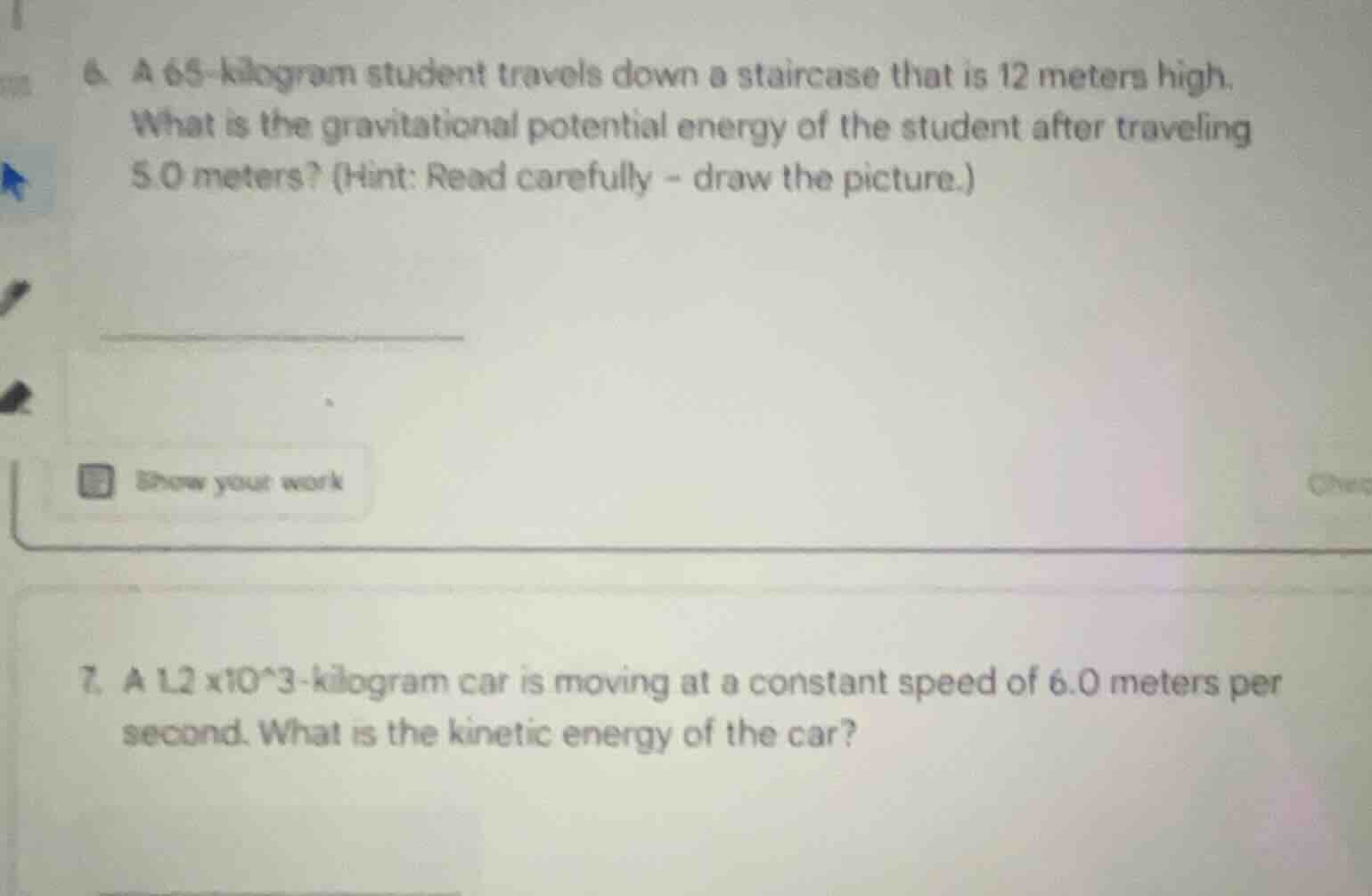
- a 65 - kilogram student travels down a staircase that is 12 meters high. what is the gravitational potential energy of the student after traveling 5.0 meters? (hint: read carefully - draw the picture.)
- a 1.2×10³ - kilogram car is moving at a constant speed of 6.0 meters per second. what is the kinetic energy of the car?
Problem 6
Step1: Determine the remaining height
The total height of the staircase is 12 m. After traveling 5.0 m down, we need to find the remaining height (h) above the ground. Assuming the staircase is vertical (or the height change is vertical), the remaining height is \( h = 12 - 5.0 = 7.0 \, \text{m} \) (wait, no—wait, when moving down a staircase, the vertical drop? Wait, maybe the 5.0 meters is the distance along the staircase, but gravitational potential energy depends on vertical height. Wait, maybe the staircase is 12 m high, so the vertical height. Wait, the hint says to draw the picture. Maybe the student is moving down 5.0 meters along the staircase, but the vertical height from the ground is \( 12 - 5.0 \)? Wait, no, maybe the staircase's total vertical height is 12 m, and after moving 5.0 m down (vertical), but no, the problem says "travels down a staircase that is 12 meters high"—so the staircase's vertical height is 12 m. So when the student travels 5.0 meters down (vertical distance), the remaining height is \( 12 - 5.0 = 7.0 \, \text{m} \)? Wait, no, maybe the 5.0 meters is the distance along the staircase, but gravitational potential energy is \( PE = mgh \), where h is the vertical height above the ground. Wait, maybe the staircase is vertical? So the initial height is 12 m, after moving down 5.0 m, the height above ground is \( 12 - 5.0 = 7.0 \, \text{m} \). Wait, but let's check the formula. Gravitational potential energy is \( PE = mgh \), where \( g = 9.8 \, \text{m/s}^2 \), \( m = 65 \, \text{kg} \), \( h \) is the height above the ground.
Wait, maybe I misread. The student travels down a staircase that is 12 meters high. So the staircase's vertical height is 12 m. After traveling 5.0 meters (vertical distance) down, the height from the ground is \( 12 - 5.0 = 7.0 \, \text{m} \). Then \( PE = mgh = 65 \times 9.8 \times 7.0 \). Wait, but let's do the steps properly.
Step1: Recall the formula for gravitational potential energy
The formula for gravitational potential energy (relative to the ground) is \( PE = mgh \), where \( m \) is mass, \( g = 9.8 \, \text{m/s}^2 \), and \( h \) is the vertical height above the ground.
Step2: Determine the vertical height (h) after traveling 5.0 m down
The staircase is 12 m high (vertical height). After traveling 5.0 m down (vertical distance), the remaining height above the ground is \( h = 12 - 5.0 = 7.0 \, \text{m} \). Wait, but maybe the 5.0 meters is the distance along the staircase, but the vertical height? No, the problem says "travels down a staircase that is 12 meters high"—so the staircase's vertical height is 12 m. So moving down 5.0 m vertically, so h = 12 - 5.0 = 7.0 m.
Step3: Calculate PE
Now, plug in the values: \( m = 65 \, \text{kg} \), \( g = 9.8 \, \text{m/s}^2 \), \( h = 7.0 \, \text{m} \).
\( PE = 65 \times 9.8 \times 7.0 \)
First, calculate \( 65 \times 9.8 = 637 \)
Then, \( 637 \times 7.0 = 4459 \, \text{J} \)
Wait, but maybe I made a mistake in the height. Wait, maybe the staircase is 12 m high, so the initial height is 12 m, and after moving 5.0 m down (vertical), the height is 12 - 5 = 7 m. That seems right.
Problem 7
Step1: Recall the formula for kinetic energy
The formula for kinetic energy is \( KE = \frac{1}{2}mv^2 \), where \( m \) is mass and \( v \) is speed.
Step2: Identify the values
\( m = 1.2 \times 10^3 \, \text{kg} \), \( v = 6.0 \, \text{m/s} \)
Step3: Plug into the formula
\( KE = \frac{1}{2} \times (1.2 \times 10^3) \times (6.0)^2 \)
First, calculate \( (6.0)^2 = 36 \)
Then, \( \frac{1}{2} \times 1.2 \times 10^3 = 600 \)
Then, \( 600 \times 36 = 21600 \, \text{J} \) or \( 2.16 \times 10^4 \, \text{J} \)
Problem 6 Answer:
Let's recheck Problem 6. Wait, maybe the 5.0 meters is the distance along the staircase, but the vertical height is different? Wait, no, the problem says "travels down a staircase that is 12 meters high"—so the staircase's vertical height is 12 m. So when the student travels 5.0 meters down (vertical), the height above ground is \( 12 - 5.0 = 7.0 \, \text{m} \). Then \( PE = 65 \times 9.8 \times 7.0 = 65 \times 68.6 = 4459 \, \text{J} \approx 4500 \, \text{J} \) or 4.5 × 10³ J. But let's do it correctly:
\( PE = mgh = 65 \, \text{kg} \times 9.8 \, \text{m/s}^2 \times (12 - 5.0) \, \text{m} \)
\( 12 - 5.0 = 7.0 \, \text{m} \)
\( 65 \times 9.8 = 637 \)
\( 637 \times 7 = 4459 \, \text{J} \approx 4.5 \times 10^3 \, \text{J} \) (or 4460 J)
Problem 7 Answer:
\( KE = \frac{1}{2}mv^2 = 0.5 \times 1200 \, \text{kg} \times (6 \, \text{m/s})^2 = 0.5 \times 1200 \times 36 = 600 \times 36 = 21600 \, \text{J} = 2.16 \times 10^4 \, \text{J} \)
Final Answers:
Problem 6:
Step1: Find remaining height
Staircase height \( H = 12 \, \text{m} \), distance down \( d = 5.0 \, \text{m} \), so remaining height \( h = H - d = 12 - 5.0 = 7.0 \, \text{m} \).
Step2: Use \( PE = mgh \)
\( m = 65 \, \text{kg} \), \( g = 9.8 \, \text{m/s}^2 \), \( h = 7.0 \, \text{m} \).
\( PE = 65 \times 9.8 \times 7.0 = 4459 \, \text{J} \) (≈ 4500 J or 4.5 × 10³ J).

Snap & solve any problem in the app
Get step-by-step solutions on Sovi AI
Photo-based solutions with guided steps
Explore more problems and detailed explanations
\( \boxed{4460 \, \text{J}} \) (or 4.5 × 10³ J, depending on rounding)