QUESTION IMAGE
Question
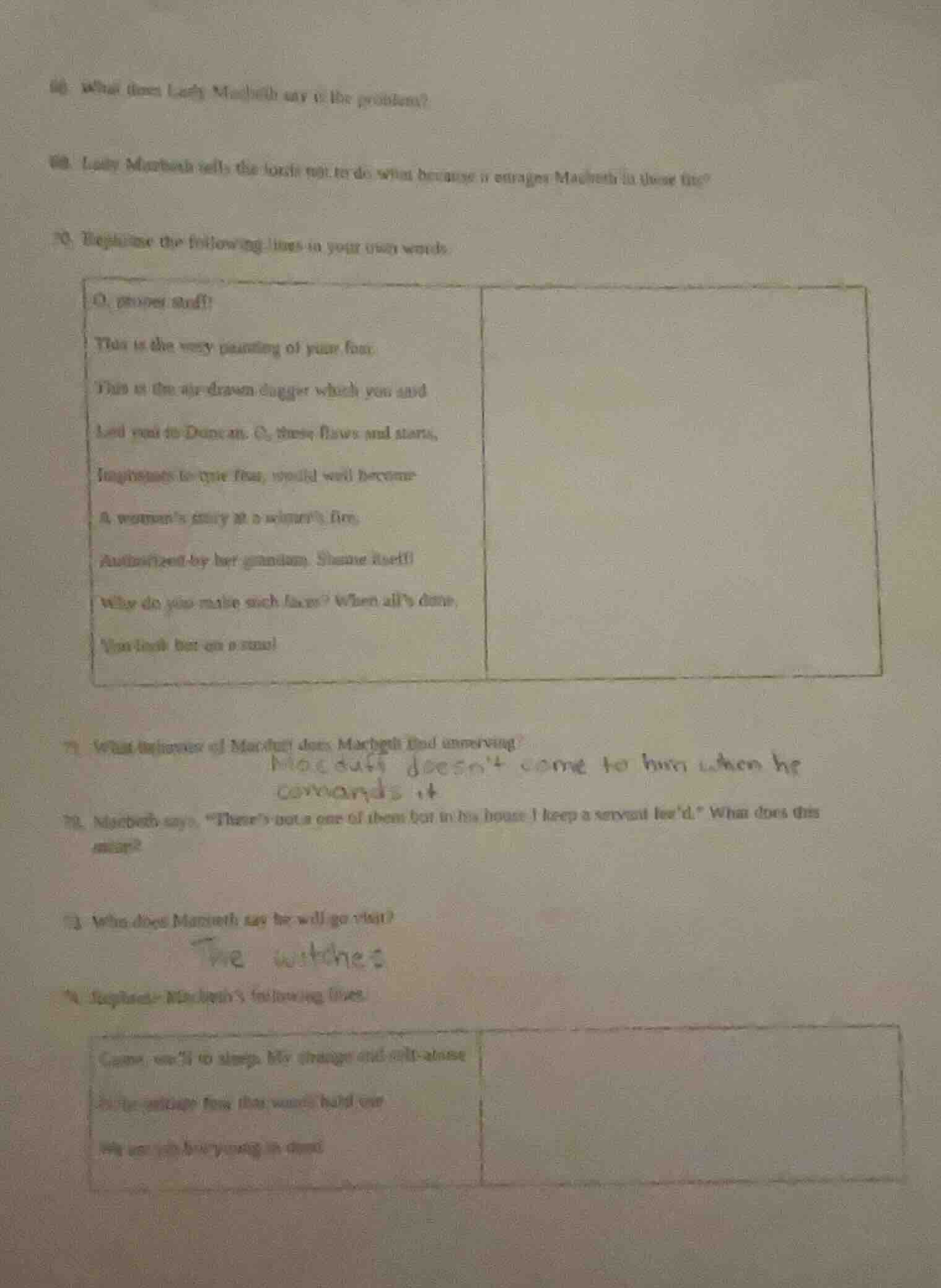
- what does lady macbeth say to the problem?
- lady macbeth tells the lords not to do what because it enrages macbeth in these lines?
- explain the following lines in your own words.
o, proper stuff!
this is the very painting of your fear.
this is the air-drawn dagger which you said
led you to duncan. o, these flaws and starts,
impostors to true fear, would well become
a woman’s story at a winter’s fire,
authorized by her grandam. shame itself!
why do you make such faces? when all’s done,
you look but on a stool.
- what behavior of macbeth does macbeth find unnerving?
- macbeth says, \there’s not a one of them but in his house i keep a servant fee’d.\ what does this mean?
- who does macbeth say he will go visit?
- explain macbeth’s following lines.
come, we’ll to sleep. my strange and self-abuse
is the initiate fear that wants hard use:
we are yet but young in deed.
To answer these questions, we analyze each one based on the context of Macbeth:
Question 70 (Explain the lines):
The lines are from Lady Macbeth’s dialogue, likely addressing Macbeth’s guilt or hallucinations. She references the “air - drawn dagger” (the imaginary dagger Macbeth saw) and “Duncan” (the king he murdered). Phrases like “implements to tie the fist” (tools for violence) and “a woman’s story at a winter’s fire” (a trivial tale) suggest she mocks his guilt, comparing his fears to a childish or exaggerated story. She questions his “faces” (expressions of guilt) and reminds him he “look’d her on a tomb” (perhaps a reference to his resolve or her own boldness).
Question 71 (Macbeth’s annoying behavior):
Macbeth is annoyed by the witches’ apparitions (or spirits) not obeying his commands—specifically, the “blacfarts” (likely a misspelling, e.g., “black spirits” or “apparitions”) not coming when he calls, showing his frustration with supernatural forces.
Question 72 (Norbeth’s line meaning):
Assuming “Norbeth” is a typo (likely “Macbeth”), the line means: For every enemy (or “one of them”), he keeps a servant (spy) in their house, implying he spies on or controls those around him to maintain power.
Question 73 (Who Macbeth will visit):
Macbeth says he will visit the witches (or “the weird sisters”) to seek more prophecies, driven by his desire for security and to confirm his fate.
Question 74 (Explain Lady Macbeth’s lines):
Her lines (“Come, we’ll to sleep...”) reflect her attempt to regain composure or dismiss guilt. “My change of self - abuse” may refer to her own internal struggle, and “the antique fix that vassal’d hard our” (likely a misprinted line, e.g., “the ancient curse that bound our”) suggests a reference to the burden of their crimes. She urges moving on, though her tone hints at lingering guilt (later, she sleepwalks, showing her mind is tormented).

Snap & solve any problem in the app
Get step-by-step solutions on Sovi AI
Photo-based solutions with guided steps
Explore more problems and detailed explanations
s (Summarized):
- Lady Macbeth mocks Macbeth’s guilt, comparing his fears to a trivial story, referencing the dagger and Duncan’s murder.
- Macbeth is annoyed that the spirits/apparitions (blacfarts) do not come when he commands them.
- Macbeth (Norbeth typo) means he spies on enemies by keeping a servant in their house.
- Macbeth will visit the witches (weird sisters).
- Lady Macbeth urges sleep, dismissing guilt, though her words hint at internal torment (later seen in sleepwalking).
(Note: Some questions have typos, but answers are based on Macbeth’s plot and dialogue context.)