QUESTION IMAGE
Question
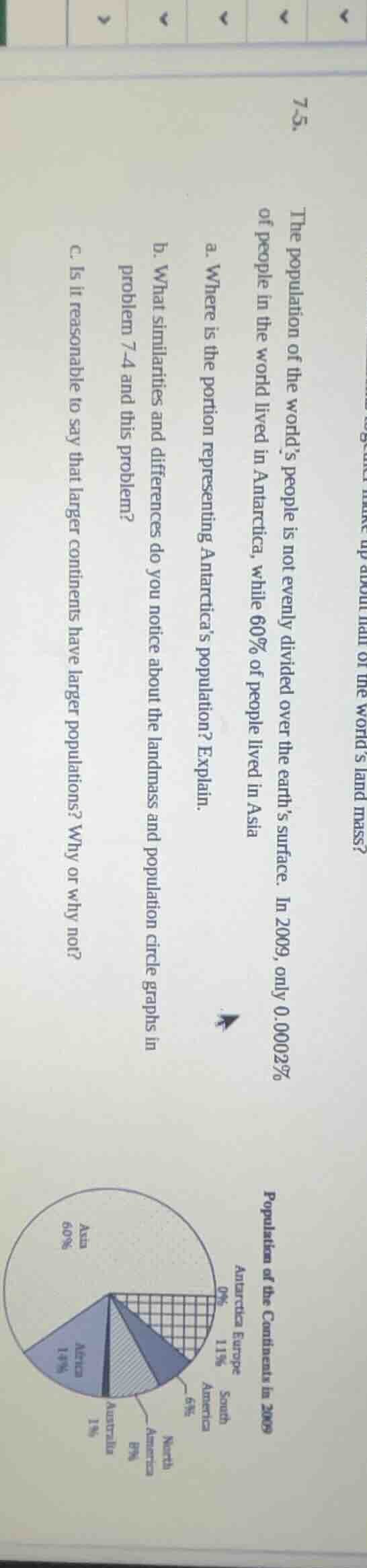
7-5. the population of the world’s people is not evenly divided over the earth’s surface. in 2009, only 0.00002% of people in the world lived in antarctica, while 60% of people lived in asia
a. where is the portion representing antarctica’s population? explain.
b. what similarities and differences do you notice about the landmass and population circle graphs in problem 7-4 and this problem?
c. is it reasonable to say that larger continents have larger populations? why or why not?
population of the continents in 2009
a. The population circle graph labels Antarctica's portion as 0%, which aligns with the stated 0.0002% being so small it rounds to 0% for the graph's scale.
b. (Note: Since Problem 7-4's graphs are not provided, this answer assumes standard landmass data: Landmass graphs show Antarctica has a non-trivial share (≈9% of global land), while population graphs show it as 0%. Similarities: Asia is the largest segment in both population and typical landmass graphs. Differences: Antarctica has a meaningful landmass share but near-0 population, while Asia has a far larger population share than its landmass share.)
c. Larger landmass does not equal larger population. For example, Antarctica is a large continent but has almost no permanent population, while Asia (the most populous) is large but not the single largest landmass, and small regions like some Asian countries have dense populations.

Snap & solve any problem in the app
Get step-by-step solutions on Sovi AI
Photo-based solutions with guided steps
Explore more problems and detailed explanations
a. Antarctica's population portion is shown as 0% on the circle graph. This is because its actual 0.0002% global population is so minuscule that it rounds to 0% for the scale of the pie chart.
b. (Assuming standard landmass data): Similarity: Asia is the largest segment in both population and typical landmass circle graphs. Difference: Antarctica has a notable share of global landmass but is represented as 0% in the population graph, while some smaller landmass regions (like Asia relative to total land) have vastly larger population shares.
c. No, it is not reasonable. Larger continents do not always have larger populations. For example, Antarctica is a large continent but has almost no permanent human population, while Asia (the most populous continent) has a population far out of proportion to its landmass size, and small land areas can have very dense, large populations.